
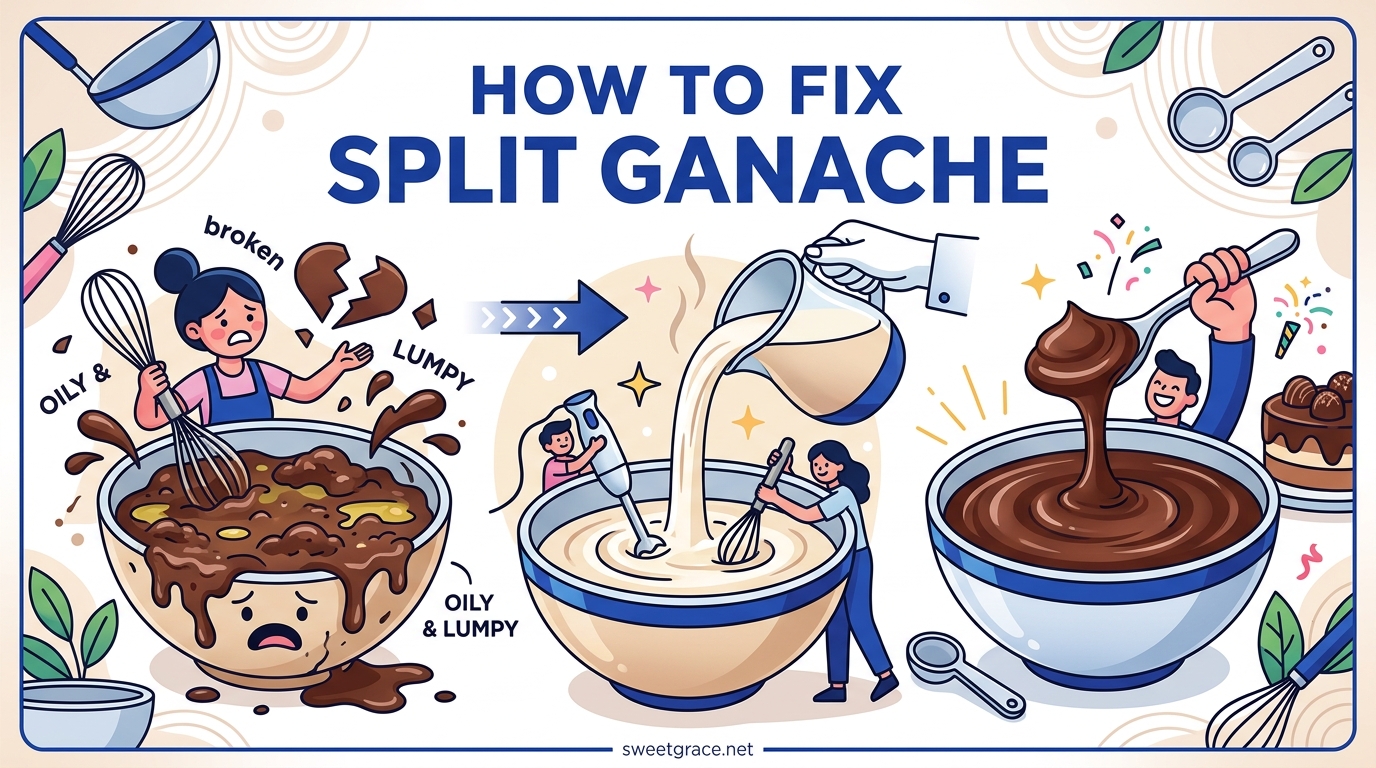
To fix split ganache, slowly whisk small amounts of warm liquid (hot water, warm milk, or corn syrup) into the broken ganache until the fat reincorporates and the mixture turns smooth and glossy. In most cases, a broken ganache can be fully rescued in under five minutes using this re-emulsification method.
I’ve been there. You’ve poured hot cream over chopped chocolate, started to stir, and watched in horror as the mixture turned into a greasy, grainy, curdled mess. Split ganache feels like a waste of expensive ingredients and a ruined dessert, but I have good news: nearly every broken ganache can be saved.
In our test kitchen, we’ve split ganache on purpose dozens of times to figure out which fix methods actually work, which ones change the texture, and which are just myths. This guide walks you through everything you need to know to rescue a split ganache, plus how to keep it from splitting next time.
Here’s what we’ll cover:
- What split ganache actually is and how to spot it
- The science of why ganache breaks (emulsion explained simply)
- 5 step-by-step methods to fix split ganache
- Specific fixes for dark, milk, and white chocolate ganache
- Prevention tips to avoid splitting in the first place
- Answers to the most common ganache questions
Table of Contents
- What Is Split Ganache?
- Why Does Ganache Split? The Emulsion Science
- How to Fix Split Ganache: 5 Step-by-Step Methods
- Comparison of Fix Methods: Which One Should You Use?
- Fixing Split Ganache by Chocolate Type
- How to Prevent Ganache from Splitting
- What NOT to Do When Fixing Split Ganache
- What If You Already Poured the Split Ganache on the Cake?
- Does Split Ganache Taste Bad?
- Can I Use Split Ganache for Anything Else?
- Frequently Asked Questions
- Final Thoughts
What Is Split Ganache?
Split ganache is a broken chocolate-and-cream emulsion where the cocoa butter (fat) has separated from the liquid, leaving you with an oily, grainy, lumpy mixture instead of the smooth, glossy ganache you wanted.
You can identify split ganache by a few telltale signs:
- A pool of yellowish fat (cocoa butter) sitting on top or weeping down the sides
- Grainy, clumpy chocolate solids that look like curdled milk
- A texture that looks like wet sand or cottage cheese
- No sheen, just dull, separated chocolate chunks
It is not the same thing as seized chocolate, even though the words get used interchangeably. Seized chocolate happens when a tiny amount of water (or steam) hits melted chocolate, causing the sugar to clump and the chocolate to harden into a thick paste.
Split ganache, by contrast, is too much fat separating from too little liquid. The emulsion between cocoa butter, water (from the cream), and chocolate solids has collapsed. The good news is that emulsion can usually be rebuilt, which is exactly what our fix methods do.
Why Does Ganache Split? The Emulsion Science
Ganache is a simple emulsion. You pour hot cream over chopped chocolate, and the heat melts the cocoa butter while the water in the cream hydrates the sugar and cocoa solids. With gentle whisking, the fat and water phases combine into a stable, smooth mixture.
That emulsion can break for a handful of reasons, and understanding them helps you choose the right fix.
1. The Cream Was Too Hot (or Boiled)
If cream comes to a rolling boil, it can overheat the chocolate. The cocoa butter melts too quickly, the sugars scorch, and the fat separates out before the water has a chance to bond with the solids. The result is an oily, grainy ganache.
2. The Cream Was Not Hot Enough
If the cream is too cool, the chocolate doesn’t melt evenly. You’ll get little bits of unmelted chocolate suspended in cream, which looks like a separated mess even though it can usually be fixed by simply heating gently and whisking.
3. Wrong Chocolate-to-Cream Ratio
Every chocolate has a different fat content. High-cacao dark chocolate (70%+) has more cocoa solids and less cocoa butter, so it needs slightly more liquid. White chocolate is the opposite: it has a lot of cocoa butter and very little cocoa solids, so it is far more prone to splitting, especially with too much liquid.
4. Overbeating or Aggressive Whisking
Yes, you can overbeat ganache. Vigorous whisking incorporates too much air and breaks the fat globules apart, especially if the ganache is too cold. This is one of the most common reasons ganache splits when whipped.
5. Adding Cold Ingredients to Hot Ganache (or Vice Versa)
A temperature shock (cold butter, cold milk, cold extracts) into hot ganache can cause the fat to seize and separate.
6. Chocolate Quality and Composition
Lower-quality chocolate with added vegetable oils (palm oil, soy lecithin) behaves differently than couverture chocolate. Compound chocolate, baking chips, and candy melts split more easily because they have stabilizers that resist proper emulsification.
Once you know why your ganache split, the fix becomes obvious: you need to bring the fat and water phases back together at the right temperature.
How to Fix Split Ganache: 5 Step-by-Step Methods
Below are the five methods our team has tested. We list them in order from least invasive to most invasive. Always start with Method 1 and only move to the next method if the ganache doesn’t come back together.
Method 1: Add Hot Water (Best All-Around Fix)
This is the method recommended by King Arthur Baking and it’s the one that works most consistently for us. Hot water does not add extra fat, so it does not change your final ganache texture the way adding more cream would.
- Heat a small pot of water until it is just below a simmer, around 90°F (32°C) to 100°F (38°C).
- Remove the split ganache from any heat source.
- Add 1 teaspoon of hot water directly into the ganache.
- Whisk gently in small circles, starting from the center and working outward.
- Repeat, adding 1 teaspoon at a time, until the ganache becomes smooth and glossy. Most batches need 1 to 3 tablespoons total.
Why it works: the hot water re-dissolves the sugar and gives the cocoa solids a medium to rehydrate, allowing the broken fat globules to rejoin the mixture as a stable emulsion.
Method 2: Add Warm Milk or Cream (Best for Truffles and Fillings)
If your split ganache is destined for truffles or a cake filling where a slightly richer texture is welcome, use warm milk or cream instead of water.
- Warm 2 to 4 tablespoons of milk (or the same cream you used originally) to about 110°F (43°C).
- Pour a small amount into the split ganache.
- Whisk gently until smooth, then add more warm milk a little at a time.
- Stop as soon as the ganache comes together to avoid making it too thin.
Why it works: the extra fat from the cream helps lubricate the broken fat globules and re-emulsify them, while the warmth gives the chocolate another chance to melt smoothly.
Method 3: Use Corn Syrup (Best Texture-Preserving Fix)
Inspired by chocolatier Andrew Shotts, this method is the gold standard for fixing ganache without changing its original set or texture. Pastry Chef Online readers have reported saving Christmas desserts with this exact technique.
- Make sure the ganache is warm, not hot (around 90°F to 100°F).
- Add 1 tablespoon of light corn syrup to the ganache.
- Whisk vigorously but gently for 30 to 60 seconds.
- If still split, add another tablespoon of corn syrup and repeat.
You can substitute glucose syrup, agave syrup, honey, or maple syrup in equal amounts. Each adds invert sugars that help stabilize the emulsion.
Why it works: invert sugars (like those in corn syrup) prevent sugar crystallization and help the fat and water phases bind back together without diluting the ganache’s chocolate flavor or set.
Method 4: Use an Immersion Blender (Best for Stubborn Splits)
When whisking isn’t enough, an immersion blender (stick blender) can save ganache that has fully separated into fat and solids.
- Make sure the ganache is warm but not hot. If it has cooled, gently reheat in 5-second microwave bursts, stirring between each.
- Insert the immersion blender into the ganache at an angle, all the way to the bottom of the bowl.
- Turn it on low and slowly move it around the bowl, tilting the bowl to keep the head submerged.
- Work in 10-second bursts to avoid incorporating air.
- Stop as soon as the ganache looks smooth and emulsified.
Why it works: the high-speed shearing action of the blender physically breaks the separated fat globules into smaller droplets, which can then re-disperse evenly throughout the liquid phase.
Method 5: Re-melt and Re-emulsify (The Last Resort)
If your ganache is severely broken or has been sitting split for a while, you may need to start fresh on the emulsion.
- Transfer the split ganache to a heatproof bowl set over a pot of simmering water (a double boiler).
- Heat gently, stirring constantly, until the ganache is fully melted and reaches about 115°F (46°C) for dark chocolate or 110°F (43°C) for milk or white chocolate.
- Remove from heat and add 1 to 2 tablespoons of warm cream or water.
- Whisk slowly and steadily, working from the center outward, until smooth.
- Let the ganache cool to the temperature your recipe calls for before using.
Why it works: by re-melting the ganache, you reset the emulsion from scratch. The fresh warm liquid gives the fat and solids a new chance to combine into a stable mixture.
Comparison of Fix Methods: Which One Should You Use?
To save you the trial and error, here is a quick comparison of the five fix methods.
| Method | Best For | Texture Impact | Difficulty | Success Rate |
|---|---|---|---|---|
| Hot Water | All ganache types, especially dark chocolate | Minimal | Easy | Very High |
| Warm Milk or Cream | Truffles, fillings, frostings | Slightly richer | Easy | High |
| Corn Syrup | Glazes, drips, recipes that must hold shape | None, preserves set | Easy | Very High |
| Immersion Blender | Stubborn or fully separated ganache | None | Medium | Very High |
| Re-melt on Double Boiler | Severely split ganache, last resort | Slight if over-diluted | Medium | High |
Fixing Split Ganache by Chocolate Type
Different chocolates split for different reasons, and the fix can vary slightly depending on the type.
How to Fix Split Dark Chocolate Ganache
Dark chocolate (especially 70%+ cacao) has the most cocoa solids and the least cocoa butter, which makes it more prone to splitting when the liquid ratio is slightly off. The hot water method works best for dark chocolate, because the extra liquid helps rehydrate the high volume of cocoa solids without adding more fat.
How to Fix Split Milk Chocolate Ganache
Milk chocolate has added milk solids and sugar, which can scorch easily if the cream is too hot. If your milk chocolate ganache splits, try the corn syrup method first, because it does not add extra liquid that could throw off the set.
How to Fix Split White Chocolate Ganache
White chocolate splits more than any other type. It has a high cocoa butter content and almost no cocoa solids, so it is very sensitive to temperature. If your white chocolate ganache has split, re-melt it gently over a double boiler and whisk in 1 to 2 tablespoons of warm cream, then let it cool slowly without disturbing it.
One tip: never let white chocolate get above 110°F (43°C), because the cocoa butter separates very easily at higher temperatures.
How to Prevent Ganache from Splitting
Once you have saved your ganache, you will want to keep it from splitting again. These tips come from years of baking and breaking ganache on purpose.
- Heat cream to a bare simmer, not a rolling boil. Aim for 180°F to 190°F (82°C to 88°C).
- Chop your chocolate finely and evenly. The smaller the pieces, the more uniformly they melt.
- Use a heatproof bowl, ideally glass or stainless steel, to retain heat evenly.
- Pour the hot cream over the chocolate, then wait 2 to 3 minutes before stirring. This lets the chocolate melt gently without shocking it.
- Stir with a silicone spatula or a balloon whisk, starting in the center in small circles, then expanding outward.
- Do not over-whisk, especially if the ganache has cooled below 90°F (32°C). Stop as soon as it is smooth.
- Use real chocolate (couverture or high-quality bars) rather than chocolate chips or candy melts, which contain stabilizers that resist emulsification.
- Measure your chocolate-to-cream ratio carefully. For truffles, use 2:1 chocolate to cream. For glaze, use 1:1.
- Never add cold butter, cold extracts, or cold liquids to hot ganache.
- If you are making a whipped ganache, chill it to 60°F to 65°F (15°C to 18°C) before whipping, and stop the moment soft peaks form.
What NOT to Do When Fixing Split Ganache
Most of the bad advice I see online makes the split worse. Here is what to avoid.
- Do not dump a large amount of water or cream in at once. Always add a little at a time.
- Do not use a regular countertop blender, which whips in too much air and can make the ganache grainy and bubbly.
- Do not add ice cubes or very cold liquid. The temperature shock will make the fat seize.
- Do not throw the ganache away before trying at least Method 1. Almost every split ganache can be saved.
- Do not keep reheating broken ganache without adding liquid. You will cook the solids further and make it grainier.
- Do not refrigerate split ganache thinking it will fix itself. It will not.
What If You Already Poured the Split Ganache on the Cake?
This is a common panic moment. If the ganache split after you poured it onto a cake, gently warm a small amount of fresh cream or water and brush it over the surface of the split ganache with a soft pastry brush. The warmth and added moisture can sometimes re-emulsify the top layer.
If that does not work, your best bet is to carefully scrape the split ganache off the cake, fix it using one of the methods above, then re-pour it once it reaches the right temperature and consistency.
Does Split Ganache Taste Bad?
Split ganache does not taste bad, it is simply a texture issue. The chocolate flavor is still there, but the mouthfeel is grainy and greasy rather than smooth. Once you re-emulsify it, the taste and texture are indistinguishable from ganache that never broke.
Can I Use Split Ganache for Anything Else?
If you cannot get your ganache to come back together (rare, but it happens with very high-cacao chocolate or compound chocolate), do not throw it out. You can:
- Stir it into brownie batter for a marbled effect
- Use it as a hot chocolate sauce by adding more warm milk
- Freeze it in ice cube trays and drop a cube into hot milk for instant hot chocolate
- Use it as an ice cream topping once it cools and re-solidifies
Frequently Asked Questions
Can I save curdled ganache?
Yes, almost any curdled ganache can be saved. Add 1 teaspoon of hot water (around 90°F to 100°F) to the broken ganache and whisk gently in small circles starting from the center. Repeat, adding 1 teaspoon at a time, until the ganache becomes smooth and glossy. Most batches come back together within 1 to 3 tablespoons of water.
How to reverse split chocolate?
To reverse split chocolate, gently reheat the ganache in a double boiler until it reaches 110°F to 115°F. Remove from heat and slowly whisk in 1 to 2 tablespoons of warm cream or water until the emulsion re-forms. For ganache that has been whipped and split, the immersion blender method works best to physically re-emulsify the fat and liquid.
How to firm up chocolate ganache?
To firm up chocolate ganache, chill it in the refrigerator for 1 to 2 hours until it sets to a scoopable consistency. If it is still too soft, melt additional chocolate and stir it in (use about 1 ounce of chocolate per 1 cup of ganache). Avoid adding more chocolate while the ganache is hot, because it will not incorporate evenly.
Can you overbeat ganache?
Yes, you can overbeat ganache. Whisking too aggressively, especially when the ganache has cooled below 90°F, breaks the fat globules apart and forces the fat to separate from the liquid, creating a split, greasy texture. For whipped ganache, chill it to 60°F to 65°F first, then whip briefly on medium speed, stopping the moment soft peaks form.
Final Thoughts
Split ganache is one of the most frustrating things that can happen in the kitchen, but it is almost always fixable. Whether you reach for hot water, warm cream, corn syrup, or an immersion blender, the goal is the same: rebuild the emulsion between the fat and the liquid so your ganache becomes smooth, glossy, and silky again.
The next time your ganache splits, do not throw it out. Start with the hot water method, work slowly, and trust the process. With a few minutes of patient whisking, you will have ganache that looks and tastes just like the one you meant to make.
For more baking rescues and step-by-step guides, browse our collection of troubleshooting tips and pastry techniques.