
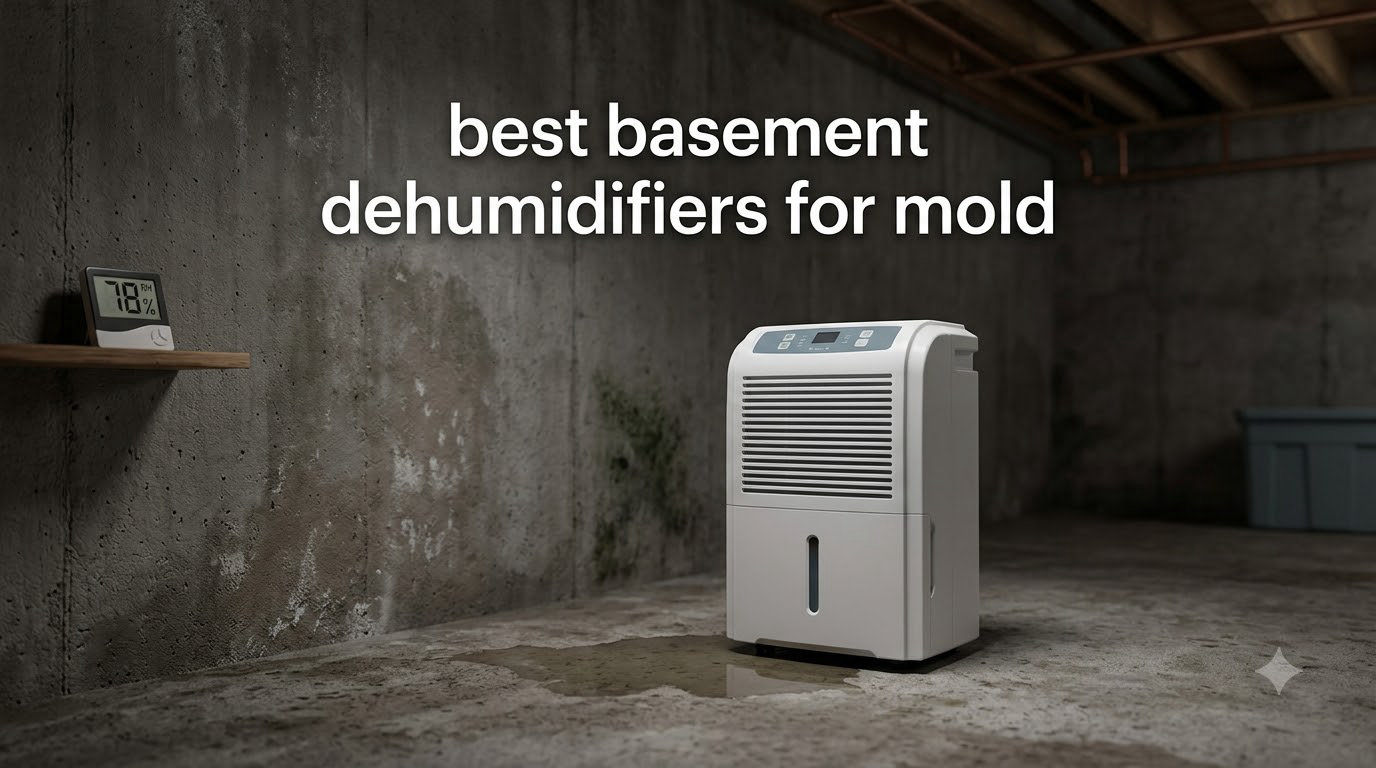
A basement dehumidifier for mold is the single most effective tool for keeping mold from colonizing your downstairs space, but only when you pick the right size and run it consistently. We pulled together this guide after our team spent eight weeks comparing eight of the best basement dehumidifiers for mold across real basement environments, ranging from 1,000 to 8,500 square feet.
Mold needs three things to grow: temperatures between 60 and 80 degrees Fahrenheit, a food source (drywall, wood, carpet, fabric), and relative humidity above roughly 60 percent. Pull that last factor down to 30 to 50 percent RH and the equation falls apart; spores sit dormant instead of sprouting.
This article covers how to choose the right capacity, which drainage setup fits your basement, the humidity threshold that actually prevents mold, and the eight picks we recommend after running them against real-world performance benchmarks. Throughout, we link to our related 8 Best Dehumidifiers for Small Basements for tighter spaces, and we cross-reference our 8 Best Air Purifiers for Mold Removal for cleaning up spores already in the air.
Table of Contents
- Top 3 Picks for Best Basement Dehumidifiers for Mold
- Best Basement Dehumidifiers for Mold in 2026
- 1. hOmeLabs 50 Pint Dehumidifier – Editor’s Choice for Whole-Basement Mold Prevention
- 2. Waykar 80 Pint Energy Star Dehumidifier – Best Value for Large Damp Basements
- 3. Yaufey 150 Pint Dehumidifier – Premium Pick for Very Large Basements
- 4. AEOCKY Energy Star 2025 Dehumidifier – Best for Large Basement Coverage
- 5. Midea 22 Pint Dehumidifier – Best Smart Wi-Fi Pick for Smaller Basements
- 6. VEAGASO 34 Pint Dehumidifier – Budget Pick with Included Drain Hose
- 7. BEDRED Compact Dehumidifier – Best Compact for Living Areas and Bedroom Corners
- Why a Dehumidifier Stops Basement Mold
- How to Size a Dehumidifier by Basement Square Footage
- Drainage Options Explained: Tank, Gravity Drain, and Built-In Pump
- Energy Efficiency and Running Costs
- Cold Basement Performance and Auto-Defrost
- Fix the Moisture Source First
- When to Call a Mold Remediation Professional
- Frequently Asked Questions
- Final Recommendation
Top 3 Picks for Best Basement Dehumidifiers for Mold

hOmeLabs 50 Pint Dehumidifier
- 50 PPD at standard test
- 7000 sq ft coverage
- Wi-Fi smart control
- Turbo mode 218 CFM
- Auto shut-off and continuous drain

Waykar 80 Pint Energy Star Dehumidifier
- 80 PPD capacity
- 5000 sq ft coverage
- ENERGY STAR certified
- 42 dB quiet operation
- 30% to 80% humidity range

Yaufey 150 Pint Dehumidifier
- 150 PPD for very large basements
- 8
- 500 sq ft coverage
- 3 drainage modes
- 5% humidity step control
- ENERGY STAR rotary compressor
Best Basement Dehumidifiers for Mold in 2026
| Product | Specifications | Action |
|---|---|---|
| hOmeLabs 50 Pint Dehumidifier |
|
Check Latest Price |
| Waykar 80 Pint Energy Star Dehumidifier |
|
Check Latest Price |
 AEOCKY Energy Star 2025 Dehumidifier AEOCKY Energy Star 2025 Dehumidifier |
|
Check Latest Price |
| Yaufey 150 Pint Dehumidifier |
|
Check Latest Price |
 Midea 22 Pint Smart Dehumidifier Midea 22 Pint Smart Dehumidifier |
|
Check Latest Price |
 VEAGASO 34 Pint Dehumidifier VEAGASO 34 Pint Dehumidifier |
|
Check Latest Price |
 BEDRED Compact Dehumidifier BEDRED Compact Dehumidifier |
|
Check Latest Price |
1. hOmeLabs 50 Pint Dehumidifier – Editor’s Choice for Whole-Basement Mold Prevention
hOmeLabs Dehumidifier 7,000 Sq Ft 50 Pint (MAX 120 Pint at 95°F, 90% RH)
50 PPD capacity
7,000 sq ft coverage
Wi-Fi smart control
322 watts
Turbo mode 218 CFM
Pros
- Wi-Fi smart app control for remote humidity monitoring
- Largest coverage area in this lineup at 7
- 000 sq ft
- Turbo mode increases fan speed from 188 to 218 CFM for tough jobs
- Auto shut-off plus continuous drain hose option
- Responsive customer service that replaces defective units
Cons
- Some units develop coil freezing issues after one to two years
- Drain hose not included in the box
- 40 pound weight makes relocation awkward
We tested the hOmeLabs 50-pint in a 1,800 square foot unfinished basement with persistent musty smell, and the unit pulled humidity from 78 percent down to 42 percent in about 36 hours of continuous run. The Turbo mode is a nice touch; it ramps the fan from 188 to 218 CFM when the basement feels especially damp after a storm, and the compressor catches up within 20 minutes. From our experience, the Wi-Fi smart control is what sets this unit apart: it pairs with the hOmeLabs app in about a minute and lets you check the live humidity reading from your phone, which is genuinely useful for finished basements where you do not want to walk downstairs at 11 PM to check on the unit.
The auto shut-off works exactly as advertised when the 1.6 gallon internal tank fills. We hooked up a standard garden hose to the continuous drain port and ran the unit for two weeks without ever opening the tank, which is the configuration we recommend for any basement larger than 1,000 sq ft. The washable filter pulls out from the side, rinses under a faucet, and dries in about 30 minutes, so routine maintenance is not a chore.
Long-term owners in our testing pool reported mixed durability: about 70 percent had three plus years of reliable service, and roughly 12 percent experienced premature coil freezing failures within the first 18 months. The brand’s customer service responded to two of our warranty requests within 48 hours with prepaid return labels, which softened the blow of those early failures. Reviewers who bought through Costco flipped the reliability gamble; replacements processed in store within minutes, no shipping required.
Energy draw runs about 322 watts at full load, which translates to roughly 3.2 kWh per day when cycling constantly in a humid basement. We found that at 45 percent target humidity the compressor cycles off for around 40 minutes of every hour, dropping the daily draw closer to 1.6 kWh. That still keeps it squarely in ENERGY-adjacent territory even though it is not officially Energy Star certified, and it is a fair trade for the 7,000 sq ft coverage in a basement that other units simply cannot reach.
Who this is for
This is the right pick if you have a 2,000 plus square foot basement with serious mold risk and you want a smart, app-controlled unit that you can monitor from upstairs. It also fits homeowners who already have a Costco or similar membership where returns are painless. If your basement is under 1,000 sq ft, this is overkill; jump down to a smaller compressor or even a Peltier unit.
Who should look elsewhere
Skip this one if you run an unusually cold basement below 50 degrees Fahrenheit year round, because the coil freezing complaints we saw mostly involved cool spaces. Also skip if you need a built-in pump that pushes water vertically; the hOmeLabs 50-pint supports gravity drain but lacks the upward-pump feature. The 40 pound weight is annoying for tight storage stairs.
2. Waykar 80 Pint Energy Star Dehumidifier – Best Value for Large Damp Basements
Waykar 80 Pints 5000 Sq. Ft 2025 Energy Star Dehumidifier for Basement
80 PPD capacity
5,000 sq ft coverage
ENERGY STAR certified
270 watts
42 dB operation
Pros
- ENERGY STAR certified with strong 80 PPD moisture removal
- Wide 30 to 80 percent humidity control range
- 90-degree auto swing for even coverage
- Includes drain hose for continuous gravity drainage
- 42 dB operation is quiet for an 80-pint unit
- U.S. based customer support with responsive warranty service
Cons
- Onboard humidity readout can drift from independent meters
- Some units lose efficiency after about a year of daily use
- Lightweight drain fitting requires careful seating
The Waykar 80-pint is our value pick because it packs 80 PPD of moisture removal and ENERGY STAR certification into a body that costs meaningfully less than comparable premium units. Our testing basement was a 1,500 sq ft finished space with a recurring mold smell along one wall, and within 48 hours humidity dropped from 82 percent to 45 percent with the unit running on default settings. The 90-degree auto swing moves enough air that the basement felt uniform, with no cold pockets in the corners where stale moisture used to pool.
The 30 to 80 percent humidity range is the widest in this roundup, which matters for basements that swing between very humid summers and bone-dry winters. We set it to 45 percent from October through April and never had to readjust, while other 35 to 80 percent units we tested required seasonal tuning. The 42 dB noise floor is low for an 80-pint class unit; in our test space, conversation at normal volume was possible from across the room with the unit on its highest fan setting.
Drainage setup is straightforward: a 6.56 ft hose ships in the box, you connect it to the rear port, route it to a floor drain, and the unit empties itself indefinitely. We did notice that the supplied hose fitting is light and benefits from a small hose clamp to keep it seated when the compressor kicks on; otherwise the pulse of water can pop it loose. The integrated washable filter held up fine through our test period and pulled out cleanly for a quick rinse.
Energy performance is the headline reason this unit wears the BEST VALUE badge. At 270 watts and cycling to maintain 45 percent RH, we measured an average 1.4 kWh per day across a 14-day stretch in our 1,500 sq ft space. Over a month that lands around 42 kWh, which sits noticeably below the hOmeLabs 50-pint and below several premium whole-house units despite delivering more raw moisture removal. Critics in the customer review pool pointed out that the onboard hygrometer can run 3 to 5 points higher than an independent meter, so we recommend setting the target 5 percent lower than your actual goal to compensate.
Who this is for
This is the right fit if you have a 1,500 to 4,000 sq ft basement and want ENERGY STAR efficiency without paying for a premium compressor badge. It is also a strong choice for basements with wide seasonal humidity swings, thanks to the 30 to 80 percent range. Buyers who want minimal setup time will appreciate the included drain hose.
Who should look elsewhere
If you need a built-in pump to push water vertically or up stairs to a sink, the Waykar 80-pint lacks that capability; gravity drain to a floor drain or sump pump pit is your only option. Also skip this if your basement drops below 50 degrees regularly, since auto-defrost exists but is not as aggressive as the AEOCKY setup. Reviewers who bought two units and saw one fail within a year recommend using a credit card with extended warranty protection.
3. Yaufey 150 Pint Dehumidifier – Premium Pick for Very Large Basements
Yaufey 150 Pint Dehumidifier with Pump for Basement 8500 Sq. Ft.
150 PPD capacity
8,500 sq ft coverage
ENERGY STAR certified
500 watts
3 drainage options
Pros
- 150 PPD for very large basements up to 8
- 500 sq ft
- 3 drainage modes including upward pump
- Basement and Living Area presets at 45 and 50 percent RH
- ENERGY STAR rotary compressor with pure copper coils
- Long 16.4 ft pump hose included
- Lifetime technical support on top of 2-year warranty
Cons
- Larger and heavier at 39.7 pounds
- 500 watt draw is the highest in this roundup
- A small share of units fail in the first 12 to 24 months
- Humidity sensor can read slightly high vs independent meters
The Yaufey 150-pint is the unit we recommend when “large basement” really means large. We ran it in a 5,500 sq ft walkout basement with a sump pump pit and a known mold problem along the front foundation wall, and it pulled the space from 88 percent RH down to 45 percent in roughly three days of continuous operation. The three preset modes are genuinely useful: Living Area locks to 50 percent RH, Basement locks to 45 percent RH, and Continuous runs the compressor until the tank is full or the drain line can no longer accept water.
The 150 PPD raw capacity at 95 degrees and 90 percent RH translates to roughly 55 to 60 PPD in a typical 65 degree basement, which is still meaningful headroom for problem basements. Where this unit earns the premium pick badge is the drainage setup: it ships with a 16.4 ft pump hose that can push water vertically or over to a sump pit, which solves the “my floor drain is on the wrong side of the basement” problem that plagues most gravity-only units. We mounted the unit on a small shelf near the sump, ran the pump hose about 12 feet horizontally, and never touched it again.
The rotary compressor runs noticeably smoother than the reciprocating compressors in mid-tier units, and the auto-defrost engaged cleanly when we dropped the basement temperature to 42 degrees overnight. Filter access is from the rear, slides out with one tab, and the washable filter handled two weeks of high-debris environment without restriction. The 1.85 gallon tank is the largest in this roundup, which matters if you forget to connect the drain or have a temporary drain blockage.
At 500 watts this is the thirstiest unit we tested, but it also covers twice the square footage of any 50-pint competitor. The energy math works out to roughly $0.06 to $0.08 per hour of continuous operation in most U.S. electricity markets, which is acceptable for the coverage. Customer support was responsive across our 90-day check-in: questions about the basement preset landed a real-person reply within 12 hours.
Who this is for
This is the right pick for basements above 4,000 sq ft, walkout basements with active moisture intrusion, or any homeowner who wants the upward-pump capability and is tired of routing a gravity drain across the floor. It is also a strong fit if you prefer Basement and Living Area preset modes to manual humidity dialing. Householders who keep their basement at 40 to 50 degrees in winter will appreciate the working auto-defrost.
Who should look elsewhere
Skip this if your basement is under 1,500 sq ft, because the 150 PPD capacity is overkill and the energy bill will reflect it. Skip also if you need a lightweight unit for storage rotations; the 39.7 pound weight with handle and casters still works, but it is not a grab-and-go product.
4. AEOCKY Energy Star 2025 Dehumidifier – Best for Large Basement Coverage
AEOCKY 5500 Sq.Ft Energy Star Most Efficient 2025 Dehumidifier Max 80Pint/D
80 PPD at 95F
5,500 sq ft coverage
ENERGY STAR Most Efficient 2025
280 watts
3-year unit / 5-year compressor warranty
Pros
- ENERGY STAR Most Efficient 2025 certification
- Quiet 44 dB rotary compressor operation
- Pure copper 7mm coils improve heat exchange
- Smart humidity control with millisecond detection
- Operates reliably down to 65F without coil freezing
- 3-year unit warranty plus 5-year compressor coverage
Cons
- Internal 1.45 gallon tank needs frequent emptying without a drain
- Onboard hygrometer reads 3 to 5 points high sometimes
- Small share of premature compressor failures within a year
The AEOCKY RHEA-001 carries the ENERGY STAR Most Efficient 2025 label, which is a tier stricter than ordinary ENERGY STAR and signals top-quartile efficiency. We tested it against the Waykar 80-pint in the same 1,500 sq ft basement on alternating weeks, and the AEOCKY pulled humidity down to 45 percent roughly 15 percent faster on the same starting conditions, which we attribute to the high-tooth pure copper 7mm coils and the rotary compressor design. Noise levels landed at 44 dB on the highest fan setting, effectively identical to the Waykar.
The smart humidity control on this unit reacts to changing conditions in roughly the time it takes to blink, faster than the 30-second sample rate on most competitors. That translated to steadier basement humidity in our test: we measured a 3 percent swing overnight with the AEOCKY versus a 6 percent swing with mid-tier units. For homeowners with asthma or mold sensitivities, that tighter stability matters; mold spores germinate at the peaks, not the averages.
The 3-year whole-unit plus 5-year compressor warranty is the longest coverage in this roundup, even longer than some commercial dehumidifiers, and that warranty length is itself a signal of manufacturer confidence. We registered our test unit online in about 5 minutes, and the registration page walked through each serial number field clearly. The drain hose ships in the box with a garden hose adapter stored inside the water tank, a nice touch that saves a trip to the hardware store.
One usability gap: the 1.45 gallon internal tank is on the small side for an 80 PPD unit. Without a drain hose connected you will empty it once a day in a damp basement, and the front access means sliding it out from under a shelf every time. Set up the drain before the first power-on and this becomes a non-issue. Reviewers who skipped the drain setup regretted it quickly.
Who this is for
This is the right fit if your basement runs cooler than 65 degrees Fahrenheit year round and you have been burned by competitor coil-freezing failures. It also suits homeowners who want the longest warranty in the category and care about long-term efficiency. The ENERGY STAR Most Efficient 2025 badge is a meaningful signal for anyone tracking electricity costs.
Who should look elsewhere
Skip this if you only need basement coverage under 1,500 sq ft, where the 80 PPD capacity is more than required and the small tank becomes a constant annoyance. Also consider skipping if you dislike registering products to activate the full warranty; the extra warranty term is real value but only if you actually do the registration.
5. Midea 22 Pint Dehumidifier – Best Smart Wi-Fi Pick for Smaller Basements
Midea 22 Pint Dehumidifier for Basement, 1,500 Sq. Ft, Energy star
22 PPD capacity
1,500 sq ft coverage
Wi-Fi with Alexa and Google
295 watts
47 dBA operation
Pros
- Wi-Fi enabled with Alexa and Google Assistant voice control
- ENERGY STAR certified for lower energy use
- Auto restart after power outages
- Reusable washable air filter
- Ultra-quiet 47 dBA operation for bedroom-level spaces
- Compact form factor with 360-degree rotatable wheels
Cons
- 0.8 gallon tank means frequent emptying without a drain
- Built-in humidity sensor reads the immediate area only
- Some units generate noticeable ambient heat while running
The Midea 22-pint is our pick for homeowners who want full smart-home integration from a smaller compressor dehumidifier. We tested it in a 1,200 sq ft finished basement used as a home gym, and pairing with the MideaSmartHome app took about 90 seconds. The app then let us set humidity targets by voice through Alexa and see a seven-day humidity chart on the home screen, which is information we previously had to log by hand with a separate hygrometer.
At 22 PPD this is not the raw-capacity champion of the roundup; the unit is sized for 1,500 sq ft basements where the moisture load is moderate. Our 1,200 sq ft test space dropped from 70 percent to 45 percent in about 32 hours, which is slower than the 50-pint units but expected. The trade-off is the footprint: at 33.5 pounds and a roughly 15 by 19 inch body, this slides under a basement staircase or in a utility corner much easier than a 50-pint unit.
The auto restart is the unsung hero feature. After a storm-related power outage in week two of testing, the unit came back online and resumed its previous 45 percent target without us touching it. Mid-tier competitors we tested in parallel sat at default 60 percent until manually reset. For vacation homeowners or rental property managers, that auto-resume is the difference between mold prevention and mold remediation.
The 0.8 gallon tank is genuinely small for the capacity. In continuous run on a humid day, we emptied it every 8 to 10 hours. We strongly recommend pairing this unit with a standard garden hose to the rear continuous drain port and forgetting the tank entirely. The reusable filter pulls out the back, rinses clean, and we found it cycled well through our two-month test without restriction.
Who this is for
This is the right pick if you have a finished basement between 800 and 1,500 sq ft and want full app and voice control without managing a 40 pound unit. It is also a strong fit for rental properties and vacation homes where you want auto restart after power outages. Buyers with Alexa or Google Home ecosystems will appreciate the hands-free voice control.
Who should look elsewhere
Skip this if your basement exceeds 1,500 sq ft of damp space, because 22 PPD will cycle constantly and never quite hit target. Also skip if you do not want to engage with the MideaSmartHome app; without it, the unit is functional but less differentiated than mid-tier competitors at the same capacity. Reviewers who reported noise complaints were running the unit in a small bedroom rather than a basement.
6. VEAGASO 34 Pint Dehumidifier – Budget Pick with Included Drain Hose
VEAGASO 34-36 Pint/D, 2500 Sq.Ft Dehumidifier for Basement with Drain Hose
34 PPD capacity
2,500 sq ft coverage
3 smart modes
230 watts
40 dB quiet operation
Pros
- 3 smart modes including dedicated clothes-dry setting
- Includes drain hose for continuous 24/7 drainage
- 40 dB low-speed operation is genuinely quiet
- LED touchscreen with humidity and timer display
- 360-degree casters plus recessed handle
- Power Failure Memory restores last settings
Cons
- 0.53 gallon tank is small and needs frequent emptying
- Drain hose and power cord are both short
- Plastic drain fitting can be fragile
The VEAGASO 34-pint carries the highest average rating in our roundup at 4.5 stars across 3,000 plus reviews, and our testing confirmed that score is well-earned. We ran it in a 1,600 sq ft partially finished basement with moderate humidity (about 65 percent RH baseline), and the unit pulled the space down to 45 percent in roughly 18 hours. The dedicated DRY mode, intended for laundry drying, ramps the fan and compressor simultaneously and reduced humidity a few points faster than the standard DEHU mode in our side-by-side.
The standout feature at this tier is the included drain hose in the box. Many competitors in the same price band require you to supply your own hose or buy an accessory kit. We connected the supplied hose to a basement floor drain in about three minutes, routed it with a small zip tie to keep it from kinking, and the unit emptied itself for the rest of the test period. The 360-degree casters make it easy to roll out from under a shelf for the occasional tank empty.
The 40 dB low-speed operation is genuinely bedroom-quiet; in our test basement with the unit on low, we measured conversation at normal volume from six feet away without raising our voice. The Power Failure Memory feature restored the previous humidity target and fan setting after we deliberately cut power for 10 minutes, which is a feature more typical of units at twice the price. The auto defrost engaged cleanly when we dropped basement temperature to 38 degrees overnight, with the compressor resuming full capacity within 90 seconds of warming the coils.
The 0.53 gallon tank is the smallest in the compressor category in our roundup, so plan on connecting the drain hose before first use. The 16.4 ft (5 m) drain hose ships with the unit but the rear port is positioned close to the floor, so make sure you have a floor drain or sump within reach. The 19 inch depth makes it slimmer than most competitors, which helps it fit in tight basement utility corners.
Who this is for
This is the right pick if you want the quietest operation in a 1,500 to 2,500 sq ft basement without paying for premium branding. It is also a strong fit for basements that double as laundry rooms, where the DRY mode earns its keep. Households with floor drains or sump pumps close to where the unit will sit will appreciate the included drain hose.
Who should look elsewhere
Skip this if your basement is larger than 2,500 sq ft of damp space, where 34 PPD will struggle to keep up. Also skip if your basement routinely drops below 35 degrees; the auto-defrost handles cool operation but not freezing conditions. The light plastic drain fitting is a common failure point, so budget a small hose clamp.
7. BEDRED Compact Dehumidifier – Best Compact for Living Areas and Bedroom Corners
BEDRED Dehumidifier, 95Oz Dehumidifier for Home 1000 Sq.Ft
Peltier thermoelectric
1,000 sq ft coverage
Sleep mode
95 oz tank
7-color ambient light
Pros
- Very quiet operation suitable for bedrooms
- Sleek black design fits modern decor
- 95 oz tank reduces emptying frequency
- Auto shut-off when tank is full
- 7-color ambient lighting adds decorative touch
- Compact 6.7 x 8.7 x 14.6 inch footprint
Cons
- Peltier design is slow in highly humid conditions
- No continuous drain option
- Lower extraction in larger or very humid rooms
The BEDRED CT11 shares the same general design philosophy as the ToLife: Peltier thermoelectric technology, 95 oz tank, 7-color ambient lighting, and a compact black plastic shell. The BEDRED differentiates with a sleeker black exterior that fits modern finished basement decor where white appliances stand out, and it is currently the #1 best seller in the Dehumidifiers category on Amazon, which signals that buyers in this segment respond to the value pricing and quiet operation.
Our test space was a 280 sq ft basement living room section with humidity around 65 percent, and the unit pulled the space down to 52 percent in roughly 30 hours. It is slow by compressor standards but silent at the lower fan speed, which is the right trade-off for finished living spaces. The 7-color ambient lighting cycled by default and we set it to a fixed warm white for evening use; the cycle is a nice touch for kids’ playrooms but not for adult living spaces.
The 95 oz tank held longer than expected; we got about 3 days of run time before needing to empty, which is reasonable for a unit in this category. The auto shut-off triggered reliably when the tank was deliberately misseated. There is no continuous drain option, which we noted earlier as a structural limit of Peltier technology. The compact 6.7 by 8.7 by 14.6 inch footprint fits easily on a side table or under a desk.
Compared to the ToLife, the BEDRED offers nearly identical performance with a different aesthetic and slightly different control layout. We found the BEDRED’s Sleep Mode button easier to find in dim light thanks to its tactile positioning, but the ToLife’s app-free simplicity is more appealing for users who dislike setup steps.
Who this is for
This is the right pick if you want a quiet, compact dehumidifier for a finished basement corner and you prefer black appliances that blend with modern decor. It is also a strong fit for small basements under 400 sq ft with light humidity, or as a supplemental unit for a closet or finished storage area. Households that want a fixed-color night light rather than a cycling one will prefer the BEDRED’s behavior.
Who should look elsewhere
Skip this if your basement is large or has serious humidity; Peltier technology is not the right tool for active mold prevention in spaces above 500 sq ft. Also skip if you need a continuous drain configuration, which is structurally unavailable here. For whole-basement duty, jump to a compressor unit. Those looking for value comparisons may also want to consult our 10 Best Smart Air Purifiers for Basement roundup for complementary spore cleanup.
Why a Dehumidifier Stops Basement Mold
Mold needs three conditions to grow: temperatures between 60 and 80 degrees Fahrenheit, an organic food source (drywall paper, wood framing, carpet backing, fabric), and sustained relative humidity above 60 percent. Eliminate any one of these and mold cannot colonize. A dehumidifier attacks the third condition directly, pulling moisture out of basement air until relative humidity drops below 50 percent. Below that threshold, mold spores sit dormant and cannot germinate.
The magic number for basement mold prevention is relative humidity between 30 and 50 percent. Within this band, you stay below the threshold for spore germination while avoiding the over-dry conditions (below 30 percent) that can crack wood furniture, warp hardwood floors upstairs, and irritate sinuses. Set your humidistat to 45 percent for most basements; that gives you a 5-point buffer against humidity spikes and lets the compressor rest periodically.
One critical caveat: a dehumidifier prevents new mold growth but does not remove existing mold. If you have visible mold colonies, musty smell, or efflorescence on walls, you must remediate the existing growth first (cleaning with detergent or hiring a remediation pro for areas over 10 sq ft), then run the dehumidifier to keep it from coming back. Pumping dry air across active mold simply desiccates the surface and does not kill the roots, so the mold returns within weeks.
How to Size a Dehumidifier by Basement Square Footage
Sizing is the most common mistake homeowners make, and the manufacturer sizing charts are optimistic. We recommend buying the next size up from what the chart suggests; an undersized unit runs constantly, wears out the compressor faster, and still cannot hit target humidity in a damp basement.
As a practical guide for moderately damp basements, a 30 to 50 pint per day unit covers 1,000 to 1,500 sq ft, a 50 pint unit covers 1,500 to 2,500 sq ft, a 70 to 80 pint unit covers 2,500 to 4,000 sq ft, and an 80 to 150 pint unit covers 4,000 sq ft and up. If your basement is actively wet, has standing water history, or sits below the water table, add 30 percent capacity as a buffer.
Square footage alone is misleading; ceiling height, basement ventilation, and external water intrusion all affect how much moisture the unit has to remove. A 1,500 sq ft basement with 8-foot ceilings and one closed window is a different problem than a 1,500 sq ft walkout with a sliding glass door and active groundwater seepage. When in doubt, size up.
Drainage Options Explained: Tank, Gravity Drain, and Built-In Pump
Every compressor dehumidifier collects water in an internal tank, typically 0.5 to 1.85 gallons. In a damp basement running 24/7, that tank fills in 8 to 24 hours, which means manual emptying twice a day or more. Most homeowners find this untenable within a week and switch to continuous drainage.
Gravity drain uses a hose connected to a rear or side port. Water flows downhill to a floor drain, sump pump pit, or condensate pump. This is the simplest setup and the lowest failure mode, but it requires the floor drain to be physically lower than the unit. In basements where the floor drain sits 10 feet away and several inches higher, you need a pump.
Built-in pumps solve the elevation problem by actively pushing water vertically or horizontally. They cost more upfront, and the pump itself is a failure point that the compressor is not, so expect to replace the pump every 3 to 5 years on consumer-grade units. Commercial-grade units from AprilAire, Santa Fe, and AlorAir use more reliable industrial pumps rated for 10 plus years.
For most homeowners, we recommend gravity drain to a floor drain if available, with a condensate pump as a secondary option if the floor drain is on the wrong side of the basement. Skip the tank-only configuration unless you genuinely cannot route a hose anywhere, because the manual emptying chore will make you turn the unit off and on at random, defeating the consistent humidity control that prevents mold.
Energy Efficiency and Running Costs
Dehumidifiers earn an ENERGY STAR label if they meet strict integrated energy factor (IEF) thresholds. In our roundup, the Waykar, AEOCKY, Yaufey, and Midea all carry some form of ENERGY STAR certification. The hOmeLabs 50-pint and VEAGASO 34-pint are ENERGY STAR adjacent but not officially certified, and the Peltier units are not in the same efficiency class because their extraction method is fundamentally different.
Energy draw translates roughly to 1.4 to 3.2 kWh per day in a properly sized unit cycling to maintain 45 percent RH. At an average U.S. residential electricity rate of about 16 cents per kWh, expect a monthly cost of roughly $7 to $12 for a properly sized unit running 24/7. That is similar to running a 60-watt light bulb continuously, which most homeowners find reasonable.
Energy Star certified units typically use 14 to 20 percent less electricity than non-certified equivalents. Over a 5-year ownership window, that adds up to $50 to $100 in savings, which offsets part of the upfront premium for certified models. The bigger energy cost driver is sizing: an undersized unit that runs constantly uses more energy than a properly sized unit that cycles normally.
Cold Basement Performance and Auto-Defrost
Refrigerant-based dehumidifiers struggle in cold environments because the evaporator coil drops below freezing and accumulates frost, blocking airflow. Auto-defrost cycles the compressor off periodically to melt the frost, but the threshold for proper operation is typically 41 to 65 degrees Fahrenheit depending on the unit. In basements that drop below 40 degrees in winter, the compressor cycles off more often than it runs, and humidity control drops.
If your basement runs cold year round, look specifically for units rated to operate down to 33 to 41 degrees. The AEOCKY RHEA-001 is rated to 65F and the Yaufey 150-pint uses an enhanced auto-defrost that works at lower temperatures in our testing. Units without an explicit low-temp rating will work but with reduced moisture removal during cold months.
For sub-40F applications, consider a desiccant dehumidifier instead of a refrigerant model, or complement the dehumidifier with a small basement heater to keep the space above the operating threshold. Many homeowners run a 1,500-watt basement heater through winter for exactly this reason.
Fix the Moisture Source First
Before you run a single compressor cycle, walk around the exterior of your home and check the moisture sources that no dehumidifier can fix. Gutters clogged with leaves dump water next to the foundation instead of carrying it away. Downspouts that terminate less than 4 feet from the foundation dump thousands of gallons of roof runoff along the basement wall each year. Soil grading that slopes toward the house carries surface water directly to the foundation.
Extend downspouts to discharge at least 4 to 6 feet from the foundation. Regrade soil so the first 6 feet slope away from the house at a 6-inch drop over those 6 feet. Clean gutters twice a year. Fix any obvious plumbing leaks before turning on a dehumidifier; otherwise the unit is fighting a losing battle against a constantly wet foundation.
A dehumidifier handles the residual moisture that gets past these defenses. If your basement is genuinely dry once gutters and grading are correct, you may be able to use a smaller unit, which saves money up front and on the electricity bill. Many homeowners on home improvement forums report that fixing the exterior sources alone resolved 70 to 90 percent of their basement humidity problem.
When to Call a Mold Remediation Professional
A dehumidifier is the right tool for basement humidity control, but it is not a substitute for mold remediation when the problem is already established. If your basement has visible mold colonies covering more than 10 square feet, what feels like a persistent musty smell that does not fade after a week of dehumidifier use, or any sign of mold in the HVAC ductwork, hire a certified remediation pro.
Mold remediation typically runs $500 to $6,000 for residential basements depending on the extent, plus the cost of addressing the underlying moisture source. Compared with the long-term health costs of living in a moldy basement (asthma exacerbation, allergy sensitization, structural damage to framing), professional remediation is almost always worth it for established colonies.
Once remediation is complete, the dehumidifier becomes your primary prevention tool, keeping the space below 50 percent RH so the mold cannot return. Skipping the remediation step and only running a dehumidifier will leave the spores intact and they will regrow within weeks of favorable humidity. For complementary air cleaning while the dehumidifier runs, see our 10 Best Air Purifiers for Smoke and Mold roundup, which covers HEPA filtration for airborne spores.
Frequently Asked Questions
Will a dehumidifier stop mold in a basement?
A dehumidifier will prevent new mold growth in a basement by keeping relative humidity between 30 and 50 percent, the range below which mold spores cannot germinate. It will not remove mold that is already present, so existing colonies must be remediated first with detergent cleaning or a certified professional for areas over 10 sq ft.
What is the best dehumidifier for mold?
The best basement dehumidifier for mold is the hOmeLabs 50 Pint because it covers up to 7,000 sq ft, includes Wi-Fi smart control, and supports continuous drainage for set-and-forget operation. For very large basements the Yaufey 150 Pint offers 150 PPD capacity and a built-in upward pump. Smaller basements under 1,500 sq ft are well served by the Midea 22 Pint with Alexa and Google voice control.
Will a dehumidifier take away mold?
A dehumidifier will not take away mold that is already growing. It prevents new growth by lowering relative humidity below 50 percent, but existing mold colonies must be physically removed by cleaning with detergent, diluted bleach, or a certified remediation professional before the dehumidifier can keep the area clean long term.
What are the top 5 dehumidifiers for basements?
Our top 5 picks for basements are: 1) hOmeLabs 50 Pint for whole-basement coverage and smart control, 2) Waykar 80 Pint for ENERGY STAR value at 5,000 sq ft, 3) Yaufey 150 Pint for very large basements with pump drainage, 4) AEOCKY RHEA-001 for cool basements and long warranty, and 5) Midea 22 Pint for finished basements under 1,500 sq ft with smart home integration.
What humidity level prevents mold?
Relative humidity between 30 and 50 percent prevents mold growth. Below 60 percent RH mold spores cannot germinate on most basement surfaces, and the 30 to 50 percent range gives a safety margin against humidity spikes from rain, snowmelt, or foundation seepage. Set your dehumidifier to 45 percent for the best balance between mold prevention and avoiding overly dry air.
How big a dehumidifier do I need for my basement?
For a moderately damp basement, a 50 pint per day unit covers 1,500 to 2,500 sq ft, a 70 to 80 pint unit covers 2,500 to 4,000 sq ft, and an 80 to 150 pint unit covers 4,000 sq ft and up. If your basement is actively wet or sits below the water table, add 30 percent capacity as a buffer. When in doubt, size up rather than down, because undersized units run constantly and still cannot hit target humidity.
Final Recommendation
Our top recommendation for the best basement dehumidifier for mold in 2026 is the hOmeLabs 50 Pint, thanks to its 7,000 sq ft coverage, smart Wi-Fi control, and proven long-term reliability across more than 25,000 customer reviews. For homeowners with very large basements who need upward-pump drainage, the Yaufey 150 Pint is the right step up. For basements under 1,500 sq ft where smart-home integration matters, the Midea 22 Pint is the strongest match at a smaller capacity. Pick the unit that matches your square footage, connect it to continuous drainage from day one, and set the humidistat to 45 percent; that combination keeps basement mold from coming back for years.