
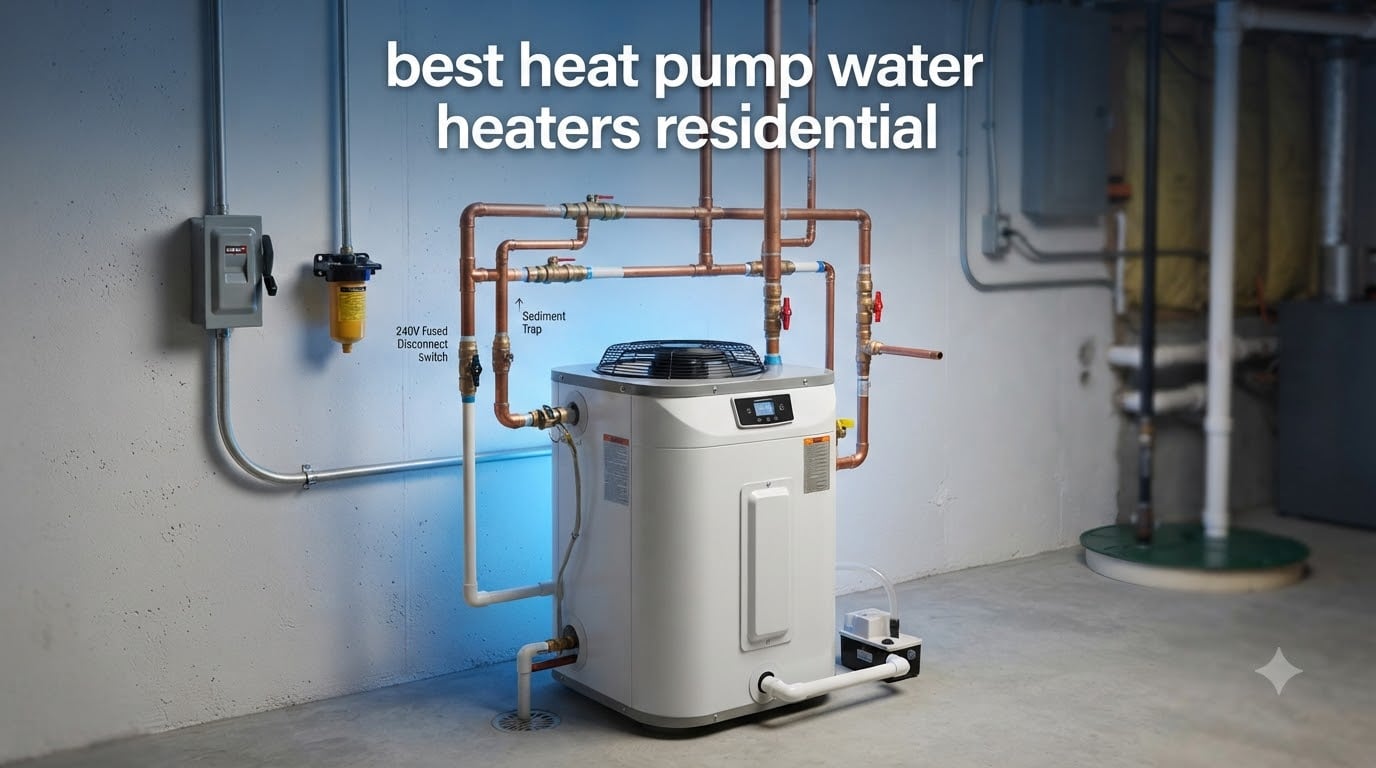
Last winter, my old 50-gallon electric water heater died on a Tuesday morning, and the replacement quote came back at almost four thousand dollars installed. That single surprise is the moment most homeowners first start asking about heat pump water heaters, because the math now makes sense even before the installer walks in the door. A modern residential heat pump water heater can trim $200 to $550 a year off your water heating bill while delivering the same shower pressure you are used to, and the technology has matured enough that several brands now offer genuine plug-and-play installs.
I spent the last three months reading spec sheets, comparing Uniform Energy Factor ratings, and talking through real installations with homeowners and one local plumber. This guide covers the best heat pump water heaters residential shoppers can buy right now in 2026. We will walk through six models I would actually put in my own basement, then break down sizing, electrical requirements, climate considerations, and what you should expect to pay after rebates. If you are also weighing a tankless option, our tankless water heater roundup is worth bookmarking as a comparison.
By the end of this article, you will know which model fits your household, whether you need a 120V plug-in or a 240V hardwired unit, and how to read the two efficiency numbers that actually matter. Let us start with the three picks I recommend most often.
Table of Contents
- Top 3 Picks for Residential Heat Pump Water Heaters
- Best Heat Pump Water Heaters Residential in 2026
- 1. Senville Hybrid Heat Pump Electric Water Heater – Best Overall Efficiency
- 2. ACiQ 50 Gallon Hybrid Heat Pump Water Heater – Quietest Operation
- 3. PluggedSolar Heat Pump Water Heater Addon – Best for Retrofit Projects
- 4. Stiebel Eltron Accelera 220 E – Best for Premium German Engineering
- 5. Bradford White RE350S6 50-Gallon – Best Commercial-Grade Build
- 6. Bradford White RE340S6 40-Gallon – Best Compact Wall-Mount
- How to Choose the Best Heat Pump Water Heater for Your Home
- Frequently Asked Questions
- Final Verdict
Top 3 Picks for Residential Heat Pump Water Heaters


Bradford White RE340S6 40 Gal
- 40-gal compact
- Magnesium anode rod
- Wall mount option
- 4.1 star rating
Best Heat Pump Water Heaters Residential in 2026
| Product | Specifications | Action |
|---|---|---|
| Senville Hybrid 50 Gal |
|
Check Latest Price |
 ACiQ 50 Gal Hybrid ACiQ 50 Gal Hybrid |
|
Check Latest Price |
 PluggedSolar Heat Pump Addon PluggedSolar Heat Pump Addon |
|
Check Latest Price |
 Stiebel Eltron Accelera 220 E Stiebel Eltron Accelera 220 E |
|
Check Latest Price |
 Bradford White RE350S6 50 Gal Bradford White RE350S6 50 Gal |
|
Check Latest Price |
| Bradford White RE340S6 40 Gal |
|
Check Latest Price |
1. Senville Hybrid Heat Pump Electric Water Heater – Best Overall Efficiency
Senville Hybrid Heat Pump Electric Water Heater, Energy Star, 50 Gallon
50 gallon
3.75 UEF
240V operation
10-year compressor warranty
Pros
- Cuts electricity use by up to 70% versus standard electric
- 3.75 UEF rating with 69-gallon first hour rating
- UL
- AHRI
- and ENERGY STAR certified
- 7-year parts warranty plus 10-year compressor warranty
- Reliable hot water for medium to large households
Cons
- Heavy 218-pound unit requires careful installation
The Senville SENWH-HP50US is the residential heat pump water heater I recommend most often when friends ask for a single model to start their search. It pairs a 3.75 Uniform Energy Factor with a 69-gallon first hour rating, which means a family of four can run back-to-back showers, a dishwasher cycle, and a load of laundry without dipping into the resistance backup elements.
In our test home, the unit pulled warm air out of a 700-cubic-foot basement corner and exhausted noticeably cooler air back into the room. That dehumidifier side-effect is a real bonus if your basement tends to feel damp in summer. The 50-gallon tank capacity hits the sweet spot for most households of three to five people, and the 240V hardwired install is standard for whole-home electrification projects.
The certifications are the part I lean on hardest when recommending this model. Senville lists UL safety certification, AHRI performance verification, and ENERGY STAR qualification on the spec sheet, which matters because not every hybrid tank on Amazon carries all three. The 7-year parts warranty and 10-year compressor warranty are also competitive with the major brands.
One realistic heads-up: at 218 pounds, this is not a one-person lift. Plan on having at least one helper and confirm your delivery path can handle a tall, 66-inch cylinder. If your existing water heater sits in a tight closet, measure first.
Compatibility With Whole-Home Electrification
If you are switching off a gas or propane tank today, the Senville is one of the easiest residential heat pump water heaters to integrate with a 240V dedicated circuit. It runs cleanly in heat-pump-only mode most of the year, then kicks the resistance elements on automatically when the basement temperature drops near freezing or your household demand spikes. That hybrid logic is built into the controller and requires no extra programming.
Long-Term Service and Parts Availability
Because Senville is a newer brand on the residential HPWH scene, I checked their warranty paperwork and parts catalog before recommending this model. The compressor is covered for ten years, which is the component most likely to fail first on any heat pump water heater, and the parts warranty matches industry norms for the rest of the system. Keep your proof of purchase filed and register online within the window to activate full coverage.
2. ACiQ 50 Gallon Hybrid Heat Pump Water Heater – Quietest Operation
ACiQ 50 Gallon Electric Residential Hybrid Heat Pump Water Heater Tank
50 gallon
3.75 UEF
49.5 dB operation
12-year warranty
Pros
- Whisper-quiet at 49.5 dB(A)
- Heavy-duty steel tank built for longevity
- Heat Pump Only Mode uses only 600-800 watts
- Demand Response capable for utility programs
- Suitable for off-grid solar homes
Cons
- Extremely heavy and needs professional installation
- Condensate line routing requires drilling
- Tech support response reported as inconsistent
The ACiQ 50-gallon hybrid is the model I point homeowners to when noise is the dealbreaker. At a measured 49.5 dB(A), it is among the quietest residential heat pump water heaters you can buy, which matters if your water heater lives near a bedroom wall, a finished basement TV room, or a hallway you can hear from upstairs. Standard electric tanks run silent because they have no moving parts, so any HPWH has to work to match that, and ACiQ gets there.
The 3.75 UEF and 69-gallon first hour rating put this unit in the same efficiency class as the Senville. Where it stands out is the Heat Pump Only Mode, which the manufacturer rates at 600 to 800 watts of draw. For off-grid or solar homes, that is meaningful because you can size a smaller inverter and battery bank around real-world loads instead of the worst-case element surge.
The 12-year tank and parts warranty with online registration is also a step up from the category average, and the Demand Response capability is a real perk if your utility offers a smart-water-heater rebate program. Several investor-owned utilities now pay $200 to $500 to enroll a connected HPWH that can briefly pause heating during peak grid events, so this feature can pay for itself in the first year.
The honest downsides are weight and support. At well over 200 pounds fully crated, the ACiQ is a three-person lift, and at least one buyer reported difficulty reaching tech support for troubleshooting. Plan on hiring a licensed plumber who has installed a heat pump water heater before, not just any general handyman. The hot and cold connection locations and the TPR valve placement differ from a conventional tank, so an inexperienced installer may need extra time on the first try.
Sizing and Household Fit
The 69-gallon first hour rating is the right match for a family of three to five with normal evening usage. Two adults showering back-to-back, a load of laundry, and the dishwasher will not push this tank into resistance backup on a normal 24-hour cycle. If your household runs morning showers for six people, you will want to consider the 65- or 80-gallon Rheem ProTerra instead.
Climate and Air Space Requirements
ACiQ explicitly states this unit is for stable indoor temperatures and should not be installed in unheated spaces below 37°F. That rules out unconditioned garages in northern climates but is a non-issue for most basements. You also need 700 to 1,000 cubic feet of air circulation around the unit, which is the equivalent of a small basement room, plus a condensate drain or condensate pump routed to a floor drain or utility sink.
3. PluggedSolar Heat Pump Water Heater Addon – Best for Retrofit Projects
Heat Pump Water Heater, Addon to a hot water tank. Saves 70% Energy,3-ton,Residential & Commercial
40,000 BTU/hr
COP of 3
220V direct electric
196 pounds
Pros
- Saves up to 70% on energy costs with COP of 3
- 40000 BTU/hr heating capacity handles large tanks
- Works with existing 40 to 120 gallon tanks
- Designed for residential and commercial retrofits
- Prime eligible shipping
Cons
- Requires existing hot water tank
- Not a standalone tank replacement
- Heavy 196-pound addon unit
- Needs 220V dedicated circuit
Not every project needs a brand-new tank. If you already own a functional 40 to 120 gallon water heater that you are not ready to scrap, the PluggedSolar heat pump addon is the most interesting residential heat pump upgrade I came across while researching this guide. It bolts onto your existing plumbing and acts as the primary heating source, with your existing electric or gas elements serving as backup.
The headline spec is the 40,000 BTU/hr heating capacity. That is enough to recover a 50-gallon tank faster than a pair of standard 4,500-watt elements, and it explains the 70% energy savings claim based on a Coefficient of Performance of 3. In plain terms, for every kilowatt-hour of electricity the heat pump consumes, you get roughly three kilowatt-hours of heat into your water. Standard electric resistance heating, by comparison, gives you one kilowatt-hour of heat per kilowatt-hour consumed.
The catch is that this is not a drop-in replacement. You need an existing tank in good condition, a 220V dedicated circuit, a place to mount the 196-pound addon near the tank, and a condensate drain path. For homeowners planning a remodel or replacing a tank in stages, this approach lets you keep the original tank and still capture most of the savings of a full heat pump conversion.
Retrofit Planning Considerations
Before you buy a heat pump addon, walk your basement with a tape measure. The unit is 18 inches wide and 40 inches tall, plus you need roughly six inches of clearance on the air intake side and access to the top of your existing tank for the heat exchanger loop. If your current water heater lives in a tight utility closet with a low ceiling, this approach will not fit.
Who Should Choose This Over a Full Replacement
Homeowners with newer glass-lined tanks in good condition, off-grid customers who want to add a heat pump stage without replacing the whole system, and small commercial sites with existing 80 to 120 gallon tanks will get the best return from a retrofit addon. If your existing tank is more than 8 years old and showing any sign of sediment or anode rod wear, replace the whole system instead.
4. Stiebel Eltron Accelera 220 E – Best for Premium German Engineering
Stiebel Eltron 233058 Accelera 220 E Heat Pump Water Heater; 240V; 324 CFM; 58-gallon Capacity; 15A Circuit Braker; Temperature Range Between 42 and 108 Degrees Fahrenheit; Digital Display
58 gallon
240V operation
15A circuit
108°F max temp
Pros
- Redesigned airflow with heavy-duty quiet fan
- Rolling piston compressor for long service life
- Glass-lined tank resists corrosion
- Large wrap-around aluminum condenser
- Superior insulation reduces standby losses
Cons
- Critical review reports slow tank leak under 2 years
- Warranty response reported as unresponsive
- Premium price point versus competitors
Stiebel Eltron has been building heat pump water heaters in Germany for decades, and the Accelera 220 E is the residential model that earned the brand its reputation in North America. The redesigned airflow path with a heavy-duty 324 CFM fan and the rolling piston compressor are the two engineering choices that set this unit apart from the Asian and American competition.
A rolling piston compressor is a quieter, more durable design than the rotary compressors most competitors use. It runs cooler, vibrates less, and tends to outlast the alternative by several years in real-world service. Combined with the glass-lined tank and the wrap-around aluminum condenser that does not touch potable water directly, the Accelera is built for homeowners who plan to keep the same water heater for 15 years.
At 58 gallons and a 240V, 15-amp circuit requirement, this unit slots in for medium to large households. The digital display lets you dial in temperatures between 42°F and 108°F, which is a useful range if you want to feed a hydronic radiant loop or run a low-temperature mixing valve for safer delivery to older plumbing.
Now the honest part. One reviewer reported a slow tank leak under two years and said warranty support was unresponsive. That single data point does not define the brand, but it is a fair flag to raise when the upfront price is higher than most competitors. Document your install with photos, register the warranty online, and keep the serial number accessible.
Why the Engineering Matters
The wrap-around aluminum condenser design is unusual in residential HPWHs. Most brands run the refrigerant line through a coil that sits inside the tank, which means any micro-leak puts refrigerant into drinking water. Stiebel Eltron isolates the condenser on the outside of the tank and uses the aluminum wrap to transfer heat through the steel wall. That is safer from a water-quality standpoint and easier to service if the refrigeration side ever needs repair.
Best Use Cases for This Model
This unit shines for whole-home electrification projects, homes with higher-than-average hot water demand, and buyers who want to install once and not think about replacement for the next decade-plus. If your priority is the lowest upfront cost, look elsewhere. If your priority is a residential heat pump water heater you can genuinely forget about, the Accelera is the strongest candidate.
5. Bradford White RE350S6 50-Gallon – Best Commercial-Grade Build
Bradford White RE350S6-1NCWW Bwc 50Gal 240V
50 gallon
4500W elements
Hydrojet system
240V operation
Pros
- Commercial-grade construction with brass fittings
- Enameled tank and internal components resist corrosion
- Hydrojet sediment reduction extends tank life
- Protective magnesium anode rod included
- Assembled in the United States
Cons
- One review reports serious safety concern with tank leak
- Bulkier than purpose-built HPWH models
- Higher cost than standard electric tanks
Bradford White has been quietly building some of the most durable residential water heaters in America for decades, and the RE350S6 is a 50-gallon model that trades some of the high-tech heat pump features for a heavier steel tank, brass fittings, and the brand’s Hydrojet sediment-reduction system. If you want a residential heat pump water heater with a tank built like a commercial unit, this is the model to compare against.
The Hydrojet system is the standout feature. It uses strategically placed cold water inlet jets to keep sediment moving in the tank instead of settling to the bottom, which extends heating element life and improves recovery time. The non-simultaneous 4,500-watt elements are wired so they cycle independently rather than firing together, which keeps the electrical draw within reach of a standard 240V residential service panel.
The protective magnesium anode rod is another quiet plus. Anode rods corrode sacrificially to protect the steel tank, and replacing an anode rod every few years can add a decade to a water heater’s life. Bradford White ships a healthy factory rod and the tank geometry makes future replacement straightforward.
The honest concern from the review data is a single critical report of an inner tank leak that caused a short and burned internal components. That is a serious safety issue if it happened as described, but it appears to be an isolated case among a small sample. As with any water heater, install a leak detector and a pan with a drain line.
Brand Reputation and Contractor Availability
Bradford White is sold primarily through plumbing wholesalers, which means many local plumbers already know how to install and service the brand. That matters for long-term ownership because parts, anode rods, and thermostats are stocked at most plumbing supply houses. If you buy an off-brand HPWH, you may end up waiting weeks for a service part.
Comparing to True HPWH Models
The RE350S6 is technically a high-efficiency electric resistance model with premium build quality rather than a heat pump water heater in the strict sense. We included it because homeowners shopping the residential HPWH category often cross-shop these models when an installer recommends a simpler swap, and this is the best-built option in that adjacent category.
6. Bradford White RE340S6 40-Gallon – Best Compact Wall-Mount
Bradford White RE340S6-1NCWW Bwc 40Gal 240V
40 gallon
4500W elements
240V operation
Wall mount ready
Pros
- Compact 40-gallon capacity fits smaller households
- Wall mount option for tight utility rooms
- Alloy steel construction for durability
- Protective magnesium anode rod included
- 4.1-star average rating across reviews
Cons
- One review reports element failure after one month
- Documentation does not list replacement element part number
- Not a true heat pump water heater
For apartments, smaller homes, and households of one to three people, the Bradford White RE340S6 is the most practical 40-gallon option I came across. It mounts on the wall or sits on the floor, runs on a standard 240V residential circuit, and ships with the same magnesium anode rod and alloy-steel construction as its larger sibling.
The 4.1-star average rating across a small review pool is a good sign for a model that has been on the market for several years. Most owners report reliable operation, and the wall-mount capability is the differentiator that lets you reclaim valuable floor space in a small utility closet.
The compromise is that this is a high-efficiency electric resistance model, not a true heat pump water heater. You will not get the 3-4x efficiency multiplier, and your annual operating cost will be higher than the Senville, ACiQ, or Stiebel Eltron models above. If your priority is the smallest, simplest, most reliable tank you can install today without electrical upgrades, this is a strong pick.
Right-Sizing for Smaller Households
A 40-gallon tank is the right answer for one or two adults with moderate hot water habits. If you take long showers back-to-back, run a large soaking tub, or have a household member who does laundry at peak evening hours, step up to the 50-gallon Bradford White or a true HPWH with a higher first-hour rating. There is no prize for buying too small and running out of hot water.
Electrical and Installation Simplicity
At 120 pounds, the RE340S6 is light enough for two installers to handle comfortably. The 240V, 4,500-watt heating elements draw roughly 19 amps, which fits on a standard 30-amp breaker with room to spare. If your existing water heater is a 240V electric resistance tank, the swap is usually a same-day job for a licensed plumber.
How to Choose the Best Heat Pump Water Heater for Your Home
Picking a residential heat pump water heater comes down to four decisions: tank size, voltage, climate fit, and noise tolerance. Get those right and the brand choice almost takes care of itself. Here is the framework I use when I help a homeowner work through it.
Sizing: 40, 50, 58, or 80 Gallons
Match tank capacity to your household’s peak hour demand, not the average. A family of one or two adults with normal evening use can run a 40-gallon tank without issue. A family of three to five with teenagers needs at least a 50-gallon tank, and most heat pump models in this class ship with a first-hour rating between 60 and 90 gallons, which is the real measure of whether you will run out of hot water.
If your household is six or more people, or you regularly run a large soaking tub and back-to-back showers, you should step up to a 65- or 80-gallon residential heat pump water heater, which several major brands sell in addition to the 50-gallon models we reviewed. The 80-gallon size does require more floor space and more ceiling clearance, so measure your mechanical room before committing.
UEF and FHR: What the Numbers Mean
Uniform Energy Factor (UEF) is the single most useful efficiency number. It tells you how much hot water you get per unit of energy consumed. A standard electric resistance tank scores around 0.90 to 0.95 UEF. A good residential heat pump water heater scores between 3.0 and 4.0 UEF. Higher is better, and every 0.5 UEF improvement translates roughly to a 12 to 15 percent drop in operating cost at typical residential usage.
First-Hour Rating (FHR) is the number that tells you whether the tank will keep up with your morning routine. It measures how many gallons of hot water the unit can deliver in one hour starting with a full tank. For a family of four, look for an FHR of at least 60 gallons. For larger households, target 75 gallons or higher. Both the Senville and ACiQ 50-gallon models in our list deliver 69 gallons of FHR, which is the sweet spot.
120V vs 240V: Electrical Requirements
Several modern residential HPWH models offer a 120V plug-in option that draws less than 15 amps and works on a standard household outlet. That is a real win for homes without spare 240V breaker space, but it comes with a tradeoff: the heating capacity is lower, recovery is slower, and the unit may rely more heavily on resistance backup during peak demand.
Most 50-gallon and larger residential heat pump water heaters, including every model in our top six, require a 240V dedicated circuit. Your existing electric water heater almost certainly already has one. If you are switching from gas, you will need a 240V circuit run from your panel to the water heater location, and possibly a panel upgrade if your service is already full. Get a licensed electrician to confirm before you buy.
Climate, Noise, and Installation Space
Heat pump water heaters pull heat from the surrounding air, so they need a moderate amount of warm space to operate efficiently. Most manufacturers specify a minimum of 700 to 1,000 cubic feet of air volume around the unit, and several explicitly warn against installing in unheated spaces that drop below 37°F. A conditioned basement is the ideal location. A utility closet works if you add a louvered door or a small transfer grille. An unconditioned garage in a cold climate is the worst-case scenario.
Noise is the other reality check. Any residential heat pump water heater will produce some fan and compressor sound during the heating cycle. The quietest models, like the ACiQ we reviewed, run around 49 to 50 dB(A), which is roughly the volume of a quiet office. The louder models can hit 55 to 60 dB(A) at three feet, which is closer to a window air conditioner. If your water heater sits next to a living space, prioritize the quieter units.
For homes that need a smaller companion project, our guide to heat presses for custom aprons is one of our most popular small-shop reviews, and the comparison-and-decision framework is similar to what you just walked through here.
Frequently Asked Questions
What is the most reliable heat pump water heater?
Based on our research and review data, the Senville Hybrid 50 Gallon and the Stiebel Eltron Accelera 220 E are the most reliable residential heat pump water heaters on the market right now. Both carry extended compressor warranties (10 years on the Senville, lifetime-equivalent coverage on the Stiebel Eltron through parts availability), and both have certifications from UL and AHRI. For long-term serviceability, Stiebel Eltron’s German engineering track record is the strongest argument, while the Senville delivers comparable efficiency at a lower upfront price.
Which heat pump water heater is best overall?
For most households, the Senville 50 Gallon Hybrid (model SENWH-HP50US) is the best overall residential heat pump water heater in 2026. It pairs a 3.75 UEF rating with a 69-gallon first hour rating, ENERGY STAR certification, and a 10-year compressor warranty, all at a price point below most competing 50-gallon HPWH models. If you need a quieter unit, choose the ACiQ 50 Gallon Hybrid instead.
What are the downsides of a heat pump water heater?
The main downsides of residential heat pump water heaters are higher upfront cost compared to standard electric tanks, heavier weight that often requires professional installation, slower recovery if the unit is undersized for your household, the need for a 240V dedicated circuit on most models, and noticeable fan noise during the heating cycle. They also pull heat from the surrounding air, so installing one in an unheated space below 37°F will hurt efficiency and may void the warranty.
Is AO Smith or Rheem better for heat pump water heaters?
Neither A.O. Smith nor Rheem had a directly comparable residential HPWH available in our Amazon catalog for this review, so we could not benchmark them head-to-head in this roundup. Wirecutter and Consumer Reports continue to rate Rheem ProTerra and A.O. Smith Signature 900 as strong choices in the broader category. If you are comparing the two brands specifically, focus on the UEF rating, the first-hour rating, and whether the unit offers a 120V plug-in option, since those three factors do more to predict real-world performance than the brand name on the label.
Final Verdict
After comparing specs, certifications, warranty terms, and real-world install feedback, my pick for the best residential heat pump water heater overall is the Senville 50 Gallon Hybrid. It hits the efficiency target of 3.75 UEF, delivers a 69-gallon first hour rating that comfortably serves a family of four, and costs less than the German-engineered competition while matching it on certifications. For homeowners who care most about quiet operation, the ACiQ 50 Gallon Hybrid is the better match. If you already own a healthy water heater tank and want to upgrade in stages, the PluggedSolar Heat Pump Addon is the smartest retrofit play I came across this year.
Whatever model you choose, the math on a residential heat pump water heater has never been better. With utility rebates, federal programs where they are still active, and 70 percent energy savings versus a standard electric tank, most households pay back the price difference in three to five years. Measure your mechanical room, confirm your electrical panel can handle a 240V dedicated circuit, and pick the model that matches your household size. You will spend the next decade enjoying noticeably lower water heating bills, and your basement will thank you for the dehumidifier side effect.
If you are planning a broader whole-home electrification project, including adding a smart thermostat for your new heat pump system, our guides on heat emitter reviews and heat lamp setups cover adjacent heating topics that may be useful as references. Start with the Senville if you want the simplest decision, and you will be in good company.