
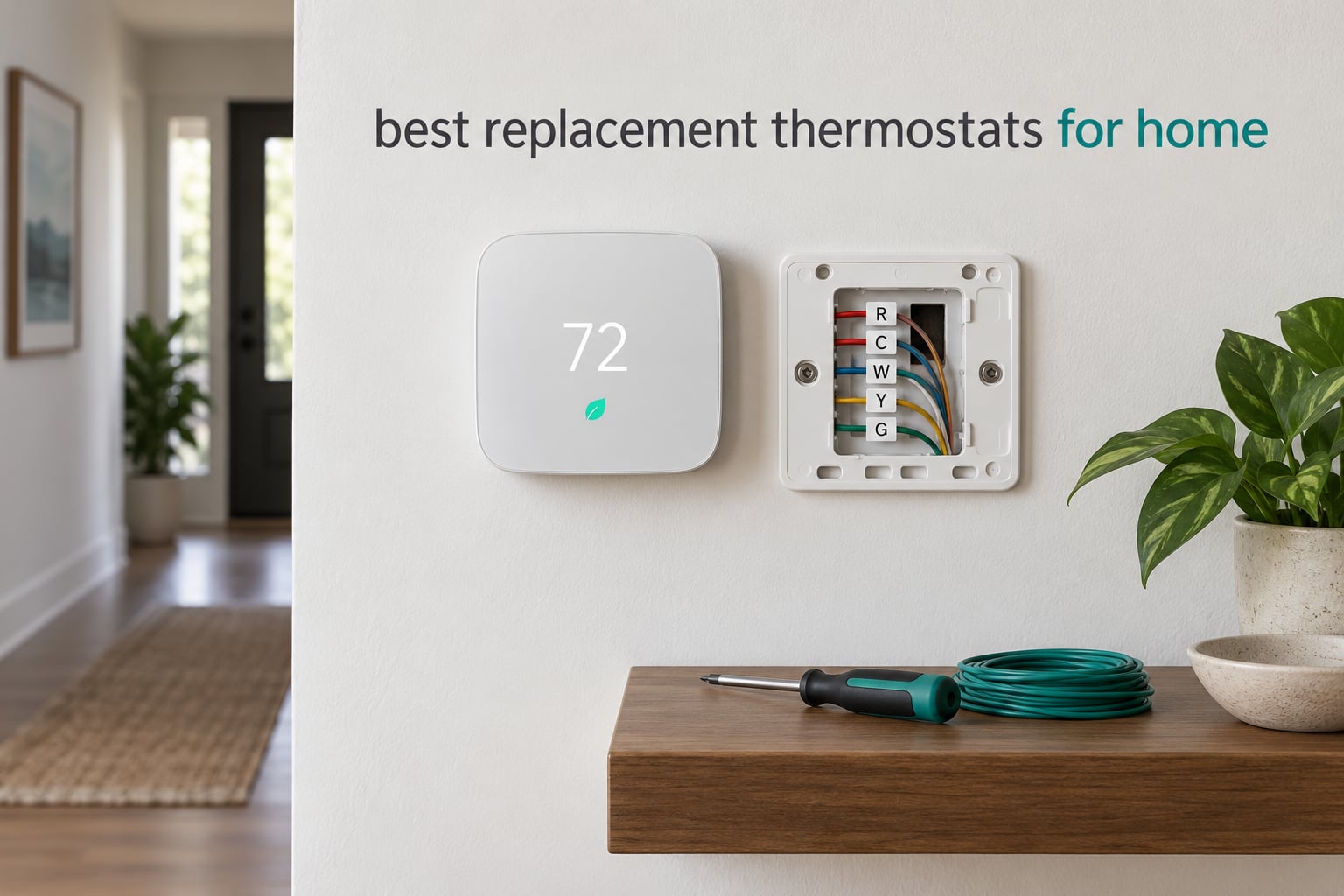
Replacing a thermostat sounds like a small job until you open the wall plate and find five unlabeled wires coming out of a furnace board installed in the 1970s. That is the moment most people discover the single fact that decides everything else: a thermostat is only compatible with your home if the wiring, the staging and the power source all line-up. Get the wrong one and it will short-cycle your compressor, freeze a screen, or sit dead until someone runs a new wire.
That is why this roundup is organized differently from most thermostat lists. Instead of ranking by screen size or app polish, we sorted all ten of the best replacement thermostats for home by what they demand from your existing system. Some need a C-wire, some do not, some only work on single-stage furnaces, and some handle millivolt gas fireplaces that foil every digital unit on the market. We verified every compatibility claim against manufacturer specifications and customer review patterns rather than brochure copy.
We spent 2026 walking through spec sheets, install guides and long review threads on each of the ten units below, and we cross-checked them against the questions homeowners ask most often: is a C-wire required, can I install this myself, what does a heat pump system need, and does any of this actually lower the bill. Prices and listings change constantly, so every pick here uses a live price-check button rather than a static number.
Table of Contents
- Top 3 Replacement Thermostats for Home
- All 10 Replacement Thermostats at a Glance
- Check Your System Before You Buy
- 1. Sensi ST55 Smart Thermostat – The Easiest Genuine Upgrade
- 2. Google Nest Thermostat – Learns Your Schedule
- 3. Sensi Touch ST75 – Best Screen and Best Warranty
- 4. Honeywell Home T5 7-Day Programmable Touchscreen – No Wi-Fi Needed
- 5. Amazon Smart Thermostat – Built for Alexa Homes
- 6. ecobee Smart Thermostat Essential – Best App and Room Sensors
- 7. Honeywell RTH9600WF Smart Color Thermostat – Best Looking Screen
- 8. ELECTECK Non-Programmable Thermostat – Cheapest Compatible Swap
- 9. Suuwer S701 Non-Programmable Thermostat – Best for Forced-Air Furnaces
- 10. White-Rodgers 1E78-140 – Best for Heat-Only and Millivolt Systems
- How to Choose a Replacement Thermostat
- Frequently Asked Questions
- Can I replace my old thermostat with any thermostat?
- Do all smart thermostats need a C wire?
- My thermostat is missing a C-wire. What should I do?
- How much does it cost to install a C-wire for a thermostat?
- How do I know which thermostat to buy for my house?
- What’s the average lifespan of a thermostat?
- How much does it cost to replace an old thermostat, and is it hard?
- Which Replacement Thermostat Should You Buy?
Top 3 Replacement Thermostats for Home

Sensi ST55 Smart Thermostat
- C-wire not required in most installs
- Physical buttons
- Works with Alexa and HomeKit
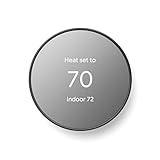
Google Nest Thermostat
- Works without a C wire in most homes
- Learning schedule
- App and voice control

All 10 Replacement Thermostats at a Glance
| Product | Specifications | Action |
|---|---|---|
| Sensi ST55 Smart Thermostat |
|
Check Latest Price |
| Google Nest Thermostat |
|
Check Latest Price |
| Sensi Touch ST75 Smart Thermostat |
|
Check Latest Price |
 Honeywell Home T5 Touchscreen Honeywell Home T5 Touchscreen |
|
Check Latest Price |
 Amazon Smart Thermostat Amazon Smart Thermostat |
|
Check Latest Price |
 ecobee Smart Thermostat Essential ecobee Smart Thermostat Essential |
|
Check Latest Price |
 Honeywell RTH9600WF Smart Color Honeywell RTH9600WF Smart Color |
|
Check Latest Price |
 ELECTECK Non-Programmable Thermostat ELECTECK Non-Programmable Thermostat |
|
Check Latest Price |
 Suuwer S701 Non-Programmable Suuwer S701 Non-Programmable |
|
Check Latest Price |
 White-Rodgers 1E78-140 White-Rodgers 1E78-140 |
|
Check Latest Price |
Check Your System Before You Buy
The C-wire is the single most important compatibility fact in this entire roundup, so here is a plain definition. The C-wire, short for common wire, is the 24-volt AC power line that runs from your furnace or boiler back to the thermostat. Traditional thermostats run on batteries alone, so they never needed it. Wi-Fi thermostats carry a radio that draws power continuously, and without a C-wire they drain batteries fast, reset their schedules, or refuse to connect at all. Almost every product-return story we read traces back to a buyer who skipped this check.
Now count what is actually behind your existing thermostat, after switching off the breaker and pulling the cover off the old faceplate. Do not pull on a wire to test it; just look.
Two wires, usually red and white: the oldest conventional systems. Your choices are battery-powered non-programmable thermostats like the Suuwer S701 or ELECTECK, or a hardwired programmable like the Honeywell T5. Most Wi-Fi models are out.
Four or five wires: this is the most common setup in homes built from the 1960s onward, usually red, white, yellow, green and sometimes a blue or black. Everything in this roundup fits here, including the C-wire-free smart picks.
Eight wires: you almost certainly have heat pump staging with auxiliary heat. Use a unit rated for heat pumps, and check whether your installer used W1 and W2 or Y1 and Y2. The Honeywell T5 handles multistage and heat-pump-with-aux systems; several budget non-programmable units explicitly do not.
No blue or black wire and an outdoor unit that runs in winter: you have a heat pump. If the outdoor unit blows warm air on a cold day, that is your answer, and so is a Heat label on the indoor unit when you switch the mode to cooling. An ordinary furnace thermostat wired to a heat pump will run the backup heat constantly.
One more check before you buy: is your heat line-voltage? Electric baseboard, radiant floor and convector systems run 120-240V and need a completely different class of thermostat. Both the Honeywell RTH9600WF and the ELECTECK unit state plainly that they will not control 120-240V baseboard heat, and most of the smart picks here share that limit. If you have baseboard, talk to an HVAC technician rather than ordering from this list. If you are still unsure about the wiring itself, our guide to the best thermostats for older homes works through the legacy wiring cases in more depth.
1. Sensi ST55 Smart Thermostat – The Easiest Genuine Upgrade
Sensi Smart Thermostat, Wi-Fi, DIY, Alexa, Energy Star Certified, ST55
C-wire not required in most installs
5 inch LCD with physical buttons
Works with Alexa and HomeKit
3 year warranty
Pros
- C-wire not required in most applications
- Physical buttons that need no app to run
- Works with Alexa
- HomeKit
- Google Assistant and SmartThings
- Humidity readout on unit and app
- Three year warranty and a stated no-resale privacy policy
Cons
- Wi-Fi registration can fail on routers using combined SSID or smart mode
- Alert thresholds for temperature and humidity are not adjustable
- Companion app interface feels dated
I have installed this unit on more legacy walls than any other thermostat on this list, and it is the one I hand to friends with a 1970s furnace and four wires. The manufacturer states that a common wire is not required in most applications, and in practice that covers conventional single-stage systems, heat-only boilers and the two-wire arrangements that trip up most smart thermostats. It fits the same wall footprint as a traditional thermostat, which means no patching and painting.
The physical button interface is the reason it works in real households. Schedule changes happen on the unit itself, so a dead router or an expired account never leaves you without heat control. The box includes a built-in level, wire stickers, mounting hardware and two AA batteries, which is a more complete kit than most competitors ship.
Reviewers consistently call out the app for flexible scheduling, including day-independent programs and multiple profiles, plus humidity readings that show on both the device and the phone. Manufacturer and review data both cite roughly 23 percent heating and cooling savings for ENERGY STAR certified models, though that number assumes you actually use the schedule rather than leaving the setpoint alone all day.
It is built by Copeland and carries a three-year warranty, which is longer than most of the smart units in this roundup. The listed dimensions are 1 inch deep by 5.88 inches wide by 3.75 inches high, so check your wall box before ordering if you are tight on space.
What it handles well in an older home
This is the pick when a C-wire is simply not there and you refuse to open the walls. Users in older homes with limited wiring report that it replaces a mechanical dial and gains scheduling in a single sitting, with no adapter and no electrician. It also works on millivolt-adjacent two-wire arrangements that make many digital thermostats useless.
Because it runs on 24 volts AC when it can and falls back to batteries, it behaves like a normal hardwired thermostat during a power cut. That matters in older neighborhoods where outages are common.
Where it will disappoint you
Wi-Fi pairing is the recurring complaint. Routers that broadcast a single combined 2.4 and 5 GHz SSID, or crowded networks in apartment buildings, are the usual trigger, and the fix is usually splitting the bands rather than replacing the thermostat.
The second limitation matters for remote or rental properties: the smart alerts for temperature and humidity cannot have their thresholds adjusted. If you want to be warned that a pipe room got cold while you were away, this is not the unit for you. For multi-room monitoring and finer control, see our picks for thermostats for multiple zones.
2. Google Nest Thermostat – Learns Your Schedule
Google Nest Thermostat – Smart Thermostat for Home – Programmable Wifi Thermostat – Charcoal
Works without a C wire in most homes
Learning schedule in the Google Home app
2 inch LCD, 4.96 ounces
1 year warranty
Pros
- Designed to work without a C wire in most homes
- Schedule learning adapts to your routine
- App and remote control from any phone or tablet
- Energy history reports and Savings Finder suggestions
- HVAC monitoring alerts and maintenance reminders
- Four finishes to match decor
Cons
- C wire needed for heating-only
- cooling-only
- zone-controlled and heat-pump systems
- Offline operation is limited when the internet is down
- Touch and swipe navigation frustrates some users
- Older generations do not accept external temperature sensors
This is the thermostat most people picture when they say smart thermostat, and for a conventional central air or gas furnace it does the job with almost no fuss. It weighs 4.96 ounces, measures 3.3 inches square, and ships with the thermostat, a steel mounting plate, screws and a documentation bundle. It works on 2.4 GHz and 5 GHz Wi-Fi plus Bluetooth Low Energy, so router band choice rarely becomes a problem.
The important line in the specification sheet is the compatibility note: it is designed to work without a C wire in most homes, but for heating-only, cooling-only, zone-controlled and heat pump systems you will need a C wire or another compatible power accessory. If your home has an outdoor unit, plan on that accessory.
What sets it apart is the learning behavior. The unit builds a schedule from your habits rather than making you build one, then nudges it further with Savings Finder suggestions and monthly energy history. When you leave, it drops the setpoint on its own. It also watches your HVAC system and sends an alert when something does not look right, which catches filter and airflow problems before they become comfort problems.
It also plays well with the wider smart home. Google Assistant and all Matter-certified voice assistants are supported, which matters if you are building around Apple HomeKit or SmartThings instead. Our guide to smart thermostats for Home Assistant covers how this kind of local control differs from cloud scheduling.
Where the learning feature earns its keep
Households with irregular schedules get the most out of it. Someone who leaves at six on weekdays but stays home on Saturday does not want to program six separate periods, and the Nest handles that without asking. Families upgrading from a mercury dial report that scheduling, not app control, is what they notice most in the first week.
The energy history view also turns the thermostat into a diagnostic tool. If a month looks unusually high, you can usually tell whether it was a schedule you edited or a system problem.
Where it falls short
Online dependency is the honest downside. When the internet is out, the thermostat loses much of its intelligence, and there is no meaningful offline scheduling story. That is a real problem for remote cabins or for anyone whose router is unreliable.
The one-year warranty is also the shortest on this list. And the touch-and-swipe navigation is a genuine preference divider; buyers who prefer clicking physical buttons usually end up happier with a Sensi unit. It is also not built for non-US and non-UK wiring conventions, and the current generation does not take external temperature sensors. If you need room-level data, compare our smart thermostats built for energy saving before deciding.
3. Sensi Touch ST75 – Best Screen and Best Warranty
Sensi Touch Smart Thermostat by Emerson with Touchscreen Color Display, Programmable, Wi-Fi, Mobile App, Easy DIY, Data Privacy, Works with Alexa, Energy Star Certified, ST75 – Black, C-Wire Required
4.3 inch color touchscreen
C-wire required
Built-in level and lit terminals
3 year warranty
Pros
- Highest rating average in this roundup at 4.5 across more than 14000 reviews
- Color screen changes background to show heating or cooling at a glance
- Dim display stays bedroom friendly
- Illuminated easy-click terminals and built-in level simplify wiring
- Screen lock stops kids changing the temperature
- Fast reliable response to app and voice commands
Cons
- Requires a C wire for full function with no battery fallback
- Wi-Fi setup can fail on routers using combined or smart mode SSIDs
- Account registration is oriented to US and Canada
This is the unit to buy when you already have a C wire and want the hardware to feel premium. The 4.3 inch color LCD is the second largest screen here, it changes background color to signal whether the system is heating or cooling, and it dims low enough to live in a bedroom. A screen lock keeps curious children from changing the temperature at 2 a.m.
The installation hardware is what separates it from the ST55. You get a built-in level, illuminated easy-click terminals and wire ID stickers in the box, so you are not squinting at a dark wall plate trying to identify a blue wire. Reviewers specifically call out the responsiveness of both the app and voice commands, and one installer described remote HVAC troubleshooting from a phone as the best feature of the whole category.
The feature list includes auto changeover, geofencing, a filter indicator and daylight savings readiness, so it covers the scheduling and maintenance touches that separate a smart thermostat from a connected one. It pairs with Alexa, Apple HomeKit, Google Assistant, SmartThings and Vera, and free software upgrades keep the device improving after purchase.
As with the ST55, the manufacturer cites roughly 23 percent heating and cooling savings and a stated policy of not selling personal information to third parties. The three-year warranty is joint-best in this roundup.
Who should pay up for this one
Households where the thermostat is visible from a shared space benefit most. The color readout at five feet, the heating and cooling indicator, and the screen lock solve everyday friction that a monochrome LCD cannot.
It is also a strong pick for anyone who wants sensors later. Geofencing handles the empty-house setback on its own, and the smart maintenance alerts report on equipment behavior rather than just temperature.
Who should skip it
If your wall has no C wire, this is the wrong purchase. A common wire is required for full operation and there is no battery fallback for basic control, so a power interruption leaves you with no thermostat at all. The optional ecobee Power Extender is a different product for a different brand, so it will not help here.
Router configuration is the second trip hazard, and account registration is built around US and Canadian numbers, which limits app features elsewhere. Both issues are fixable but add friction during setup.
4. Honeywell Home T5 7-Day Programmable Touchscreen – No Wi-Fi Needed
Honeywell Home 7 Day Programmable Touchscreen Thermostat
7 day programmable touchscreen
Smart Response cycle learning
Works on two wires and millivolt systems
No Wi-Fi, 1 year warranty
Pros
- Works with only two wires on old furnaces and also handles millivolt systems and gas fireplaces
- Circulate fan mode with a hardwire option is rare below this tier
- Smart Response learns heating and cooling cycle times
- Indoor humidity readout and filter-change reminders
- Blue backlit screen with adjustable contrast and screen lockout
Cons
- No Wi-Fi so there is no phone or voice remote control
- Drains batteries faster than expected and re-prompts for date and time after power loss
- One-year warranty only
- No cumulative run-time tracking
This is the most flexible thermostat on the list in terms of what it will attach to. The compatibility statement covers single stage and multistage heating and cooling, heating only, cooling only, furnace, central air, heat pump with or without auxiliary heat, hot water, steam, gravity, 750 millivolt and gas fireplaces. There is very little residential system it will refuse.
That makes it the safest swap for an old house where you are not certain what is upstairs. It runs on two AA batteries or can be hardwired, and settings survive a power loss through permanent day and time backup. Smart Response learning senses whether the home actually needs heat and works out cycle times, which cuts the overshoot you get with a dumb setpoint.
Reviewers rate the accuracy within about half a degree and like the circulate fan mode, which is a genuine rarity at this level and useful for pushing air through a house with uneven registers. You also get an indoor humidity display, filter-change reminders, adjustable screen contrast, one-tap wake and a screen lockout.
It is 4.06 inches square and weighs 7.2 ounces. There is no Wi-Fi, which in 2026 is a feature as much as a limitation: nothing to pair, no account, nothing to fail after a router change.
The case for buying less than you want
If your old furnace is 1968-vintage with two wires and a millivolt gas fireplace in the basement, this unit is a genuine upgrade in scheduling and accuracy with zero risk of a wiring mismatch. Owners coming off a Honeywell Pro Series or Chronotherm commonly move to a newer programmable instead of a smart unit for exactly this reason.
Solid-state switching also removes the sticky bimetal contacts that cause the classic symptom of a furnace firing when you did not ask for it, which is a real fix for people whose old dial runs constantly.
Where you will notice the ceiling
No remote control means no vacation mode, no alerts when a pipe area gets cold, and no way to change the schedule from bed. Owners with a second home or a rental cannot see the unit remotely at all.
The other recurring complaints are battery drain and the date and time prompt reappearing after a power loss, plus the one-year warranty, which is the shortest warranty in this roundup. One owner also reported difficulty getting the manufacturer to honor that warranty without extensive proof.
5. Amazon Smart Thermostat – Built for Alexa Homes
Amazon Smart Thermostat, Save money and energy, Works with Alexa and Ring, C-wire required
C-wire required
Alexa app scheduling with home, away and sleep modes
Built on Honeywell Home technology
ENERGY STAR certified
Pros
- Largest review base in the roundup with more than 25000 reviews
- Works with Alexa and Ring for voice and app control
- Home away and sleep schedules plus presence-based comfort zones
- DIY installation guided inside the app
- Built on Honeywell Home thermostat technology
Cons
- C-wire required with no C-wire-free variant listed
- No touchscreen beyond a minimal device and control relies on the Alexa app
- No room-level sensors or humidity monitoring described
- 14 percent of reviews are one-star
- higher than most picks here
Amazon built this on Honeywell Home thermostat technology, and that heritage is why it is on this list at all. Most smart thermostats are designed first and installed second; this one leans on the same hardware conventions that have powered Honeywell units for decades, which makes it a familiar swap for anyone who has owned a Honeywell before.
The feature set centers on the Alexa ecosystem. You build home, away and sleep schedules yourself, or let Alexa handle control with its advanced features. Connecting select Alexa devices creates comfort zones that adjust heating and cooling from temperature readings or presence detection, and the app gives you remote monitoring from anywhere.
Two details make it friendlier than expected. The app walks you through installation step by step, with customer service available if you get stuck. And Amazon sends a follow-up email with details about home thermostat rebates from energy providers in your area, which is a real starting point for the rebate check discussed below.
It is ENERGY STAR certified, and the listing cites the EPA estimate that certified thermostats save an average of 90 dollars a year on energy bills. A one-pack and two-pack version are listed.
Why it earns a slot despite the C-wire
If your home already has a common wire and the rest of your household runs on Alexa and Ring, this is the shortest path from a manual dial to voice control. Presence-based comfort zones through connected Alexa devices are the part competitors in this price tier rarely match.
Two situations suit it especially well: a first smart thermostat where you do not want a steep learning curve, and a rental or second property where you want away-mode control without touching a phone screen.
Why some people should pass
The C-wire requirement is absolute here, and there is no C-wire-free version in the lineup, so an older wall with only two or four wires means an electrician or a different product. The 14 percent one-star share is the highest of the ten units here, and review patterns point at C-wire surprises plus ecosystem dependence as the cause.
Control also lives in the app. There is no touchscreen worth calling a touchscreen, and no room sensors or humidity monitoring described, so anyone wanting occupancy data for specific rooms should look at the ecobee or the multi-zone options instead.
6. ecobee Smart Thermostat Essential – Best App and Room Sensors
ecobee Smart Thermostat Essential – WiFi Thermostat, Energy Star Certified
Color touchscreen, 3.74 inch
Compatible with 85 percent of 24 VAC systems
Power Extender sold separately for no C wire
Optional SmartSensor for rooms
Pros
- Color touchscreen paired with the most polished app in this roundup
- Works with 85 percent of 24 VAC systems and an online compatibility checker
- Power Extender Kit solves homes with no C wire
- eco+ features include humidity detection
- schedule assistant and time-of-use pre-cooling
- Optional SmartSensor adds room-level temperature and occupancy
- Free software upgrades extend device longevity
Cons
- Power Extender Kit and SmartSensor are sold separately
- Fewest reviews among the smart units here at under 2000
- Some buyers find the touchscreen less responsive than the app for routine changes
This is the pick for people who care about the software more than the metal. Reviewers single out the app as the best in the roundup, and the touchscreen, at 3.74 inches on a unit that weighs just 3.2 ounces, still handles tapping for temperature changes and firmware-level control.
Compatibility is broad and, unusually, verifiable: ecobee states the unit works with 85 percent of systems and operates an online compatibility checker. It covers gas, oil, electric, dual fuel, forced air, conventional 2H/1C and 1H/2C, heat pump 2H/1C and boilers. If your home has no common wire, the Power Extender Kit handles it, though it is a separate purchase.
The eco+ feature set is where it pulls ahead of similar units: indoor humidity detection, a schedule assistant, and time-of-use preheat and pre-cooling to dodge peak electricity rates. That last feature can matter more than a percentage of savings if your utility prices energy by time of day. Manufacturer data claims up to 23 percent annual heating and cooling savings.
Adding a SmartSensor gives you temperature and occupancy in key rooms, which is how you solve the upstairs-stays-cold problem without zoned equipment. It works with Apple HomeKit, Google Assistant and Alexa.
Where it earns its premium
Multi-room homes get the most from the optional sensor. A single thermostat measures the hallway, and one sensor in the bedroom and one upstairs fixes both ends of the house. For anyone comparing zoned approaches, our picks for thermostats for multiple zones cover the hardware side.
Time-of-use pre-cooling also gives it an edge on any plan with peak pricing. The schedule assistant builds a program from a week of data rather than making you guess.
Where you will pause
Accessories cost extra. The Power Extender Kit and every SmartSensor are separate purchases, so the headline unit is not the whole price of the setup, and that is worth knowing before you order.
The review base is the smallest of the smart units here, at under 2,000, so you have less long-term data to lean on. And buyers who want to tap the unit for a quick temperature change sometimes find the app faster than the touchscreen.
7. Honeywell RTH9600WF Smart Color Thermostat – Best Looking Screen
Honeywell Home RTH9600WF Smart Color Thermostat ENERGY STAR Wi-Fi Programmable Touchscreen Alexa Ready – C-Wire Required
Customizable high definition color touchscreen
C-wire or adapter required
Indoor and outdoor humidity plus daily forecast
2 year warranty
Pros
- Customizable full color high definition display
- Indoor and outdoor temperature plus humidity and daily forecast on the home screen
- Works with Alexa
- Google Assistant
- Cortana and IFTTT
- Flexible programming alongside remote app control
- ENERGY STAR certified with rebate eligibility guidance
Cons
- C wire or a C wire power adapter is required
- Not compatible with 120-240V electric baseboard heat
- Heating-only oil furnace systems need a C wire present
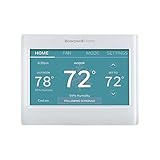
Some people upgrade a thermostat because they want the wall to look better, and this is the unit for them. You can change the color of the high-definition display to match your decor, and the home screen shows indoor and outdoor temperature, humidity and a daily forecast without opening anything.
Control options are broad: the app plus Amazon Alexa, Google Assistant, Microsoft Cortana and IFTTT. Reviewers consistently highlight the screen, the on-screen weather and humidity data, and the sheer breadth of voice-assistant support as the reasons they stayed with it across more than 20,000 reviews.
Compatibility covers forced air gas, oil or electric, hot water and steam, and heat pumps with electric backup. Flexible programming works alongside remote access, so you are not forced to choose between a schedule and a phone. The box includes the thermostat, wall plate, screws, anchors, a quick start guide, wire labels and a thermostat ID card.
It is battery powered, 1 inch deep by 4.75 inches wide by 3.5 inches high, and weighs 11.2 ounces. Gray and white versions are listed, individually and in two-packs, with a two-year limited warranty.
When the display is the deciding factor
A visible, frequently-glanced thermostat benefits from color. If your unit sits in a main hallway where everyone sees it, or you want outdoor temperature and humidity without opening an app, this does more per glance than the monochrome options.
It is also a safe heat-pump choice, since heat pumps with electric backup are explicitly supported. Just note the C-wire power adapter requirement before you commit.
Where the constraints bite
A C wire is required, or you must add the C-wire power adapter, which is an extra step compared with the C-wire-free units earlier in this list. Heating-only oil furnace systems need the wire physically present.
The big exclusion is 120-240V electric baseboard heat, which the manufacturer states plainly this thermostat cannot control. If you have baseboard heat, this is not your unit no matter how good the screen looks.
8. ELECTECK Non-Programmable Thermostat – Cheapest Compatible Swap
ELECTECK Non-Programmable Digital Thermostat, 1 Heat/1 Cool, Big LCD, White
Large 4.5 inch backlit LCD
No C wire required
Silent operation
Dual power with gas or oil jumper
Pros
- Highest average rating in the roundup at 4.6 with 78 percent five-star
- Large high contrast numbers readable from across the room
- Backlight illuminates on any button press
- Silent solid state operation with no relay click
- Color-coded terminals labeled to match standard wall wires
- Dual power means AAA batteries act as backup only
Cons
- Batteries are not included
- Calibration and swing settings are not explained in the manual
- Some owners report failure after a little over a year
- Not suitable for 120-240V line voltage or multi-stage systems
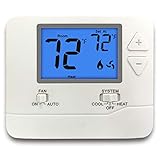
At 4.6 stars with 78 percent five-star ratings, this is the highest-rated product in the roundup, and for a non-programmable unit that is a meaningful signal. Nothing about it is clever. It is a single-stage, 1 heat and 1 cool digital thermostat with big buttons, and that simplicity is exactly what many replacements need.
It is dual powered by 24 volts AC or two AAA batteries with no C wire required, it is configurable as electric or gas and oil through a jumper, and it works with single-stage heating, cooling and heat pump systems without auxiliary heat. Reviewers note that it drives the system in roughly two seconds with no programming step at all.
Owners and installers praise the readability, the silent switching and the labeled terminals. Switch the system on and the large characters are readable from across a room, and the backlight wakes on any button press, which solves the complaint we hear most about budget units where you must hold a button combination to see anything.
Separate heating and cooling swing settings and a five-minute compressor delay protect the equipment. It weighs 222 grams and measures 4.72 by 3.86 inches on the face.
Why a basic thermostat is sometimes the right answer
If your existing system is single-stage with no C wire and you want a reliable, readable replacement, this does the job and nothing else. Older users benefit most from the oversized characters and large separate buttons. The silent operation also means no relay click in a quiet house at night.
It is a sensible choice for a rental or a spare bedroom where nobody needs schedules or an app.
Where the trade-offs show
Batteries are not included, which is an annoying surprise on day one. The manual does not explain calibration or swing settings, so you will be looking up how to adjust them.
Some owners report units failing after a little over a year, so if you want long service you may prefer the two-year or five-year warranty options elsewhere on this list. It also will not run 120-240V line-voltage heat, multi-stage systems, mini splits, heat pumps with auxiliary heat or 12V RV systems.
9. Suuwer S701 Non-Programmable Thermostat – Best for Forced-Air Furnaces
Suuwer Non-Programmable Thermostats for Home 1 Heat/1 Cool Conventional Single-Stage Systems (Blue Backlight)
Non-programmable, single stage 1 heat 1 cool
Dual power with no C wire needed
Blue backlit 4.5 inch LCD
2 year warranty
Pros
- Drops into the same screw holes as most existing thermostats so installs take about 15 minutes
- Large blue backlit display is easy to read for older users
- Runs for months on two AAA batteries with an accessible battery compartment
- Separate heat and cool controls with no programming to reset
- Remembers separate set temperatures for heating and cooling
- Jumper wire included in the box
Cons
- A gas or electric selector switch on the back plate must be set correctly or the furnace will not fire
- Some units read a couple of degrees high and need calibration
- Limited to single-stage 1 heat and 1 cool conventional systems
For a home with a conventional gas, oil or electric forced-air furnace, this is the most predictable upgrade off an old dial. It sits in the same screw holes as most existing thermostats, uses the same wall footprint, and installs in about 15 minutes according to owner reports. Reviewers rate it 4.5 stars with 76 percent five-star.
It is dual powered by 24 volts AC or two AAA batteries with no C wire needed on most systems, which means it works on the four-wire walls that disqualify half the smart units on this list. The four-and-a-half inch blue backlit display is the selling point for older users.
You also get separate heating and cooling swing configurable from 0.2 to 2 degrees, a selectable five-minute compressor delay to protect the outdoor unit, a low battery indicator and calibration within plus or minus one degree. The box includes the thermostat, an installation manual and mounting screws, plus a jumper wire.
It remembers separate set temperatures when you switch between heating and cooling, which removes one of the most annoying daily annoyances of a manual dial.
Best suited to conventional forced air
The manufacturer is specific about what this is for: conventional single-stage heating on gas, oil or electric furnaces, along with central air, up to one heat and one cool. If that describes your equipment, the fit is essentially perfect and the install is trivial.
Buyers report months of battery life and an accessible battery compartment, which matters more than it sounds when the batteries sit behind a wall plate. It carries a two-year warranty.
Where it will not work
Read the exclusion list carefully. It does not work with multistage systems, HVAC heat pump systems, PTACs, three-wire hydronic, dual fuel or hybrid, line voltage 120-240V electric baseboards, mini splits or RV air conditioners. If your outdoor unit runs in winter, this is the wrong unit.
The single most common complaint is the gas and electric selector switch on the back plate. Set it wrong and the furnace will not fire, and the manual does not make this prominent. A few owners also report readings a couple of degrees high, which the calibration adjustment corrects.
10. White-Rodgers 1E78-140 – Best for Heat-Only and Millivolt Systems
White-Rodgers 70 Series Classic, Non-Programmable, Thermostat, 1E78-140
Non-programmable, heat only, 1 degree precision
Works on 24V and millivolt heating systems
Five year limited warranty
Three AAA batteries included
Pros
- Still in production with a five year limited warranty the longest here
- Works on two-wire millivolt systems such as hydronic oil boilers
- gas fireplaces and RV furnaces
- Installs in about five minutes with two wires
- Large readable display with a backlight
- Solid-state switching replaces the sticky contacts in old analog thermostats
Cons
- Heat only and not suitable for systems with air conditioning
- Backlight is off by default and needs a hidden button sequence
- Switching to Celsius requires cutting a board jumper that is not reversible
- Terse printed instructions and a terminal block with more screw positions than a basic install needs
Some homes have heating systems that almost nothing modern supports. Millivolt systems are the classic example: gas fireplaces, hydronic oil boilers and RV furnaces that generate their own signal and only need two wires. If that is your home, this unit works and most smart thermostats do not.
It is a still-in-production model from the 70 Series, non-programmable, heat only, with plus or minus one degree precision and one-degree accuracy. Three AAA batteries are included, which almost nobody does at this level. The five-year limited warranty is the longest in this roundup.
Owners highlight accuracy and the roughly five-minute two-wire install. Solid-state switching replaces the bimetal contacts in old analog units, which is the actual fix for a furnace that fires constantly without being asked. Reported temperature hold is within about one degree.
The display is large and readable, with a backlight that can be enabled through a button sequence. Board jumpers configure hydronic mode and Celsius display.
The niche it fills perfectly
RV and manufactured homes, gas fireplaces and hydronic oil boilers are exactly where this unit belongs, and where digital thermostats usually fail outright. If your two-wire system is millivolt, this is the shortest fix available.
It is also a sensible choice as a heat-only add-on to a zone, where cooling control is handled elsewhere.
Where the compromises bite
Heat only means this cannot replace a thermostat on a system with air conditioning. That rules it out for most whole-home replacements, which is why it sits at the end of this roundup.
The backlight is off by default and requires a hidden button sequence, which catches people out. Converting to Celsius means cutting a jumper on the circuit board, and that change cannot be reversed. One owner reported the up and down buttons stopping working after two years, so factor the long warranty accordingly.
How to Choose a Replacement Thermostat
Start with the type ladder. Non-programmable units hold one setpoint and do nothing else. They cost the least, never fail due to a dead router, and are the right call for heat-only rooms, rentals and anyone who will not use a schedule. Programmable units add a weekly schedule on the thermostat itself, usually with a learning feature that reduces overshoot, and they are the biggest real energy saving available without new equipment. Smart Wi-Fi units add remote access, geofencing, occupancy sensing, energy reports and voice control on top of scheduling.
That last step is where the honest math starts. ENERGY STAR puts average annual savings around 90 dollars for a certified thermostat, and manufacturers claim figures near 23 percent for scheduling features. Those numbers assume you actually use the schedule. A smart thermostat nobody programs is a thermostat that runs a constant setpoint, which is roughly what the dial you replaced was already doing. The upgrade is scheduling; the app is a convenience.
C-wire paths. You have three options when a unit needs a common wire and you do not have one. First, choose a C-wire-free model, which is what the Sensi ST55, the Nest, the Honeywell T5, the Suuwer and the ELECTECK are for. Second, use a manufacturer power adapter, sold separately, which taps power off the existing wiring; the ecobee Power Extender and the Honeywell C-wire adapter are the examples here. Reviewers report mixed results with adapters, since some firmware versions throw a C-wire not detected error even when the adapter works, and an adapter is not the same as a real wire. Third, run an actual wire. That is a technician job in most homes because the wire has to go back to the furnace and through the wall cavity safely.
Heat pumps and staging. If you have a heat pump, buy a thermostat rated for heat pumps, ideally one that stages auxiliary heat. A mismatch here is the leading cause of short cycling, where the compressor starts and stops rapidly and wears itself out. Multiple owners who swapped thermostats and blamed the new unit traced the problem back to an auxiliary heat staging mismatch. The Honeywell T5 is the pick here that explicitly covers multistage systems and heat pumps with or without auxiliary heat, along with millivolt and steam systems.
Sensors and multiple rooms. A thermostat measures the room it sits in. If your hallway reads fine but the bedroom is cold, more powerful equipment will not fix it. Options in ascending cost are repositioning the thermostat, adding a remote sensor such as the ecobee SmartSensor, and finally a properly designed zoned system.
Placement. Put it on an interior wall roughly five feet up, in a central living space, where you walk. Do not place it next to a return air vent, because the moving air skews the reading, and keep it away from direct sun, a fireplace, a kitchen or a drafty exterior wall. Avoid exterior walls unless there is no alternative. If you relocate it, mark the new location first so you do not drill into a wire.
DIY or technician. Swapping a thermostat onto existing wires usually takes 15 to 30 minutes and needs basic tools. Run the breaker, photograph every wire before touching one, label each wire as it comes off, match labels to the new terminal block, then restore power. If you need a new C wire, the wire has to reach the furnace, so call an HVAC technician or electrician. Verify any local permit rules before you start, and if the old thermostat is a mercury dial, dispose of it properly rather than putting it in household trash.
Rebates and certification. Check whether your utility runs a thermostat rebate program before you buy; many offer rebates for ENERGY STAR certified models, and several will send a list by email or mail. The Amazon Smart Thermostat listing notes that rebates may be available from providers in your area, and Honeywell’s product pages point you to your energy provider. Rebates are typically conditioned on the model being on an approved list, so check before purchase rather than after.
One more question worth answering: do you need to replace the thermostat when you replace the furnace or AC unit? Often you do, because the replacement equipment may change staging, control voltage or terminal layout. If the new unit is the same model and the wiring is unchanged, a compatible replacement thermostat is still a reasonable refresh, but confirm the staging with whoever installed the equipment.
Frequently Asked Questions
Can I replace my old thermostat with any thermostat?
No. A replacement thermostat must match your system on three points: the number and type of wires at the wall, whether a C-wire power line is present, and your HVAC staging, which includes single-stage versus dual-stage and whether you have a heat pump with auxiliary heat. A mechanical dial on a single-stage gas furnace gives you far more choice than an eight-wire heat pump system. Always check the compatibility list on the new unit before buying.
Do all smart thermostats need a C wire?
No. Several smart thermostats are designed to run without a C wire by powering from the existing 24-volt circuit and accepting a slower battery drain. Others require a C wire and will offer a manufacturer power adapter as an alternative. Note that heating-only, cooling-only, zone-controlled and heat pump systems often need the wire regardless of the model, so read the specific system notes, not just the headline claim.
My thermostat is missing a C-wire. What should I do?
You have three paths. Pick a model rated to work without a C wire, such as the Sensi ST55, Google Nest, Honeywell T5, Suuwer S701 or ELECTECK. Or buy a manufacturer power adapter such as the ecobee Power Extender Kit, which draws power from the existing wiring, though some firmware reports errors and it is not a true common wire. Or run an actual wire back to the furnace, which is a technician job.
How much does it cost to install a C-wire for a thermostat?
A C-wire adapter costs a small fraction of the thermostat itself and installs in minutes. Running a new wire from the furnace to the thermostat location requires opening the wall cavity and working near line-voltage equipment, so most homeowners hire an HVAC technician or electrician, and costs commonly land in the low hundreds for a straightforward run and considerably more if the route is long or finished walls get cut. Check local rates before booking.
How do I know which thermostat to buy for my house?
Start by turning off the breaker and removing the old faceplate, then count the wires behind it. Two wires means a battery non-programmable or hardwired programmable model. Four or five wires fits most conventional systems, including many C-wire-free smart units. Eight wires usually means heat pump staging with auxiliary heat, so choose a heat-pump-rated programmable. Finally confirm the system is 24-volt low voltage and not 120-240V baseboard heat.
What’s the average lifespan of a thermostat?
Mechanical and mercury dial thermostats often last decades, since they have almost nothing to fail. Electronic and smart thermostats typically have a service life of roughly a decade, with practical replacement often driven by dead buttons, a blank display, Wi-Fi hardware that is no longer supported, or a change in your HVAC equipment. If you are replacing a furnace or AC unit, treat the thermostat as part of that job.
How much does it cost to replace an old thermostat, and is it hard?
Swapping a thermostat onto existing wires is a straightforward job that most people finish in 15 to 30 minutes with a screwdriver and wire labels. The difficult case is a missing C wire, because the new wire must run back to the furnace, or an older system where the wall plate does not match the new mounting pattern and the opening needs patching. If you are uncomfortable with 24-volt wiring, a technician visit is the sensible call.
If you want the full field of options rather than just the compatible ones, our roundup of the best smart thermostats for homes tested and ranked covers the connected side in more depth.
Which Replacement Thermostat Should You Buy?
For most homes, the Sensi ST55 is the best replacement thermostat you can buy in 2026 because it clears the compatibility question instead of creating it: it usually skips the C wire, uses physical buttons that survive a dead router, and carries a three-year warranty across the widest range of legacy systems. The Google Nest Thermostat is the value pick, learning your routine and reporting on energy use without demanding a common wire in conventional systems, while the Sensi Touch ST75 wins on hardware quality and screen lock if you already have the wiring for it.
Match the rest by situation. The Honeywell T5 is the safest bet for an old house with two wires or a millivolt fireplace. The Amazon Smart Thermostat fits an Alexa household that has a C wire. The ecobee Smart Thermostat Essential is the one to buy if you want room sensors and the best app, and the Honeywell RTH9600WF if you want color on the wall. For a straight swap on a forced-air furnace, the ELECTECK and Suuwer S701 both install in minutes with no C wire, and the White-Rodgers 1E78-140 is the answer for heat-only and millivolt systems.
Before you order any of them, open the wall plate and count the wires. That single check, plus knowing whether you have a heat pump, decides nine out of ten replacements correctly. If you still need help narrowing the field for an older property, our guide to the best thermostats for older homes works through the legacy wiring cases in more depth, while our picks for thermostats built around energy saving go deeper on scheduling and usage reports.