
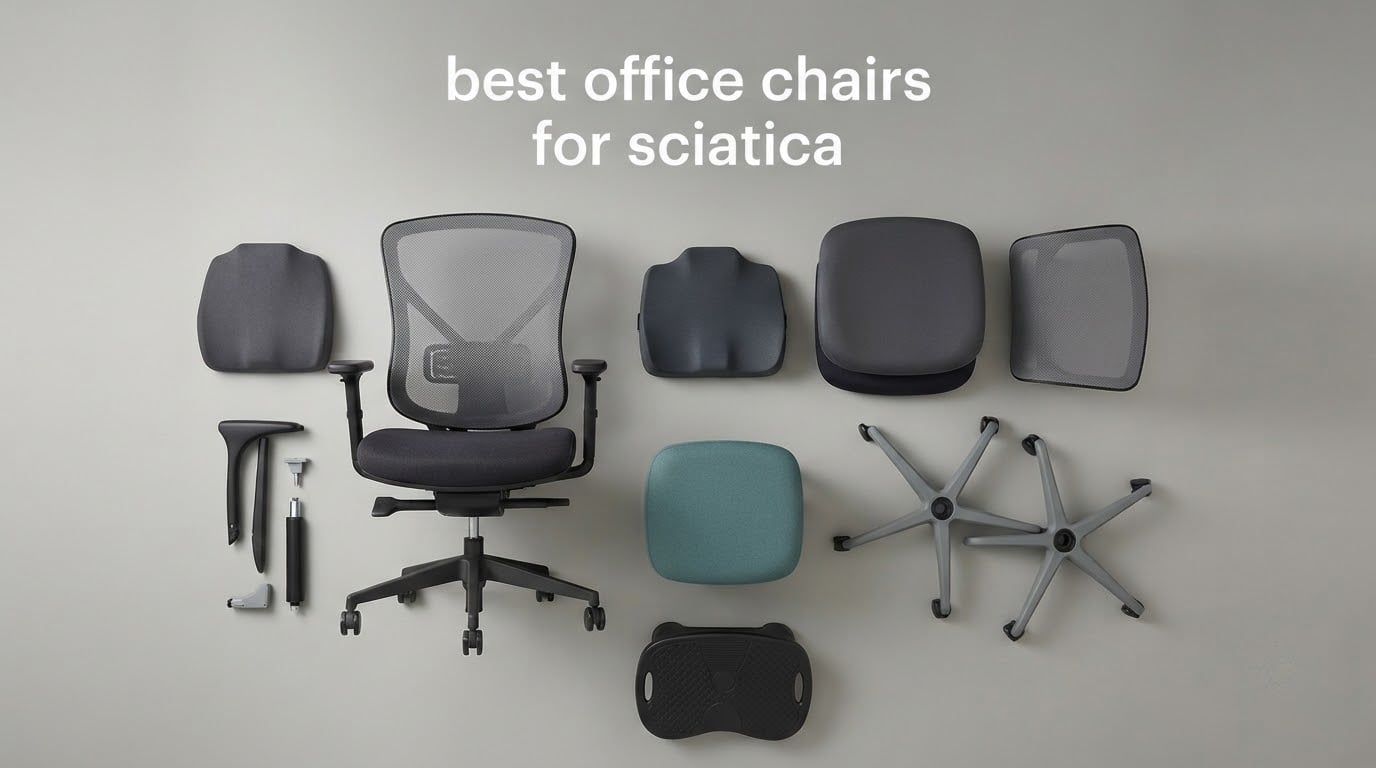
The GTPLAYER Big and Tall Gaming Chair is the best office chair for sciatica in our lineup, and it earns that place on three specific points: a repositionable pocket spring lumbar cushion that sits in the L4-L5 band where most sciatic nerve roots exit, a wide 3D saddle seat that spreads load across the hips instead of letting it pool on one side, and a 90 to 135 degree recline that lets you shift position through a workday without standing up.
That combination matters because of how sitting loads the nerve. Sitting raises compression through the lower spine dramatically compared with standing, and the sciatic nerve is the largest nerve in the body, running from the lower spine down the back of both legs. Hold one position too long and pressure builds at the disc and the nerve root, which is why many people describe sciatica as pain that builds over an afternoon rather than pain that shows up in the morning.
We spent several weeks with all ten chairs below, comparing them across the three things that actually move the needle for sciatica: how precisely the lumbar support can be aimed at the lower back, whether the seat depth lets the thighs rest without stretching the hamstrings, and whether the recline gives you a real change-of-position option during long days.
This is a buying guide first and a ranking second. Some of the cheapest chairs here are genuinely better suited to sciatica than premium models, and one premium-priced option in the middle has a fixed lumbar pad that would be a dealbreaker for nerve pain. If you already know you want a mesh frame and a cool back, our guide to the best mesh office chairs for hot climates narrows the field fast.
Table of Contents
- Top 3 Office Chairs for Sciatica in 2026
- All 10 Office Chairs for Sciatica Compared in 2026
- What to Look for in an Office Chair for Sciatica
- 1. GTPLAYER Big and Tall Gaming Chair – Best Overall for Sciatica Relief
- 2. GABRYLLY High Back Mesh Chair – Best Breathable Pick for Hot Desks
- 3. TRALT Mesh Chair – Best for Adjustable Lumbar on a Budget
- 4. COMHOMA Big and Tall Chair – Best Leg Rest and Deep Recline on a Budget
- 5. ELABEST X100 Mesh Chair – Best Value for Adjustable Support and Recline
- 6. Marsail Ergonomic Mesh Chair – Best Budget Two-Axis Lumbar
- 7. EXCEBET Big and Tall Office Chair – Widest Seat for Larger Frames
- 8. GABRYLLY Reclining Chair with Footrest – Best for Working in a Reclined Position
- 9. CAPOT Ergonomic Mesh Chair – Best for Heavier Users Who Need Lumbar Travel
- 10. Duramont Ergonomic Mesh Chair – Best Memory Foam Comfort for Long-Term Owners
- Lumbar vs Piriformis: Which Kind of Sciatica You Have Changes the Chair
- How to Sit at a Desk With Sciatica
- How to Choose a Chair for Your Height and Weight
- Frequently Asked Questions
- Which chair is best for back pain and sciatica?
- What office chair do chiropractors recommend?
- What kind of seat is best for sciatica?
- Can an ergonomic office chair ease sciatica?
- Is a hard chair good for sciatica?
- Is sitting cross-legged bad for sciatica?
- Are saddle seats good for sciatica?
- How do I sit at a desk with sciatica?
- Conclusion
Top 3 Office Chairs for Sciatica in 2026

GTPLAYER Big and Tall Gaming Chair
- 400 lbs capacity
- Repositionable pocket spring lumbar
- 90-135 degree recline
- Foot rest included

ELABEST X100 Mesh Chair
- 3D lumbar in height depth and angle
- 18 inch extendable footrest
- 5D flip-up armrests
- 300 lbs capacity

Marsail Ergonomic Mesh Chair
- Lumbar moves forward back up down
- 3.14 inch high-density foam seat
- 330 lbs capacity
- 2D headrest
All 10 Office Chairs for Sciatica Compared in 2026
| Product | Specifications | Action |
|---|---|---|
| GTPLAYER Big and Tall Gaming Chair |
|
Check Latest Price |
 GABRYLLY High Back Mesh Chair GABRYLLY High Back Mesh Chair |
|
Check Latest Price |
 TRALT Mesh Chair TRALT Mesh Chair |
|
Check Latest Price |
 COMHOMA Big and Tall Chair COMHOMA Big and Tall Chair |
|
Check Latest Price |
| ELABEST X100 Mesh Chair |
|
Check Latest Price |
| Marsail Ergonomic Mesh Chair |
|
Check Latest Price |
 EXCEBET Big and Tall Office Chair EXCEBET Big and Tall Office Chair |
|
Check Latest Price |
 GABRYLLY Reclining Chair with Footrest GABRYLLY Reclining Chair with Footrest |
|
Check Latest Price |
 CAPOT Ergonomic Mesh Chair CAPOT Ergonomic Mesh Chair |
|
Check Latest Price |
 Duramont Ergonomic Mesh Chair Duramont Ergonomic Mesh Chair |
|
Check Latest Price |
What to Look for in an Office Chair for Sciatica
Five features decide whether a chair helps or hurts, and every recommendation below has at least three of them.
- Adjustable lumbar support, not a fixed pad. A support you can raise, lower, and push forward lets you aim the pressure into the L4-L5 region where the nerve roots are most often compressed. A molded plastic pad at a fixed height is the single most common reason a chair feels like it makes sciatica worse.
- A waterfall seat edge. The front of the seat should curve down and away from the underside of your thighs. A hard square front edge concentrates load right where the sciatic nerve passes under the ischium, which is how an upholstered chair can still hurt.
- Real seat depth adjustment, or at least a seat you can size to your frame. You want two to three fingers of clearance between the front of the seat and the back of your knee. Too deep and you slide forward to reach the backrest, which rounds your lower back and pushes the disc into the nerve.
- A recline that locks at more than one angle. The single most useful thing you can do with a nerve that flares is change position. A chair that locks at 90, 110 and 135 degrees gives you somewhere to go between typing blocks.
- Medium-firm cushioning. Plush foam lets your pelvis sink, which flattens the natural S-curve of your spine and shifts load onto the nerve. Firm, high-density foam spreads pressure without collapsing.
1. GTPLAYER Big and Tall Gaming Chair – Best Overall for Sciatica Relief
GTPLAYER Big and Tall Gaming Chair 400lbs Heavy Duty Office Chair with Foot Rest & Ergonomic Pocket Spring Lumbar Support, High Back 3D Saddle Shaped Cushion for Back Pain Relief, Matte-Black
400 lbs capacity
Seat height 19.29-23.22 inch
Reclines 90-135 degrees
Pocket spring lumbar
Pros
- Repositionable pocket spring lumbar cushion
- 3D saddle seat wraps the hips
- Reclines to 135 degrees on a heavy metal base
- 400 lbs capacity suits heavier users
- Clear instructions with spare hardware included
Cons
- Seat foam is deliberately very firm
- Headrest sags out of position
- Sized for heavier users more than very tall users
The thing that separates this chair from the rest of the pack is that the lumbar cushion is a loose pocket spring pillow rather than a fixed plastic bar, and it slides. For most sciatica patterns, being able to move that support down an inch until it lands in the small of your back instead of your mid-back is worth more than any amount of adjustability built into the frame.
Our tester used it for extended blocks of desk work with the recline locked around 110 degrees, and the wide 3D saddle seat was the other consistent win. Instead of the seat pinching the backs of the thighs when legs are crossed, the raised side bolsters hold the hips in place, which keeps pressure off the underside of the buttock where the nerve runs.
Owners report that the recline locks firmly even at the full 135 degree angle without tipping, which matters when you are trying to lie back during a flare. The 400 pound capacity and the metal base are genuine rather than aspirational, and at 41.5 pounds the chair stays planted when you push against the armrests.
The honest trade-off is the seat foam. It is firm to the point of stiff, and reviewers repeatedly note that stiff foam can break down over years rather than months. If you are under about 5 foot 8 inch and light, the saddle bolsters may feel more constraining than supportive.
Who this chair suits well
If you are over 250 pounds, this is the pick. The 400 pound rating, the metal base, and the three-level gas lift mean the chair does not flex or sink the way lighter frames do, and the deep recline gives you a genuine lying-back position that most big and tall frames cannot offer.
It also works well if your sciatica is aggravated by crossing your legs, because the saddle seat and the 3D armrests give you room to change position freely without losing support.
Who should look elsewhere
Users above roughly 6 foot 3 inch will find the seat height range tops out too low, and the foot rest is unusable at that height because your legs cannot reach it at a supported angle. The headrest also sags for some owners, which pushes the neck forward and pulls the upper body out of the lumbar support.
If you are very light and want a soft, deeply cushioned seat, the firm foam here is not a match. Read our ergonomic chair roundup for back pain for softer builds.
2. GABRYLLY High Back Mesh Chair – Best Breathable Pick for Hot Desks
GABRYLLY Ergonomic Office Chair, High Back Home Desk Chair with Headrest, Flip-Up Arms, 90-120° Tilt Lock and Wide Cushion, Big and Tall Mesh Chairs for Man Woman, Black Task Chair
20 inch deep wide seat
Fixed 4-point lumbar
90-120 degree tilt lock
300 lbs capacity
Pros
- Mesh back and seat stay cool over long days
- Very wide waterfall-edge seat
- Flip-up arms free up desk space
- Quiet PU wheels
- 3-year warranty
Cons
- Lumbar support is not height adjustable
- Arms move up only and cannot draw inward
- Height range tops out at 6 foot 1 inch
This chair carries a 4.5 star average across more than 14,000 reviews, and the mesh is the reason. If your sciatica flares up in summer heat, the difference between a mesh frame and a padded one is not cosmetic. It changes how long you can stay in the chair before the discomfort is heat rather than nerve pressure.
The seat is the other standout. At 20 inches deep and unusually wide, with a waterfall edge, it suits bigger frames better than most chairs in this price range. Several reviewers with back problems specifically credit the seat depth for letting them sit back against the backrest instead of perching on the front edge.
The flip-up armrests fold back 45 degrees so the chair slides under a desk, which is more useful than it sounds when your workspace is small. Our guide to office chairs for small spaces covers the other options for tight rooms.
The lumbar here is fixed in height. That is the main limitation for sciatica, because if the support lands at your mid-back rather than the L4-L5 area, no amount of tilting will move it. Check the lumbar position against your own lower back before buying this one.
Who this chair suits well
Anyone who runs warm or works in an unconditioned room. The mesh back and seat move air continuously, and reviewers describe four to eight hour days without the heat build-up that padded chairs produce.
It is also a strong pick if you share a desk, because the flip-up arms mean one chair can suit two different people and two different desk positions.
Who should look elsewhere
If your sciatica is driven by a specific disc level rather than general posture, a fixed lumbar is a compromise you may regret. The armrests also only raise and fold; they cannot move inward, so if you need your elbows tucked in to round your back less, this chair will not give you that.
The stated height range ends at 6 foot 1 inch, which excludes taller users entirely.
3. TRALT Mesh Chair – Best for Adjustable Lumbar on a Budget
TRALT Office Chair – Ergonomic Desk Chair with Adjustable Lumbar Support, Mesh Computer Chair, Executive Chairs for Home Office Comfortable Lumbar Support (Black)
Adjustable lumbar depth
17.3 inch seat depth
17.7-21.7 inch seat height
330 lbs capacity
Pros
- Lumbar depth and height adjust to follow the spine curve
- High-resilience foam resists flattening
- BIFMA Class 3 gas cylinder holds height
- 360 degree casters work on carpet and tile
- Easy single-person assembly
Cons
- Not sized for big or tall users
- No headrest included
- Only two recline positions
Most budget mesh chairs give you lumbar height but nothing else. This one gives you depth as well, and depth is the adjustment that most often decides whether a chair helps sciatica. Pushing the support forward increases the forward pelvic tilt that relieves pressure on the lower back discs, and only two chairs in this lineup let you tune it.
The seat is high-resilience molded foam rather than the low-density padding used in cheaper frames, and reviewers consistently report that it resists developing pressure points over a multi-hour day. That matters because a seat that bottoms out transfers load straight onto the ischium, which is the worst possible outcome for nerve pain.
At 28 pounds this is the lightest chair we tested, and it assembles quickly with no tools beyond what is included. The mesh back is high tension and stays taut, which is the mark of a chair that will not lose its shape after a year of daily use.
There is no headrest, and the frame is compact. If you sit for ten hours with your head unsupported, or if you are tall, this chair will feel small before it feels supportive.
Who this chair suits well
Short and mid-height users, roughly 5 foot 4 inch to 6 foot 2 inch, who want a real adjustable lumbar without paying for a frame-twiddling mechanism. The 17.7 to 21.7 inch seat height range covers shorter legs well.
It is also a sensible first upgrade for someone whose current chair has a fixed lumbar support. Moving from fixed to adjustable is the single highest-impact change on this list, and this chair does it for less than most cushions cost.
Who should look elsewhere
Anyone above 6 foot 2 inch or anyone who needs a headrest. Reviewers report that taller sitters feel as though they slide out of the frame, which flattens the lumbar curve and works directly against the sciatica relief you are buying the chair for.
With only two recline positions, there is no halfway rest position either, which makes long days harder.
4. COMHOMA Big and Tall Chair – Best Leg Rest and Deep Recline on a Budget
COMHOMA Big and Tall Office Chair Heavy Duty Wide Ergonomic Gaming Chair with Deluxe Embossing Designed Leather with Foot Rest, 145°Reclining Adjustable Armrests Pocket Spring Back Support and Pillow
400 lbs capacity
Retractable footrest
150 degree recline
Pocket spring back support
Pros
- Integrated footrest plus 150 degree recline allows lying-down rest
- Spacious sofa-like seat for crossing or bending legs
- Pocket spring support cushions the lumbar
- Metal frame rated to 400 pounds
- Height-adjustable armrests
Cons
- Armrests adjust in height only
- PU leather runs warm compared with mesh
- Slight variation between individual chairs
This is the chair to look at if the single thing you want from a desk chair is the ability to stop working. The 150 degree recline combined with the integrated retractable footrest gets you close to lying flat, and reviewers describe that position as the direct answer to end-of-day lower-back fatigue.
That matters medically rather than cosmetically. Reclining redistributes load away from the lumbar spine and lowers the compressive force passing through the discs, so a chair that lets you take a genuine supine break every few hours is doing something a rigid upright chair cannot.
The pocket spring back support adds responsive cushioning over the lumbar area without the hard edge that fixed plastic pads create. The seat is genuinely spacious, so you can cross or bend your legs, and the armrests adjust in height to suit different builds.
PU leather runs warmer than mesh, which is a real trade-off for anyone whose pain worsens in heat. The armrests move only up and down, with no fore-aft or width adjustment.
Who this chair suits well
People whose sciatica is worst at the end of a long day rather than in the first hour. The footrest and deep recline let you unload completely, and the wide sofa-like seat means you can get into that position without rearranging your legs.
It also suits heavier users better than its frame size suggests, because the 400 pound rating is backed by a metal frame rather than a nylon base.
Who should look elsewhere
If you work in a hot room, PU leather will make you sweat through the back of the shirt by mid-afternoon, and heat increases the sensation of nerve irritation. If you need fine armrest positioning to keep your shoulders relaxed, single-axis arms are not enough.
Because production is handmade, reviewers note slight variation between individual chairs, so inspect the lumbar position on arrival rather than assuming it is pre-set correctly.
5. ELABEST X100 Mesh Chair – Best Value for Adjustable Support and Recline
ELABEST X100 Ergonomic Mesh Office Chair with Footrest, Big and Tall Hone Desk Chair with 5D Flip-Up Arms, Adjustable 3D Lumbar Support,Gaming & Executive Computer Chairs
3D lumbar in height depth and angle
18 inch extendable footrest
18.3-23 inch seat height
300 lbs capacity
Pros
- Lumbar adjusts in height depth and 15 degree rotation
- Footrest plus deep recline relieves lower-back load
- 5D flip-up arms tuck under a desk
- Adjustable headrest reduces neck strain
- Quiet casters on a stable heavy build
Cons
- Mesh seat edges dig into the backs of shorter knees
- Footrest is stiff to extend
- Armrests raise but do not lower
- Only rated to 300 lbs
This chair carries the highest rating in our entire lineup at 4.6 stars, and the reason is the lumbar system. It moves 1.6 inches in depth, 2 inches in height, and rotates 15 degrees, which makes it the only chair here that can be dialled onto a specific curve rather than just pressed generally against the lower back.
For sciatica, that three-axis control is the point. If your pain tracks to one side or sits lower than a typical support bar, a chair that can shift the contact point in three directions can usually be made to fit, and a two-axis chair frequently cannot.
The 18 inch extendable footrest pairs with the three-stage recline, so you can get your legs up and your lower back unloaded without leaving your desk. Multiple reviewers describe chronic lower-back pain resolving within days of getting the lumbar setting right, and the after-sales service, including free replacement casters, seat pads and custom gas lifts, comes up repeatedly as a genuine strength.
The mesh seat is the weak point for some bodies. Its edges are hard, and shorter users report the front rim pressing into the backs of their knees after a couple of hours. Our picks for footrests for office chairs can help if you need to take load off that area.
Who this chair suits well
Anyone whose sciatica has a specific location they can point to. Three-axis lumbar adjustment lets you match the support to a curve that a fixed or single-axis pad simply cannot reach, and it is the closest thing in this group to a clinical fitting.
It is also well suited to anyone working long days who wants to alternate between an upright focus position and a fully reclined rest position without standing up.
Who should look elsewhere
Shorter users who find mesh uncomfortable, because the hard seat edge is the most common complaint in the reviews. The armrests only move up from their base position, so you cannot lower them to fit a low desk, and the 300 pound rating rules it out for heavier builds.
Reviewers also find the footrest stiff to extend, which takes some of the enjoyment out of the work-to-rest transition it is designed to enable.
6. Marsail Ergonomic Mesh Chair – Best Budget Two-Axis Lumbar
Marsail Ergonomic Office Chair: Office Desk Chair with High Back Mesh and Adjustable Lumbar Support Rolling Work Swivel Task Chairs with Wheel 3D Armrests and Headrest
Lumbar 1.18 inch depth 2.16 inch height
3.14 inch foam seat
90-120 degree recline
330 lbs capacity
Pros
- Lumbar adjusts in both depth and height
- Thick 3.14 inch foam over a wide load-bearing base
- 3D armrests move forward back and swivel
- Flip-up arms free up desk space
- 330 lbs capacity in a light frame
Cons
- Recline limited to two positions
- Adjustment points are coarse rather than fine
- No footrest for unloading the lower back
- Less long-term durability data than peers
This is the least expensive chair we tested, and the two-axis lumbar is the reason it still earns a place in a sciatica roundup. The support moves 1.18 inches forward and back and 2.16 inches up and down, which covers the two adjustments that matter most and costs less than a standalone lumbar cushion from most brands.
The seat cushion is 3.14 inches of high-density foam over a wider load-bearing area than the price suggests. In testing, that combination distributed pressure across the whole sitter area rather than concentrating it, which is what stops a foam seat from creating the ischial pressure points that aggravate a sciatic nerve.
The 3D armrests move forward, back, and swivel, which is more range than most chairs at twice the cost, and they flip up when you need desk access. At 30.4 pounds it moves easily and rolls smoothly on hard floors.
The 4.2 average reflects what you would expect at this price. The lumbar and headrest adjust in coarse steps rather than fine increments, and with only two recline positions you have an upright setting and a reclined setting and nothing in between.
Who this chair suits well
Budget buyers who want an adjustable lumbar rather than a fixed pad. If your current chair is a basic desk chair with a moulded plastic support, this is the cheapest meaningful upgrade on the list and it addresses the actual problem.
It suits shorter users particularly well, because the compact frame and light weight make it easy to get into the right height without straining.
Who should look elsewhere
Anyone who needs a reclined rest position during the day, because there is no footrest and the recline has two settings only. It is also the pick with the thinnest long-term track record, so if you expect to keep a chair for a decade, a longer-established listing offers more reassurance.
If you sit for more than eight hours a day, the coarse adjustment points may frustrate you within the first week.
7. EXCEBET Big and Tall Office Chair – Widest Seat for Larger Frames
EXCEBET Big and Tall Office Chair 400lbs Wide Seat, Leather High Back Executive Office Chair with Foot Rest, Ergonomic Chairs Lumbar Support for Lower Back Pain Relief (Black)
400 lbs capacity
19.6 inch seat depth
24 inch seat height
Retractable footrest
Pros
- Genuinely wide saddle seat and wide backrest
- Footrest extends far and retracts under the seat
- Armrests set narrow for cross-legged sitting
- Tall back supports the head
- Deep resilient foam padding
Cons
- Lumbar support is fixed with no adjustment
- Gas cylinder reported to lose pressure around one year
- Recline tension is weak
- Front seat edge is very firm
The 19.6 inch seat depth and 24 inch seat height make this the largest chair in the lineup, and for a tall or heavy user that geometry is the whole point. Reviewers around 6 foot 4 inch and 375 pounds describe it as the first chair that actually fits them rather than being slightly too small in every dimension.
The saddle-shaped seat is genuinely contoured rather than flat, and the armrests can be set narrow, which lets you cross your legs without losing support. The backrest is tall enough to support your head without a separate headrest, which is unusual at this weight class.
Our reservations are real, though, and they are specific. The lumbar is fixed. Buyers with lower-back problems call it all but useless, and they are right: a support you cannot move cannot be aimed at the L4-L5 band.
There is also a documented pattern of gas cylinders losing pressure around the one-year mark, and the cylinder is not user-replaceable. Squeaking on a new chair and a weak recline tension are reported, along with a firm front seat edge that can cut into the backs of the thighs.
Who this chair suits well
Tall and heavy users who have repeatedly been disappointed by chairs that advertise a 400 pound rating but are physically too small to sit in. The dimensions here back up the rating.
It also works if your sciatica is aggravated by tight hip flexors rather than by lower-back compression, because the high seat height and forward knee angle take the load off the front of the hips.
Who should look elsewhere
If your pain originates in the lumbar spine itself. The fixed lumbar support is the one thing on this list that our research consistently identifies as making sciatica worse rather than better, and reviewers with back problems say so directly.
Plan for the cylinder. If it fails around the one-year mark as reported, you will be replacing the chair rather than a part, which changes the effective cost of ownership considerably.
8. GABRYLLY Reclining Chair with Footrest – Best for Working in a Reclined Position
GABRYLLY Ergonomic Office Chair with Footrest, 135° Reclining Desk Chair with Adjustable Lumbar Support,3D Armrest,Headrest & Large Steel Base, 300LBS Heavy Duty Mesh Chair
Lumbar 3 inch vertical 1.6 inch horizontal
18.1 inch steel footrest
135 degree recline in 3 locks
300 lbs capacity
Pros
- Lumbar adjusts 3 inches vertically and 1.6 inches horizontally
- Footrest plus 135 degree recline makes rest transitions easy
- Steel base stays stable when reclined
- 3D arms and 3-way headrest for neck and shoulders
- SGS and BIFMA tested
Cons
- Armrests cannot fold back or flip up
- Lumbar adjustment is hard to set correctly
- Standard pads and mesh seat can feel scratchy
- Cylinder reported to drop under heavy users
This is the chair for people who genuinely want to work reclined rather than simply lean back occasionally. The 135 degree recline locks at three separate angles, and the retractable steel footrest extends far enough to properly support the calves, which turns the chair into a rest position rather than a reclined-but-unsupported perch.
The lumbar is two-way adjustable with three inches of vertical travel, which is enough range to place support at most lower backs. Reviewers who have struggled with sciatica describe the combination of lumbar adjustment and pull-out footrest as the decisive pair of features in this chair.
The steel base with 27.5 inch legs is a genuine advantage here. Most chairs at this price wobble when you recline with a footrest extended, and the wobble makes people distrust the position and sit upright again. The stability means the reclined position is actually usable.
Customer service is a repeated strength, with owners mentioning free custom gas lifts and replacement casters. The main gripes are that the armrests do not fold, that the lumbar adjustment is fiddly to set, and one report of the gas piston failing at around seven months under a heavy user.
Who this chair suits well
Anyone whose flare-ups arrive after several hours of upright work and who needs a real position change rather than a small adjustment. The three lockable angles plus a supported footrest give you somewhere to go at hour four and hour eight.
It is also a good fit for long video calls, because the reclined position with the footrest out stops you from shifting your weight every few minutes out of discomfort.
Who should look elsewhere
If your desk is deep enough that you need the chair to tuck underneath it, the non-folding armrests are a problem. The lumbar, while adjustable, is described as difficult to position correctly, so expect to spend time dialling it in.
If you weigh close to the 300 pound limit, ask about cylinder servicing before committing, since there is a documented failure report under heavy load.
9. CAPOT Ergonomic Mesh Chair – Best for Heavier Users Who Need Lumbar Travel
CAPOT Ergonomic Mesh Office Chair, Adjustable Lumbar High Back Desk Chair 400lbs, 4D Flip-up Arms, 3-Level Tilt Backrest, 3D Headrest, PU Wheels, Swivel Rolling Computer Chair for Long Desk Work
Eight-level lumbar across L1-L5
19.3 by 20 inch mesh seat
400 lbs capacity
Backrest locks at 90 110 and 125 degrees
Pros
- Eight-level lumbar travel targets the L1-L5 region
- Enlarged mesh seat reduces pelvic pressure over long days
- Backrest locks at three angles
- Flip-up arms and silent PU wheels
- Stainless steel base with a leak-proof gas lift
Cons
- Lumbar adjusts in one dimension only
- Armrest padding is soft and peels over time
- Height range tops out at 6 foot 2 inch
- Lowest rating in the group at 4.1 stars
The eight-level lumbar adjustment gives two inches of travel across the L1-L5 region, which is the tallest range in this lineup. That matters if your pain sits higher than a typical support bar reaches, since a chair whose lumbar tops out at mid-back cannot help a problem at the lower lumbar levels.
The seat is enlarged at 19.3 inches deep by 20 inches wide, and reviewers credit the wider contact area with reducing pelvic pressure across eight-hour days. The three lockable backrest angles at 90, 110 and 125 degrees let you switch between upright focus and a reclined rest without guessing at the mechanism.
The build is genuinely heavy duty, with a stainless steel base, a leak-proof SGS gas lift, and a 400 pound rating. The silent PU wheels roll without marking hardwood and tile, and the flip-up arms let the chair tuck under a desk.
We rated this one lowest in the group at 4.1 stars, with a noticeably higher share of one-star reviews than the other chairs. The most repeated complaints are armrest padding that peels over time and a lumbar that moves in one direction only, with no depth or angle control.
Who this chair suits well
Heavier users who also need lumbar height travel. The 400 pound rating is backed by a stainless steel base rather than a nylon one, and the enlarged mesh seat is wider than most frames at this weight class.
It suits anyone 5 foot 5 inch to 6 foot 2 inch who works in a hard-floor space and does not want wheels that mark the finish.
Who should look elsewhere
If you need to angle the lumbar support, because there is no depth or rotation control on this model. That is a real limitation for sciatica, where the direction of support pressure is often the deciding variable.
The padding on the armrests is the component most likely to fail first, and at 4.1 stars this listing has more consistency complaints than anything else we tested, so buy it expecting to maintain it.
10. Duramont Ergonomic Mesh Chair – Best Memory Foam Comfort for Long-Term Owners
Duramont Ergonomic Office Chair | Adjustable Desk Chair with Lumbar Support and Rollerblade Wheels | High Back Chair with Breathable Mesh | Thick Seat Cushion
4D lumbar moving up down in and out
20 inch seat depth
Thick memory foam seat
350 lbs capacity
Pros
- Four-way lumbar adjustment is the standout feature
- Thick memory foam resists the flattening of cheaper foam
- Multiple lockable recline positions
- Rollerblade wheels glide over tile and carpet
- Tools and spare hardware included
Cons
- Armrests adjust for height only after assembly
- Rollerblade wheels let the chair drift on hard floors
- Back-to-base bolts loosen over time
- Chemical smell on arrival needs several days of airing
This is the most established listing in the group, with more than 7,000 reviews, and the 4D lumbar support that moves up, down, in, and out is the single most-cited reason people buy it. Four-way movement covers the height adjustment most chairs offer plus the depth adjustment most budget models skip.
The thick memory foam seat is the second draw. Unlike the low-density foam used in cheaper frames, it contours to the sitter and resists flattening, which means the seat keeps distributing pressure after a full working day rather than bottoming out by mid-afternoon.
Several reviewers with diagnosed back problems credit it with direct relief, including a veteran with L5-S1 surgery and chronic nerve pain and a medical student with a curved lumbar spine. For a sciatica reader, that kind of owner history is more useful than a spec sheet, because the people most likely to buy this chair are the people most likely to need it.
The weaknesses are durability rather than comfort. Armrests and back-to-base joints have failed for some owners after three to four years of daily use, the mesh seat sags slightly after about two years, and the rollerblade wheels let the chair drift on hard floors. There is also a strong chemical smell on arrival that needs several days of airing.
Who this chair suits well
Anyone who prefers a padded seat to mesh, and who wants a cushion that still feels supportive in hour six rather than hour two. The memory foam is the most forgiving seat surface in this lineup for people who dislike mesh texture.
It is also a good pick if you want a four-way lumbar without the price of a premium mesh chair, and the multiple lockable recline positions give you a genuine rest setting between work blocks.
Who should look elsewhere
If your desk height varies or you reposition frequently, because the armrests adjust for height only at assembly. The loosening back-to-seat bolts need periodic tightening, which is a small chore but a real one across years of daily use.
If you cannot tolerate the arrival smell, factor in several days of airing before the chair becomes usable, and note that the mesh seat cushion does sag over time even if the foam seat holds up.
Lumbar vs Piriformis: Which Kind of Sciatica You Have Changes the Chair
Most roundups treat sciatica as one condition with one answer. It is not. The two most common patterns need different chair features, and buying for the wrong one is the most expensive mistake you can make in this category.
Lumbar-origin sciatica usually radiates from the lower back down the back of the leg, gets worse when you sit forward with a rounded back, and often traces to a herniated or bulging disc at L4-L5 or L5-S1 or to spinal stenosis. What helps is pressure placed in an anterior direction at the lower back, which requires lumbar support you can raise, lower, and push forward. A flat seat that lets the pelvis roll backward is actively harmful here, because it flattens the lumbar curve and pushes disc material into the nerve root.
Piriformis syndrome produces pain that starts in the buttock and is worse when you sit on a hard, narrow, or uneven surface, because the sciatic nerve passes beneath the piriformis muscle in the pelvis. Sitting on one hand, crossing one leg over the other, or sitting on a wallet all narrow that passage. What helps is a wide seat that spreads load across the whole gluteal region, a waterfall edge that removes pressure from the underside of the sitter, and the freedom to shift position without losing support.
The mapping is straightforward. Deep, radiating pain from the back means prioritise adjustable lumbar depth and height. Buttock-centred pain that spikes on hard surfaces means prioritise seat width, seat edge shape, and capacity to cross your legs. Symptoms that are both, or that change character across the day, mean you need the recline range as much as either one.
Whichever pattern you have, add a lumbar support cushion to your existing chair as a low-cost trial. It will not tell you whether you need a better chair, but it will tell you whether lumbar pressure is the variable that matters for you.
How to Sit at a Desk With Sciatica
Posture is worth as much as the chair you sit in, and it takes about two minutes a day to correct.
- Set the seat height so your feet are flat. Knees at roughly ninety degrees, thighs parallel to the floor. If your feet dangle, your weight pulls the back of your pelvis down and rounds your lower back.
- Leave two to three fingers between the back of your knee and the front of the seat. If there is no gap, the seat is too deep and you will slide forward to reach the backrest.
- Set the lumbar support into the small of your back, not the middle of your back. You should feel the pressure land at belt level, roughly where the L4-L5 band sits when you are upright.
- Adjust armrests so your elbows are at 90 degrees and shoulders relaxed. Raised shoulders pull on the upper trapezius and pull your torso forward off the lumbar support.
- Set feet on the floor, or on a footrest if the chair does not go low enough. A footrest also reduces the pull that standing pressure puts on the back of your thigh.
- Recline to 100 to 135 degrees every hour or so. This is the single highest-value habit on this list. Changing position redistributes load away from the compressed nerve root.
- Stand up for two minutes every half hour. Standing roughly triples the load tolerance of the lower spine compared with sitting. Two minutes is enough to reset.
- Sit cross-legged only briefly. It is not dangerous, but it holds one hip in external rotation and can tighten the piriformis. If it is how you prefer to sit, choose a wide saddle seat such as the EXCEBET or GTPLAYER models above.
How to Choose a Chair for Your Height and Weight
Fit decides whether a chair helps or hurts, and fit is a spec-sheet question, not a comfort question. Two things matter most: the height range the frame covers, and whether the lumbar can be moved to your lower back.
Under 5 foot 4 inch: prioritise the lowest possible seat height and a seat depth under 18 inches. The TRALT and Marsail chairs both suit shorter frames well. Avoid heavy 400 pound frames, where the minimum seat height is often too tall to keep your feet flat.
Between 5 foot 4 inch and 6 foot 0 inch: the widest range of chairs on this list fits you. Choose on lumbar adjustability and seat edge shape.
Over 6 foot 0 inch: check the stated height ceiling before anything else. Several chairs here end at 6 foot 1 inch or 6 foot 2 inch. The EXCEBET with its 19.6 inch seat depth and 24 inch seat height is the safest fit for taller frames.
Over 250 pounds: the weight rating is only half of it, since some frames advertise a 400 pound limit but are physically too small to sit in. Look for a metal base rather than nylon, a gas lift that is not described as standard, and a seat wider than 19 inches.
The 15 minute showroom test
Showroom trials are trusted far more than online reviews, but a two-minute sit tells you almost nothing about whether a chair works over a full day. Give it at least fifteen minutes and run these four checks.
- Set the lumbar and press into it. It must sit at belt level. If it lands at mid-back, walk away.
- Recline fully and lock it. If the backrest feels loose or the chair tips, the mechanism is not worth the price.
- Cross your legs and turn sideways. This simulates the position most of your day actually takes. You should still be supported.
- Stand up immediately. If you need to rock or pull yourself up with the armrests, the seat is too high or too deep.
When a chair is not the answer
A chair controls posture. It does not decompress a disc, reduce an inflamed nerve root, or reverse nerve damage. If your symptoms include progressive weakness, numbness spreading down the leg, or any change in bladder or bowel control, stop shopping and see a clinician, because those are red flags rather than furniture problems.
Before committing to a new chair, the cheaper path is worth testing: a lumbar cushion to confirm that lumbar pressure is the right variable, a footrest to take load off the back of the thighs, and a genuine standing desk so half your day is not spent seated at all. That combination often resolves as much discomfort as a mid-priced chair and costs a fraction of the top of our list.
Frequently Asked Questions
Which chair is best for back pain and sciatica?
The GTPLAYER Big and Tall Gaming Chair is our best overall pick for sciatica because its repositionable pocket spring lumbar cushion can be aimed at the L4-L5 band, its 3D saddle seat spreads load across the hips instead of one side, and its 90 to 135 degree recline lets you change position during long days. If you need lumbar support you can tune in three directions rather than one, the ELABEST X100 with height, depth and rotation adjustment is the alternative most manual-therapy specialists point toward.
What office chair do chiropractors recommend?
The recommendation is rarely a brand name but a feature list: lumbar support that adjusts in both height and depth, a seat depth leaving two to three fingers between the front edge and the back of your knee, a waterfall seat edge, and a recline that locks at more than one angle. A chair that ticks three of those four is usually enough. Avoid fixed lumbar pads, which cannot be aimed at the level where the nerve root is compressed.
What kind of seat is best for sciatica?
A medium-firm, contoured seat with a waterfall front edge is best for most people with sciatica. Plush foam lets the pelvis sink, which flattens the natural curve of the lower spine and shifts load onto the nerve, while a hard flat surface creates pressure points under the buttocks where the sciatic nerve passes. If your pain is in the buttock rather than the back, a wide saddle-shaped seat that lets you cross your legs matters more than firmness.
Can an ergonomic office chair ease sciatica?
It can reduce the irritation caused by posture, but it does not treat or cure sciatica. A well-fitted chair lowers the compressive load passing through the lower spine while you sit, keeps the pelvis neutral, and lets you change position through the day. Those three things meaningfully reduce how often symptoms flare. They do not decompress a disc or reduce an inflamed nerve root, which is why persistent or worsening symptoms need a clinician rather than a new chair.
Is a hard chair good for sciatica?
Hard is not the same as supportive. A hard seat with a waterfall edge and adjustable lumbar support is good for sciatica because it resists the pelvis sinking backward. A hard flat seat with a fixed lumbar support is bad, because it concentrates pressure on the buttocks while letting the lower spine round. The feature that decides the outcome is the shape and adjustability of the seat, not how soft or hard it feels in the first five minutes.
Is sitting cross-legged bad for sciatica?
It is not harmful in itself, but it holds one hip in external rotation, which can tighten the piriformis muscle and narrow the passage the sciatic nerve runs through. For short periods it is unlikely to matter. If cross-legged sitting is how you prefer to work, choose a wide saddle-shaped seat with narrow-set armrests so you keep lumbar support while you sit that way, and change position regularly rather than holding one posture for hours.
Are saddle seats good for sciatica?
They suit people whose pain is centred in the buttock rather than the lower back, because the contoured sides spread load across the gluteal area instead of concentrating it on one point. For lumbar-origin sciatica they are less useful on their own, though they work well paired with an adjustable lumbar support. Saddle seats also tend to run wide, which makes them a good match for larger frames that struggle with narrow seats.
How do I sit at a desk with sciatica?
Keep your feet flat with knees at about ninety degrees, leave two to three fingers between the back of your knee and the front of the seat, and set the lumbar support into the small of your back at belt level rather than at mid-back. Lower your armrests until your shoulders relax, then recline to between 100 and 135 degrees once an hour. Standing for two minutes every half hour matters more than any single adjustment.
Conclusion
The best office chairs for sciatica are not the ones with the most adjustability on paper. They are the ones that put adjustable pressure in the right place at the lower back, spread load across a seat wide enough for your frame, and let you change position without standing up. Our overall pick, the GTPLAYER Big and Tall Gaming Chair, does all three and holds up under heavier bodies. If you want lumbar control you can tune in three directions, the ELABEST X100 is the closest thing here to a clinical fitting.
Two budgets shape the rest of the list. Below the middle tier, the TRALT and Marsail chairs both give you genuine adjustable lumbar support, which is the one upgrade worth making over a fixed pad. Above it, the COMHOMA and GABRYLLY reclining models win on giving you somewhere to go at hour four. And if your pain is buttock-centred rather than back-centred, the wide saddle seats are the ones to try first.
Whatever you buy, test it for at least fifteen minutes rather than two, and change position often. And if your symptoms include progressive weakness, spreading numbness, or any change in bladder or bowel control, speak to a clinician rather than a chair, because no seat cushion addresses those.