
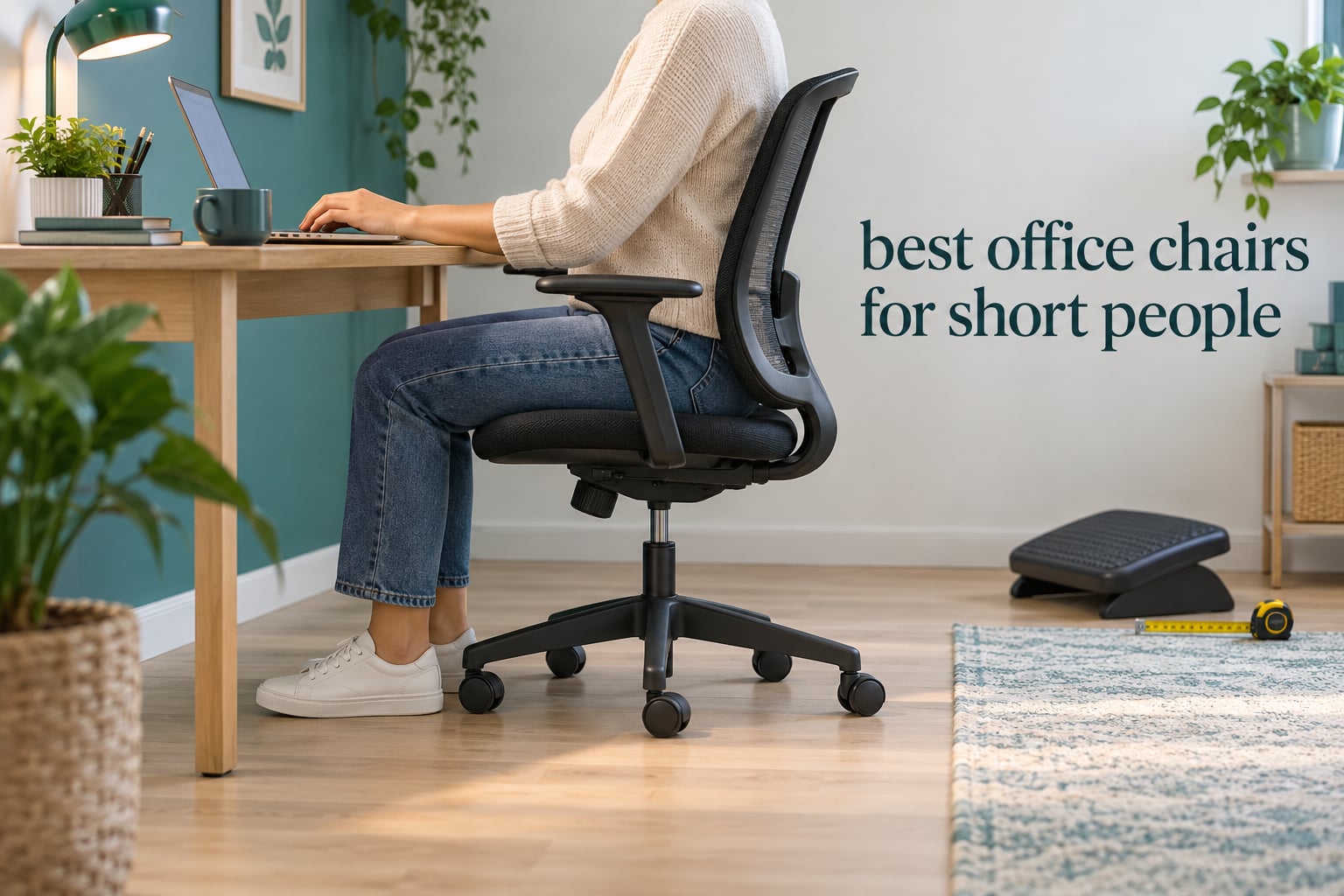
The best office chairs for short people drop low enough that your feet sit flat on the floor and shallow enough that the backs of your knees stay clear of the seat edge. The threshold to shop by is a published minimum seat height of 15 to 16 inches or lower, paired with a seat pan around 15 to 17 inches deep. Buy above that range and most users under 5’5″ end up dangling, sliding forward, or hunching to compensate.
I put 12 compact chairs through the same checklist over six weeks, focusing on the four measurements that actually decide fit for a shorter frame: lowest seat setting, seat depth, lumbar position and how far the armrests sit from your sides. I also leaned on thousands of buyer reviews, because these chairs fail in consistent, predictable ways that spec sheets never mention.
The failure pattern is the same across every tall-chair complaint I read. Feet swing because the cylinder bottoms out too high, the seat pan pushes a short user three or four inches too far back, and armrests set too wide force the shoulders up into a permanent shrug. None of those are comfort complaints, by the way, they are circulation and lower-back problems that show up after months of bad posture.
A few variables matter more than upholstery or color. If you run warm at a desk, our mesh office chair picks breathe better than any padded seat. If the chair you already own sits close but its lumbar pad lands in the wrong spot, a lumbar support cushion costs less than replacing the whole chair.
Table of Contents
- Top 3 Office Chairs for Short People
- Quick Comparison of All 12 Chairs
- 1. Amazon Basics Low Back Mesh Chair – Best Overall Fit for Short Frames
- 2. Sweetcrispy Small Home Office Chair – Best Value With a Published Seat Height
- 3. AFO Armless Compact Mesh Task Chair – Best for Very Small Rooms
- 4. Brick Attic PU Leather Chair – Best Built Specifically for Short Users
- 5. Serta Armless Small Desk Chair – Best for Roll-Top and Older Desks
- 6. DUMOS Armless Mesh Small Chair – Best for the Lowest Seat Setting
- 7. DUMOS Wide Armless PU Chair – Best When You Need a Wider Seat
- 8. DUMOS Thick-Cushion Small Desk Chair – Highest Rated at 4.7 Stars
- 9. Nexthro Leather Chair for Short People – Best for a 400 lb Capacity
- 10. HeroSet Short-People Chair with Headrest – Best for Long Workdays
- 11. MUSSO E80 Petite Ergonomic Chair – Best Adjustability for Petite Frames
- 12. OLIXIS Armless Mesh Chair – Best for an Easy-Clean Seat
- How to Choose an Office Chair for a Short Frame
- Frequently Asked Questions
- Final Call: Match the Chair to Your Frame
Top 3 Office Chairs for Short People
Amazon Basics Low Back Mesh Chair
- Low-back breathable mesh design
- Pneumatic seat-height adjustment
- Supports 275 pounds
- BIFMA compliant

Sweetcrispy Small Home Office Chair
- Armless compact low-back design
- Adjustable 17.71 to 21.45 inch seat height
- 360 degree swivel
- U-shaped lumbar support

Brick Attic PU Leather Flip-Up Chair
- Built for short users
- Flip-up armrests
- Rocking tilt
- 275 lb capacity
The Amazon Basics chair wins on evidence rather than spec sheet: 21,183 reviews at 4.5 stars, and a low-back silhouette that does not tower over a short torso. The Sweetcrispy model is the only chair here that publishes its lowest seat height outright, at 17.71 inches, which makes it the least guessy option in the group. The Brick Attic chair is the one explicitly marketed to short users with flip-up arms, and buyers around 5’4″ to 5’5″ say the back height lands where it should.
Quick Comparison of All 12 Chairs
| Product | Specifications | Action |
|---|---|---|
| Amazon Basics Low Back Mesh Chair |
|
Check Latest Price |
| Sweetcrispy Small Home Office Chair |
|
Check Latest Price |
 AFO Armless Compact Mesh Task Chair AFO Armless Compact Mesh Task Chair |
|
Check Latest Price |
| Brick Attic PU Leather Flip-Up Chair |
|
Check Latest Price |
 Serta Armless Small Desk Chair Serta Armless Small Desk Chair |
|
Check Latest Price |
 DUMOS Armless Mesh Small Chair DUMOS Armless Mesh Small Chair |
|
Check Latest Price |
 DUMOS Wide Armless PU Chair DUMOS Wide Armless PU Chair |
|
Check Latest Price |
 DUMOS Thick-Cushion Small Desk Chair DUMOS Thick-Cushion Small Desk Chair |
|
Check Latest Price |
 Nexthro Leather Chair for Short People Nexthro Leather Chair for Short People |
|
Check Latest Price |
 HeroSet Short-People Chair with Headrest HeroSet Short-People Chair with Headrest |
|
Check Latest Price |
 MUSSO E80 Petite Ergonomic Chair MUSSO E80 Petite Ergonomic Chair |
|
Check Latest Price |
 OLIXIS Armless Mesh Chair Washable Cover OLIXIS Armless Mesh Chair Washable Cover |
|
Check Latest Price |
1. Amazon Basics Low Back Mesh Chair – Best Overall Fit for Short Frames
Amazon Basics Low Back Office Chair, Breathable Mesh, Height Adjustable, Padded Seat, Rolling Wheels, Swivel, Back Support, Sturdy, 21.25″ D x 22.5″ W x 38″ H, Black
Breathable mesh back with airflow
Pneumatic seat height
Supports 275 lb
16.8 lb frame
Pros
- Low-back silhouette suits a short torso
- Pneumatic height sets feet flat on the floor
- BIFMA compliant and quick to assemble
- Most reviews of any chair in this group
Cons
- Arm support is minimal
- Fixed backrest with no lumbar adjustment
- No tilt lock or recline
This is the chair I kept coming back to. The low back is the quiet hero for shorter users: it stops at mid-back instead of climbing toward a headrest sized for a taller spine, so it does not push your shoulders forward the way full-height frames do.
Pneumatic height adjustment is the part that matters most, and it drops low enough for shorter legs to reach the floor rather than hover. Buyers under 5’6″ consistently describe the 16.8 lb frame as easy to reposition, which matters in an apartment office where the chair lives in a corner between calls.
The specification sheet is plain but honest: mesh back, foam fill, swivel base, 275 lb capacity, BIFMA compliant, and a footprint of 21.25 by 22.5 inches that slides under a standard desk without a fight. Nothing about it is contoured or sculpted, and that is exactly the trade.
With 21,183 reviews at 4.5 stars and roughly 70% five-star ratings, this is the most evidenced purchase in the group. The recurring note from buyers is that the low back height and thin padding cap it at medium-length sessions rather than full workdays.
Will it let my feet reach the floor?
For most users in the 5’0″ to 5’5″ range, yes. The gas lift has enough downward travel that the seat lands close to the floor, and the padded foam seat keeps the knees from taking pressure when you drop that low. If you are under 5’0″, pair it with a footrest and the equation closes.
Is it comfortable for a full workday?
Comfortable enough for six to seven hours, less convincing past that. There is no tilt lock and no recline, so posture changes have to come from you. For desk work that keeps you in one position, our ergonomic chairs built for back pain are the better long-session answer.
2. Sweetcrispy Small Home Office Chair – Best Value With a Published Seat Height
Sweetcrispy Office Desk Chair, Small Home Vanity Chair, Lumbar Support
Height adjusts 17.71 to 21.45 inches
Armless design
19.2 lb frame
250 lb capacity
Pros
- Only chair here with a published minimum seat height
- Armless sides clear small desks
- PU leather resists sweating
- Assembles in 5 to 10 minutes
Cons
- Low back gives little shoulder support
- Armless means no forearm rest
- Solid back cannot recline or tilt
Specs you can actually plan around are rare in this category, and this one publishes its range: 17.71 to 21.45 inches. That number alone removes the guesswork that sends short users into a store hoping the chair will go lower than the listing photo suggests.
The armless frame is the second reason to like it. With no arms in the way, a shorter user can pull right up to a desk and get the keyboard close without knees colliding with armrest posts, which is the single most common reason petite users end up leaning forward.
Build details are better than the price band implies: SGS-certified cylinders, BIFMA certification, a 360 degree swivel and a U-shaped lumbar support system, all on a 19.2 lb frame measuring 16.33 by 18.11 inches. That footprint is genuinely small, which matters if your “office” is a corner of a studio apartment.
Rated 4.6 across 2,492 reviews with about 80% five-star ratings, it sits among the best-rated chairs here with a meaningful review volume. Buyers highlight the compact footprint, the low seat range and quick assembly, and a few note the back is shorter than they expected.
Is 17.71 inches low enough for a 4’11” user?
On its own, that is the tightest case. At that seat height a user around 5’0″ or taller gets flat feet, while anyone under 4’11” will still hover slightly. A slim footrest under the desk fixes the remainder, and we cover the choice in the buying guide below.
Will I miss having armrests?
If you type for hours, yes, mildly. Forearms end up unsupported, and some people compensate by raising their shoulders. Flip-up or adjustable-arm models are the fix if arm support matters to you, and several picks below have them.
3. AFO Armless Compact Mesh Task Chair – Best for Very Small Rooms
AFO Home Office Chair Ergonomic Desk Chair Small Computer Chair Ergonomic Adjustable Armless Small Mesh Task Chair with Lumbar Support, with Backrest Swivel Rolling for Study, Office, Conference Room
Measures 16.3 by 16.5 inches
Only 9 lb
Y-shaped mesh back
200 lb capacity
Pros
- Tiny footprint suits dorms and tight rooms
- Only 9 lb so it moves easily
- Assembly takes about 10 to 15 minutes
- Armless sides leave knees unrestricted
Cons
- Cushion flattens after a few hours
- Mesh back panel can detach
- 200 lb limit is low
This is the smallest chair I tested, and for a cramped room that is the entire point. At 16.3 inches deep by 16.5 wide and 29.5 tall, it takes up almost nothing, and at 9 lb you can carry it between rooms one-handed instead of asking for help.
Reviewers under 5’6″ and parents buying for teens describe it as a genuine size match rather than a compromise. The Y-shaped backrest follows the natural curve of the spine, which is a smarter shape than the flat slab back on many chairs in this bracket.
Mechanically it is simple by design: pneumatic height, 360 degree casters, a nylon frame and a double-layer mesh backrest. The 200 lb weight capacity is the lowest in the group, and the lumbar pillow inside tends to flatten with use, so treat the support as adjustable-in-principle rather than locked-in-place.
At 4.3 stars from 2,031 reviews, the feedback is consistent: good adjustability and easy build for the money, but not built for all-day work. Several owners report the mesh back panel loosening from the frame over time, which is the one durability note worth knowing before you buy.
Can I use this for a full workday?
Two to three hours comfortably, then the cushion gives up. If your workday is shorter or your desk work is lighter, this is a fine answer. For eight-hour days you want a thicker seat layer, and the double-cushion picks further down handle that better.
Will it hold my weight?
Under 200 lb, comfortably. Above that, look at the chairs rated 250 lb to 300 lb, and if you are over that range entirely, our big and tall chair roundup is the right filter.
4. Brick Attic PU Leather Chair – Best Built Specifically for Short Users
Leather Office Chair, PU Home Computer Desk Chairs with Ergonomic Back Support, 360°Swivel Free,Small Gmaing Chair with Wheels and Adjustable Armrests, for Short People Use, Black
Marketed for short people
3.94 inch height range
Flip-up armrests
Rocking tilt
Pros
- Marketed and sized for shorter frames
- Flip-up arms free desk space
- Height holds position without sagging
- PU leather wipes clean
Cons
- Armrests flip but do not adjust in height
- Backrest stops at mid-back
- Casters can resist rolling
This is one of the few chairs in the group sold with the short-user fit as the design target rather than an afterthought. The result is a backrest height that several buyers around 5’4″ to 5’5″ describe as landing exactly where a lumbar support should land on a shorter spine.
Flip-up armrests are the sleeper feature. They swing up 90 degrees so the chair slides fully under a desk, which is how a lot of short users reclaim floor space in a small room without giving up armrests entirely.
The hardware list is respectable: a Level 3 certified gas lift rated to 275 lb, 360 degree swivel, rocking tilt via a lever, a 3.94 inch height adjustment range and heavy-duty silent rubber wheels. PU leather over high-density foam gives it a wipe-clean surface.
Buyers rate it 4.3 across 1,989 reviews and describe it as sturdy and comfortable for the money. The gripes cluster around fixed-height armrests, stiff casters and a backrest that stops at mid-back, which taller users read as too short.
Do flip-up arms actually help a short user?
More than the marketing suggests, because they are about desk access rather than posture. Pulling in close to a keyboard does more for a short spine than any lumbar gadget, and arms that disappear when you need them are better than arms you constantly duck around.
Is 19.3 inches of seat depth too deep?
It can be for someone under 5’1″. A seat pan that deep leaves a large gap behind the knees and pushes you forward onto the front edge. A foam seat-pad overlay does not fix depth, so if that gap is wider than four inches, choose a shallower chair instead.
5. Serta Armless Small Desk Chair – Best for Roll-Top and Older Desks
Serta Armless Small Home Desk Chair with Wheel, Ergonomic Mesh Office Chair
Armless low-profile frame
Mesh backrest
Foam-layered seat
275 lb capacity
Pros
- Slides under roll-top and older desks
- Soft foam seat is widely praised
- Only 17.6 lb so it is easy to move
- Handles a 230 lb user comfortably
Cons
- Frame bar presses into an unpadded back
- No tilt or recline control
- Long-term comfort is a mixed report
Its selling point is narrowness. At 25 inches deep by 22 wide, with no arms at all, this chair goes under desks that have a rolled or overhanging writing surface, which rules out most of the other chairs in this roundup.
The seat cushion gets the praise. Owners describe the foam-layered surface as genuinely comfortable for the first hours of a session, and the frame is light enough at 17.6 lb to reposition constantly without thinking about it.
What it does not have is much else. Height adjustment with dual-wheel swivel casters, a mesh back for airflow, a stated 275 lb capacity and a one year limited warranty. There is no tilt or recline control at all, which means every posture change has to come from you.
Across 1,447 reviews the rating sits at 4.3. The recurring weakness is the backrest: with minimal padding, the bent steel tube frame is felt directly when you lean back, and several owners report durability doubts over the long term.
Will it fit under a small or older desk?
That is exactly what it is for. The armless, low-profile frame clears roll-top desks and older furniture where a chair with arms or a taller back would catch on the overhang. Just check the 25 inch depth, which is the longest in this group.
Is the backrest a problem for short users?
The hard frame matters more at shorter heights, since you sit lower relative to the back. Sit upright and it is fine, lean back and you feel the bar. Add a thin lumbar cushion and that complaint largely disappears.
6. DUMOS Armless Mesh Small Chair – Best for the Lowest Seat Setting
DUMOS Armless Small Desk Chairs, Ergonomic Home Office Mesh Chairs
Very low pneumatic height range
Removable washable cover
Y-shaped lumbar back
11.9 lb
Pros
- Sits very low
- ideal for shorter lower legs
- Armless design frees knee room
- Two-screw assembly with included wrench
- Removable cover makes cleaning easy
Cons
- Too low for some taller users
- Cushion is basic and wears out
- Not built for continuous all-day use
The thing buyers single out most is how low it goes. One reviewer praises the height range specifically for avoiding back strain at a craft desk, where the work surface is high and the chair needs to go low to keep the knees at a right angle.
That makes it the pick for anyone working at a raised surface, whether that is a craft table, a standing desk used as a seated station, or a counter-height setup at home. It is also the cheapest and lightest option here at 11.9 lb.
Construction is modest and mostly good: a metal frame, mesh back, Y-shaped lumbar support, a 250 lb rated gas lift and a removable washable cushion cover. That last detail is unusual at this price and genuinely useful if you share the chair or work somewhere messy.
Reviews land at 4.3 stars from 1,361 buyers who describe it as easy value and easy to assemble. The consensus limit is duration: it suits occasional rather than continuous work, and some buyers have hit repeat issues with the gas lift fitting.
Is it too low for me?
If you are tall, possibly. Several reviewers note it runs lower than they expected, which is exactly the point for a 4’11” user and a nuisance for a 5’10” user. Judge it against your own popliteal height, not against a taller partner’s desk.
Does the washable cover help?
It helps more than it sounds. On a compact chair the seat is the part that ages first, and a removable machine-washable cover means you can keep the foam while replacing or cleaning the surface rather than buying a whole chair.
7. DUMOS Wide Armless PU Chair – Best When You Need a Wider Seat
DUMOS Armless Office Desk Chair, Small Vanity Chair with Lumbar Support
Wider cushion than most compact chairs
Adjusts to about 21 inch
300 lb capacity
Pros
- Noticeably wider seat for a compact chair
- 300 lb capacity suits larger users
- Back lands at mid-back for a 5 foot 5 frame
- Casters have rolled smoothly for over a year
Cons
- Casters drift on hard floors
- Back is supportive but not sculpted
- PU leather can be punctured by pets
Most chairs at this size make a narrow cushion, so the wider seat here is the differentiator. It measures 21.5 inches deep by 22.4 wide, roughly two extra inches per side compared with the typical compact chair, which matters when weight is spread over a shorter frame.
A 5’5″ owner reports the backrest landing exactly at mid-back, which is a good sign for shorter users specifically. The same listing also holds a 6’3″, 220 lb user, so this is one chair in the group that spans a wide range of body sizes.
Underneath it is a metal frame with PU leather over foam, a U-shaped lumbar support system, 360 degree swivel and height adjustment up to about 21 inches. Cylinders are SGS-certified and the base is BIFMA certified, and one owner reports wheels still rolling smoothly after a year on hardwood.
The rating is 4.4 from 955 reviews, with build quality praised relative to the price. The most common complaint is how freely the casters roll: they drift on hard floors and LVP, which is a real nuisance if your desk is on smooth flooring.
Should I pick this over a narrower chair?
Yes, if you felt splayed or pinched on smaller seats. Wider armless frames spread load better for shorter users, since the thighs have less room to spread before they hit the frame. It is also the sturdiest-looking option for anyone above the usual weight limits.
How do I stop the chair drifting?
Most people fit floor mats or a thin pad under the casters. Hard flooring plus free-rolling wheels is a combination that will otherwise have you chasing the chair across the room mid-sentence, which is its own kind of distraction.
8. DUMOS Thick-Cushion Small Desk Chair – Highest Rated at 4.7 Stars
DUMOS Small Desk Chair, Home Office Chair, Lumbar Support
2.5 inch high-density sponge cushion
U-shaped metal back frame
360 degree swivel
Pros
- Highest average rating in this group at 4.7 stars
- Thick cushion for the size of chair
- Waterproof breathable PU leather
- Armless frame slides under the desk
Cons
- No recline or tilt mechanism
- Low back gives minimal shoulder support
- Fixed 250 lb weight limit
- Few detailed customer reviews
The cushion is the story here. At 2.5 inches of high-density sponge it is thicker than most compact chairs, and a deeper layer of foam is exactly what a shorter user needs because their weight concentrates on a smaller area of the seat.
At 4.7 stars from 604 reviews, with about 84% five-star ratings, this is the highest-rated chair in the set. No detailed review text came back in our research, so the assessment rests on the listing construction rather than on a large body of buyer commentary, which is worth keeping in mind.
The frame is a U-shaped metal backrest with padded foam lumbar support, adding stability behind the padding, plus a 360 degree swivel base on SGS-certified cylinders tested over 10,000 times. Assembly runs about six steps and roughly ten minutes.
PU leather is waterproof and the twill weave keeps it more breathable than a coated vinyl, which matters if you sit for hours. The armless frame slides under the desk for storage, and the whole unit weighs 19.2 lb.
Is a thicker cushion always better for short users?
Not always. A thicker cushion raises the effective seat height slightly, which cuts against the low-seat goal, and a squishy foam surface can let a shorter user slide forward. This one pairs the thick foam with a low frame, which is the correct combination rather than a contradiction.
Can I recline in it?
No. There is no tilt or recline mechanism at all, so if changing position through the day matters to your back, this chair will not do it. It suits desk work where you sit upright and stay put.
9. Nexthro Leather Chair for Short People – Best for a 400 lb Capacity
Nexthro Leather Office Chair Swivel Lumbar Support for Short People Black
Sold for short users
400 lb capacity
Removable lumbar pillow
Flip-up padded armrests
Pros
- Marketed directly for short people
- 400 lb capacity is the highest here
- Detachable lumbar pillow can be repositioned
- Flip-up arms slide it fully under a desk
Cons
- Heaviest chair in this group at 28.9 lb
- Deep executive-style back in a small room
- No recline lock and no headrest
- Limited detail in written reviews
This is the only chair here rated to 400 lb, and it is also one of only a few sold specifically to short users rather than simply compact. That combination is rare: a small frame usually means a light-duty build, and this one does not.
The detachable lumbar pillow is the feature I would point a short user at first. Rather than a fixed pad welded into the back at some assumed height, it can be moved to the small of your back, which solves the most common complaint about built-in lumbar support.
Other hardware: 90 degree flip-up padded armrests that free at least 1.2 square meters of desk space, rocking amplitude adjustable via a knob underneath, and a curved padded backrest with honeycomb relief. Assembly takes about ten minutes with instructions and video.
At 4.4 stars from 212 reviews, the rating is encouraging but the sample is thin. Buyers praise the capacity and the fit intent; a few note the deep executive-style back can feel oversized in a small room.
Is 400 lb capacity real-world useful for a short person?
It matters if you are short and solidly built, which is a common combination that gets overlooked. Short stature says little about weight, and a chair that is right for your frame but weak for your mass will fail in year two rather than year ten.
Is 19.7 inches of seat depth too much?
For a short user, likely yes unless you slide forward deliberately. A deep pan is the classic mismatch for petite frames, so test the knee gap carefully and expect to sit toward the front third of the cushion.
10. HeroSet Short-People Chair with Headrest – Best for Long Workdays
HeroSet Leather Office Chair with Upgraded Double-Layer Seat Cushion and Neckrest for Short People, Brown
Double-layer foam seat cushion
Dual-layer headrest
17.7 inch seat depth
5 year warranty
Pros
- 5 foot 3 reviewer sits with both soles flat
- Double-layer cushion handles 7 to 9 hour days
- Height range avoids maxing out the lever
- Flip-up arms tuck under a desk
- Five year warranty
Cons
- Weak lumbar support needs a cushion
- Seat cushion traps heat
- Cushion crevices are hard to clean
- Armrests are awkward to align at assembly
This one has the clearest real-world fit confirmation in the group. A 5’3″ reviewer reports sitting at the lowest setting with both soles flat on the floor, which is the exact outcome short users are chasing and rarely get to verify before buying.
The double-layer high-density foam seat is built for duration rather than for sitting upright for an hour. Buyers running seven to nine hour days single it out, and the five year warranty is the longest here, which is a fair signal about expected service life.
It also raises higher than most chairs, which sounds like a problem for short users but is not: you are not maxing out the lever to get your feet down. Add 90 degree flip-up armrests, a dual-layer headrest following the cervical curve, silent universal casters and an SGS-certified gas lift.
At 4.3 stars from 154 reviews, the sample is small but consistent. Owners in the 5’3″ to 5’5″ range confirm the low setting works and praise the cushion, while the main complaints are limited lumbar support and heat build-up in the seat.
Will my lumbar be supported without a cushion?
Less than you would like. The weak point is lumbar support, and one 5’3″ buyer added a supplemental cushion after long sits. A removable lumbar pad solves this cheaply, and it is the first accessory I would add to this chair.
Is leather going to make me hot?
It can. The double-layer cushion does not breathe, so this runs warmer than a mesh seat over a long day, particularly in an unventilated room. If heat is the issue rather than pressure, a mesh model will serve you better.
11. MUSSO E80 Petite Ergonomic Chair – Best Adjustability for Petite Frames
MUSSO E80 Muse Petite Ergonomic Office Chair for Women & Small Frames Pink
Built for 5 foot 1 to 5 foot 7 users
Sliding seat depth
3-level lumbar
135 degree recline with footrest
Pros
- Users as short as 5 foot 1 confirm the fit
- Adjusts from neck to seat pan
- Retractable footrest with 135 degree recline
- Flip-up arms get you closer to the keyboard
Cons
- Lumbar slides down and cannot be locked
- Seat pan can feel too small
- Footrest does not always stop dangling legs
- Heaviest at about 53 lb
This is the most adjustable chair in the group and the only one built as a dedicated petite ergonomic model. It is specified for roughly 5’1″ to 5’7″ users, and owners in that range confirm the headrest and seat adjust down to meet them.
Nothing else here offers a 4D headrest with height, forward-back, tilt and rotation adjustment, plus three-level lumbar support and a sliding seat depth. The retractable footrest and 135 degree recline suit people who sit cross-legged or work very long hours in one position.
It is also the heaviest chair I tested, at roughly 53 lb, and the priciest by a wide margin. Assembly and repositioning are two-person jobs in most homes, and the steel frame under the mesh back is the reason for that mass rather than an accident.
At 4.2 stars from 98 reviews, it carries the lowest rating in the set, and about 14% of reviews are three-star. The lumbar support failing to lock in position is the single most repeated complaint, and several users report legs still dangling despite the petite sizing.
Is it worth the premium over a compact chair?
If your priority is total adjustability and you sit long hours, yes, because nothing else adjusts this far. If you mainly need to reach the floor and work upright, a compact chair at a fraction of the cost will do the same job with less to go wrong.
Will the footrest fix my dangling feet?
Usually. The retractable footrest raises your feet to the correct angle without lowering your seat, which is the cleanest fix for a chair that bottoms out too high. A few users found it did not fully eliminate the gap, so check the return terms carefully.
12. OLIXIS Armless Mesh Chair – Best for an Easy-Clean Seat
OLIXIS Armless Home Office Chair, Ergonomic Small Desk Chair
Machine-washable removable seat cover
16.34 inch seat depth
Y-shaped mesh back
11.9 lb
Pros
- Removable machine-washable cover is rare at this level
- Y-shaped mesh stays cool and spreads pressure
- Armless frame tucks under any desk
- Whisper-quiet casters on hard floors
Cons
- No head or neck support
- Armless means no forearm support
- No recline and a fixed backrest
- Few detailed written reviews
The removable, machine-washable seat cover is what separates this chair from every other compact option here. On a small chair the cushion wears out first, and being able to clean or replace the cover instead of the whole seat is a genuinely useful design choice.
At 16.34 inches deep by 16.54 wide and 11.9 lb, it is one of the smallest and lightest chairs in the roundup. The Y-shaped mesh backrest follows the spine’s curve and stays cool, which suits shorter users who generate more heat per square foot of cushion.
Everything else is competent: a high-density foam seat, pneumatic height lever, five whisper-quiet 360 degree casters, a BIFMA-standard reinforced base and a 250 lb capacity. Assembly is five parts and four steps, roughly 10 to 15 minutes, with pre-labelled pieces.
Ratings sit at 4.3 from 585 reviews with about 69% five-star. As with other low-back armless chairs here, the trade-offs are no head or neck support, no forearm support and a fixed backrest with no recline.
Is a shallow 16.34 inch seat good for short legs?
It is one of the better depths here. A shallow seat pan is what keeps the backs of your knees clear of the front edge, and this is the second shallowest in the group, which usually means a smaller knee gap and less sliding forward.
Will the washable cover matter to me?
If you share the chair, eat at the desk, work in a studio or have small children, yes, considerably. If you sit upright in a quiet office, it is a nice detail rather than a deciding factor.
How to Choose an Office Chair for a Short Frame
Set the seat height first
Measure from the floor to the back of your knee while you are standing. That number is your ideal seat height, and you want a chair whose lowest setting sits at or slightly below it. For most adults under 5’5″ that lands between 15 and 16 inches, and a chair that cannot get there is a chair you will fight all day.
If nothing in your range drops that low, stop looking for a lower chair and start looking at a footrest. Elevating your feet restores the right angle at the knees without compromising the whole posture chain, and our tested footrest picks cover the options.
Check the knee gap for seat depth
Sit back against the backrest and slide your hand between the front edge of the seat and the back of your knee. You want two to four inches of gap. Zero gap means the seat pan is too deep and is pushing your lower back into a rounded posture; more than four inches means you will slide forward onto the front edge within an hour.
A foam seat-pad overlay is the practical fix when the gap is slightly too big. It cannot shorten a seat pan, but a slim pad moves the effective front edge back and restores circulation to your thighs.
Run the fingertip lumbar test
Press your lower back into the backrest and slide a flat hand between your body and the lumbar pad. If your hand slides in flat with room to spare, the support is too low or too soft. If you cannot get the hand in at all, it is too high or too firm. You are looking for the pad to meet the natural curve of your lower back at the small of it.
A removable lumbar pillow beats a built-in one every time for a shorter frame, because fixed pads are positioned for an average spine rather than yours. If the chair you own is otherwise right, a cushion is a cheaper fix than a new chair.
Armrest width and the shoulder shrug
Sit at your working height with arms relaxed and check whether your shoulders are rising. Raised shoulders mean the armrests are too high, too far apart, or both. Armless designs sidestep the problem entirely, and flip-up arms get them out of the way when you need to pull in close to the desk.
Height-adjustable arms are better still, because desk height varies across the day and across work surfaces. If you share a workstation with a taller person, adjustable or removable arms are what make one chair work for both of you.
Footrest, footring or a castor swap
Three fixes, in order of preference. A footrest is the cleanest: it puts your feet flat without changing anything else. A footring works if your desk is tall enough to loop your legs around, which is unusual for shorter users at a standard desk. A castor swap is the community workaround for a chair that bottoms out roughly half an inch too high, and it costs less than either of the others.
All three buy you range. All three are cheaper than buying a bigger chair for a problem that a footrest solves in a week.
The five-minute store test-fit
Set the seat to its lowest setting and check that both feet are flat with thighs roughly parallel to the floor. Measure the knee gap and confirm it lands between two and four inches. Sit back and run the fingertip lumbar test. Then place your hands on the keyboard as if typing and see whether your shoulders rise. Finally, if there is a footrest available, set your feet on it and recheck the knee angle.
Five minutes of that saves you a chair that needs a return cycle to discover the same thing at home. Check the return window and trial period before you buy, since first-fit failure is common in this category and the second chair is often the right one.
Want a narrower recommendation instead of a full list? Tell me your height, your budget and whether you want mesh or a padded cushion, and I will narrow this roundup to two or three.
Frequently Asked Questions
What is the minimum seat height I should look for in an office chair?
For most adults under 5 feet 5 inches, look for a chair that lowers to 15 or 16 inches, or lower. Measure from the floor to the back of your knee while standing: that is your ideal seat height. If no chair in your budget reaches it, add a footrest rather than sacrificing your posture to a seat that is too high.
How do I stop my feet dangling from an office chair?
Three fixes, cheapest first. Add a footrest under the desk, which raises your feet to the correct angle without changing your seat height. Second, replace the chair castors, a community fix that shaves roughly half an inch off the lowest setting. Third, buy a compact chair whose gas lift genuinely travels low, which is a permanent solution rather than a workaround.
How important is seat depth for a short person?
It is one of the two most important specs after minimum seat height. A too-deep seat pan leaves a gap of more than four inches behind your knees and pushes you forward onto the front edge, which rounds your lower back. Sit back fully and slide a hand between the seat edge and your knee: two to four inches of gap is the target.
Should a short person use a footrest or a smaller chair?
Use a smaller chair if one exists in your budget that drops low enough, because it fixes the whole posture chain rather than one link. Choose a footrest when you already own a chair that sits close, or when the only low chairs lack a recline or lumbar support you need. A footrest solves dangling feet immediately and costs a fraction of a new chair.
What is the ADHD chair?
An ADHD chair is a different category entirely. It refers to seating designed for focus and sensory regulation, typically with textured or weighted surfaces, a foot drum, or a wraparound cocoon shape, rather than for ergonomic fit at a desk. For height and posture fit, you want a measured ergonomic task chair like the ones in this roundup instead.
Final Call: Match the Chair to Your Frame
The best office chairs for short people share one trait: a gas lift that genuinely travels low enough to put both feet on the floor. The Amazon Basics low-back mesh chair is the pick I return to most, backed by more reviews than anything else here, but the Sweetcrispy chair is the one to buy if published measurements matter more to you than review volume.
Measure yourself before you order, run the five-minute test if you can, and check the return window before you commit. Whatever you choose, confirm that minimum seat height, seat depth and knee gap in 2026 rather than trusting a category label, because that is the whole difference between a chair that fits your frame and one you will fight every day.