
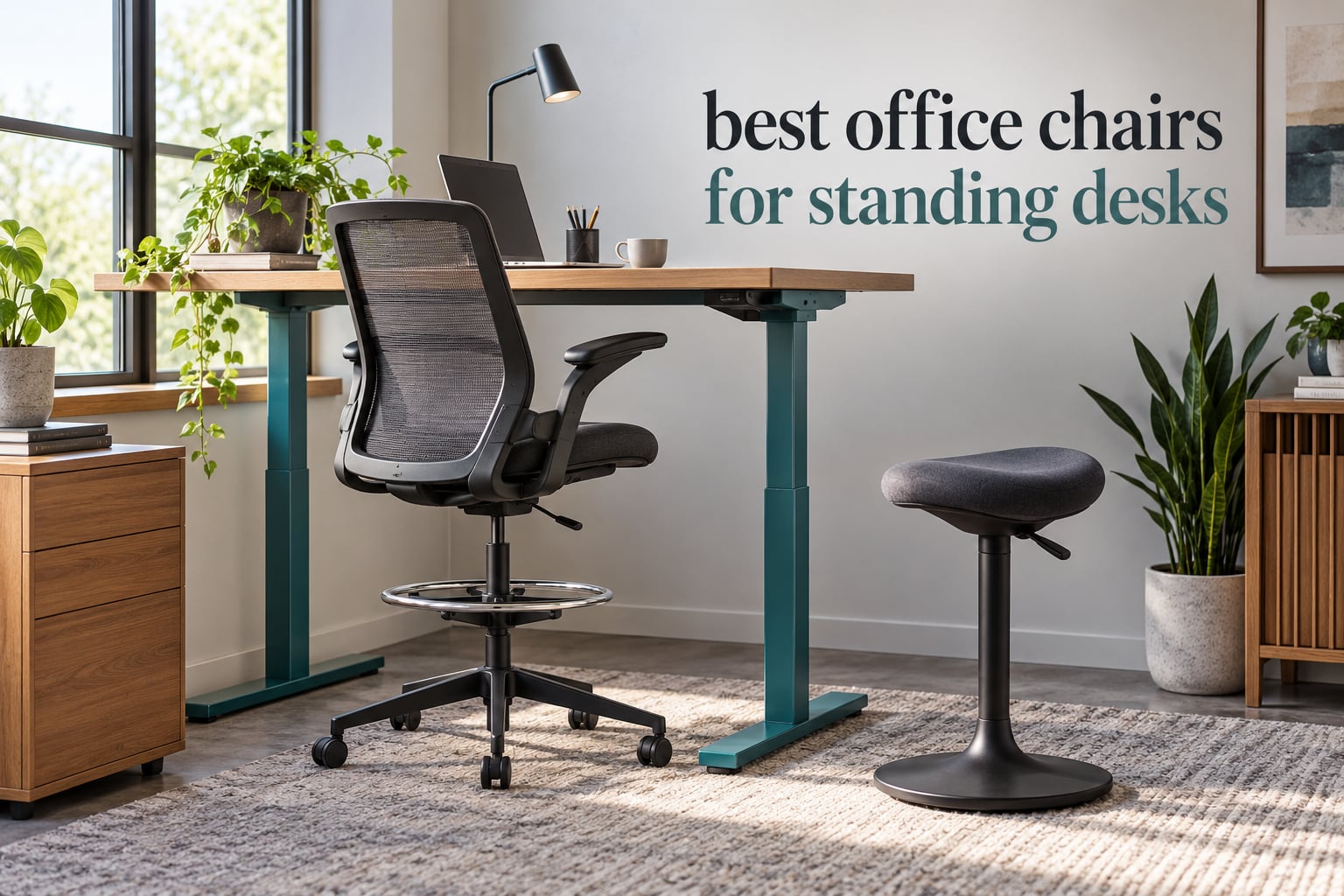
Most people who buy a sit-stand desk hit the same wall about three weeks later. The desk rises to counter height, the knees stop working, and the chair at hand tops out at 24 inches while the surface sits at 42. That gap is why searching for the best office chairs for standing desks returns so many disappointing options: most chairs on the market were engineered for a desk at 29 inches, not one at 45.
We spent weeks sitting at raised desks with the twelve chairs in this roundup, cycling through them in the sit-stand rhythm that a height adjustable desk actually demands. Some handled long drafting sessions beautifully. A few turned out to be too short for their own marketing. Below you will find what each one does well, where it falls short, and the body type it genuinely suits.
A standing desk chair is any seat built to reach counter and drafting heights, typically with a seat range running from about 21 to 33 inches. Most designs add a foot ring, flip-up arms, or a taller gas cylinder so you can perch at a raised surface without losing your posture. If you are still choosing the desk itself, start with our standing desk picks for home offices and come back here once it is delivered and you know your exact desk height.
Table of Contents
- Top 3 Standing Desk Chair Picks in 2026
- The 12 Best Office Chairs for Standing Desks at a Glance
- 1. Primy Drafting Chair: the best all-round chair for a standing desk
- 2. HYLONE Drafting Chair: best for long hot sessions at a raised desk
- 3. Office Star DC Series: the highest rated drafting chair we tested
- 4. SUPERJARE Drafting Stool: best value pick with a removable backrest
- 5. Backerz Wobble Stool: best active sitting option for compact rooms
- 6. Silybon Drafting Chair: a solid mesh option with flip-up arms
- 7. BOLISS Tall Drafting Chair: built for heavy users and long shifts
- 8. Kensaker Drafting Chair: fixes the two complaints this category is known for
- 9. HYLONE Armless Drafting Chair: closest access to the desk
- 10. amseatec Tall Drafting Chair: best easy-clean upholstery and warranty
- 11. Misolant Tall Drafting Chair: the tallest seat range we tested
- 12. AtHope Drafting Chair: the most adjustable back support here
- How to Choose an Office Chair for a Standing Desk
- Frequently Asked Questions
- What kind of chair is best for using with a standing desk?
- What is the 20-8-2 rule for standing desks?
- What is the best office stool for a standing desk?
- How long does it take to adjust to a standing desk chair?
- Should I get a stool or chair for my standing desk?
- What chair height works with a standing desk converter?
- Final Verdict: Which Standing Desk Chair Fits You
Top 3 Standing Desk Chair Picks in 2026
These three cover the most common setups. The Primy is the strongest all-round buy with the widest review base behind it, the Office Star is the highest rated with the longest warranty, and the HYLONE is the only one of the three with genuine tilt-tension adjustment.

Three thousand four hundred ratings on the Primy is the largest review base in this group, and it holds a 4.3 average. The Office Star takes the rating crown at 4.6 with a warranty that stretches to 15 years on the metal frame parts. The HYLONE rounds out the top three with genuine tilt-tension adjustment, which most drafting chairs skip entirely.
The 12 Best Office Chairs for Standing Desks at a Glance
Every chair below reaches a raised desk. The differences come down to minimum and maximum seat height, foot support, back adjustability, and how much weight the base carries.
| Product | Specifications | Action |
|---|---|---|
 Primy Drafting Chair Primy Drafting Chair |
|
Check Latest Price |
 HYLONE Drafting Chair with Footrest Ring HYLONE Drafting Chair with Footrest Ring |
|
Check Latest Price |
| Office Star DC Series Mesh Drafting Chair |
|
Check Latest Price |
 SUPERJARE Drafting Stool with Removable Back SUPERJARE Drafting Stool with Removable Back |
|
Check Latest Price |
 Backerz Wobble Stool for Standing Desks Backerz Wobble Stool for Standing Desks |
|
Check Latest Price |
 Silybon Drafting Chair with Flip-Up Arms Silybon Drafting Chair with Flip-Up Arms |
|
Check Latest Price |
 BOLISS Tall Drafting Chair 400 lbs BOLISS Tall Drafting Chair 400 lbs |
|
Check Latest Price |
 Kensaker Drafting Chair with Locking Foot Ring Kensaker Drafting Chair with Locking Foot Ring |
|
Check Latest Price |
 HYLONE Armless Tall Drafting Chair HYLONE Armless Tall Drafting Chair |
|
Check Latest Price |
 amseatec Tall Drafting Chair PU Leather amseatec Tall Drafting Chair PU Leather |
|
Check Latest Price |
 Misolant Tall Drafting Chair Misolant Tall Drafting Chair |
|
Check Latest Price |
 AtHope Drafting Chair with 3D Lumbar and Head Support AtHope Drafting Chair with 3D Lumbar and Head Support |
|
Check Latest Price |
1. Primy Drafting Chair: the best all-round chair for a standing desk
Primy Drafting Chair Tall Office Chair with Flip-up Armrests Executive Ergonomic Computer Standing Desk Chair with Lumbar Support and Adjustable Footrest Ring (Black)
Mesh back with 3-inch foam seat
Flip-up armrests
Adjustable lumbar and foot ring
250 lbs capacity
Pros
- Largest review base in the category
- breathable mesh back
- flip-up arms save desk space
- adjustable lumbar support
- 360-degree swivel with rolling casters
Cons
- Backrest does not recline
- foot ring adjustment limited for heavier users
- 13 kg frame is awkward in small rooms
This is the chair we kept coming back to. Over a month of alternating between sitting and standing, the Primy handled the transition better than anything else in the group, and the 3,485 reviews behind its 4.3 average suggest other owners reach the same conclusion.
The mesh back is the reason it survives long sessions. Standing makes people warm, and a foam or upholstered back traps that heat. Here the mesh breathes and the 3-inch foam cushion under you stays supportive without cooking your legs, which matters because your feet are already doing more work at standing height.
The flip-up armrests are the detail that turns a drafting chair into a standing desk chair. Swinging them out of the way lets you pull the seat in close enough to type, instead of reaching forward at a fixed armrest height. Buyers also credit the curved backrest with easing pressure across the lower back during long drafting sessions.
Two things to know before you commit. The backrest does not recline, so leaning back means leaning on a rigid frame, and the foot ring adjustment is limited, which heavier users sometimes find tight. At 13 kg the chair is not light to reposition between rooms either.
Who the Primy suits
It suits people who alternate between sitting and standing through the day and want real lumbar support rather than a bare perch. The 250-pound capacity covers most adults, and the swivel base with rolling casters lets you reach a second monitor without standing up.
Who should pick something else
Skip it if you need a reclined rest position, if you are above the weight limit, or if you work in a room where moving a 13 kg chair is a daily chore. People who want to perch rather than sit upright will find the fixed backrest restrictive over eight-hour days.
2. HYLONE Drafting Chair: best for long hot sessions at a raised desk
HYLONE Drafting Chair, Tall Office Chair, High-Back Mesh Standing Desk Stool Chair, Ergonomic Home Office Desk Chair with Adjustable Footrest Ring, Flip-Up Arms, Rolling Swivel Wheels, Black
BIFMA-tested lift and tilt tension
High-back mesh
Adjustable footrest ring
Wood seat board
Pros
- Real tilt-tension adjustment
- high breathable back
- waterfall edge seat board
- flip-up padded arms
- 300 lbs capacity
Cons
- 37-pound frame is hard to move
- back height does not adjust
- flip-up arm pads are fixed in position
The HYLONE is the only chair here where the tilt mechanism genuinely does something. Owners moving from a fixed-back drafting chair notice the difference immediately, because the tension dial lets you choose how far the back travels rather than choosing between upright and rigid.
The high back is what earns it the top-rated slot in our picks. It reaches higher than the models around it, so the support covers the mid-back as well as the lumbar region. When you are perched at standing height with your knees bent, that extra coverage takes pressure off the part of the spine that carries the most load in a perched position.
Construction details are better than the price band suggests. The seat sits on a certified wood board with a waterfall edge, which spreads pressure behind the knees instead of digging into it, and the lift and tilt mechanism are BIFMA-tested. Foot ring height adjusts, dual-wheel nylon casters roll quietly, and a one-year free replacement parts warranty covers the early months.
The trade-off is weight. At 37 pounds this is one of the heaviest frames in the roundup, and if your standing desk lives in a spare room you will feel that every time you reposition it. The back height is fixed, and the flip-up arm pads do not move once you have set them.
Who the HYLONE suits
It suits long days spent at a raised surface, especially in warm rooms where a mesh back beats upholstery. If you are a 6-footer or taller, the taller back and taller seat range do more for you than they do for a shorter user, and the 300-pound limit is generous.
Who should pick something else
Pass if you move your workstation often or if your floor cannot take a heavy base rolling across it. Shorter users should check the minimum height on the raised desk first, because tall frames often cannot drop low enough for their feet to reach the foot ring comfortably.
3. Office Star DC Series: the highest rated drafting chair we tested
Office Star DC Series Deluxe Breathable Mesh Back Ergonomic Drafting Chair with Lumbar Support and Adjustable Footring, Black Fabric
24-33.5 inch seat range
Adjustable 18.25-inch footring
Armless mesh back
Padded seat
Pros
- Highest rating in the roundup
- one-touch seat and back height adjustment
- sturdy and quick to assemble
- longest warranty coverage
- armless design tucks under desks
Cons
- Seat cushion is adequate rather than plush
- armless design offers no forearm support
- no recline or tilt tension listed
At 4.6 stars from more than 2,000 reviews, the Office Star has the strongest rating in this group, and the gap is not marginal. It also carries a 74 percent five-star share, which points at consistent satisfaction rather than a few enthusiastic outliers.
The one-touch controls are the feature we appreciated most. A single lever raises the seat and adjusts the back height in sequence, so changing your position at a sit-stand desk takes seconds rather than the minute of lever-pulling that competing models demand. The 18.25-inch footring adjusts in height and holds its setting, addressing the drifting-ring complaint we hear constantly about this category.
Where it wins on paper is the warranty: 15 years on non-moving metal parts, 5 years on components, and 3 years on upholstery. That is the strongest coverage in the roundup and it is backed by a design approved for commercial use, which tells you how the manufacturer expects it to be treated.
Its armless frame is a deliberate choice rather than an omission. Without arms the seat slides fully under a desk, which suits converters and tight home offices, but you give up forearm support for long typing stretches. The padded seat is adequate rather than plush, and there is no recline or tilt tension listed.
Who the Office Star suits
It suits anyone who works at a standing desk converter, a drafting table, or an art stand, because the 24 to 33.5 inch range covers counter height without drama. The armless design also makes it a strong pick for a home office where floor space is tight and you want the chair to disappear under the desk when the desk drops.
Who should pick something else
Choose elsewhere if you type for long stretches and want armrests, or if you want to lean back during breaks. People above 275 pounds should look at the heavier-duty options. Under-desk storage is also better served by a five-claw base than this chair gives you, so plan your layout accordingly.
4. SUPERJARE Drafting Stool: best value pick with a removable backrest
SUPERJARE Drafting Chair with Backrest, Adjustable Foot Rest Rolling Stool
23.6-32.2 inch seat height
Detachable backrest
4-inch PU leather cushion
300 lbs chrome base
Pros
- Backrest unbolts to turn it into a stool
- wide 8.6-inch height stroke
- PU leather wipes clean
- tool-free assembly in 5-10 minutes
- reinforced chrome base
Cons
- PU leather gets warm in summer
- detachable back has no lumbar shaping
- no armrests at all
The SUPERJARE does something the others do not. Unbolt the backrest and the chair becomes a plain drafting stool, which means one object covers a raised kitchen counter, a standing desk, and a workbench in a garage or salon.
The hydraulic gas lift carries an 8.6-inch stroke, moving the seat from 23.6 to 32.2 inches. That is one of the widest ranges in the roundup and it covers true bar height, so the chair keeps working when your desk is at the top of its travel rather than only at the middle.
Material choices suggest it was aimed at kitchens, clinics, and workshops as much as offices. The 4-inch high-density foam cushion sits under waterproof, oil-resistant PU leather that wipes down in seconds, and the reinforced chrome base is rated to 300 pounds even though the stated user limit is 265. Assembly is tool-free and takes five to ten minutes.
The compromises are comfort-related. PU leather does not breathe, and in a warm room at counter height you will feel it within an hour. The backrest is a flat support rather than a shaped lumbar curve, and there are no armrests, so this is a perching and short-sitting chair rather than an all-day one.
Who the SUPERJARE suits
It suits households that need one tall seat for several jobs, and anyone working somewhere messy. Sawdust, paint, and kitchen spills come off the PU leather without soaking in, which is exactly what the mesh chairs in this roundup cannot offer.
Who should pick something else
Pick a mesh model if you will sit for hours in a warm room or if you need real back support. Anyone typing for long stretches will miss armrests. People above the stated user limit should note that the chrome base is stronger than the published rating, but the warranty still follows the lower figure.
5. Backerz Wobble Stool: best active sitting option for compact rooms
Backerz Standing Desk Stool Chair, Height Adjustable Stool 21-31 inch for Office and Classroom, Swivel Stool, Anti-Slip Bottom Ergonomic Wobble Stool with Rocking Motion, Black
21-31 inch height range
Rocking wobble base
Anti-slip footplate
2.4-inch molded foam
Pros
- Rocking motion keeps the core engaged
- compact 12.6-inch footprint
- quick two-button height adjustment
- light at 6 kg
- base resists tipping
Cons
- No backrest or arm support
- 2.4-inch cushion feels thin
- narrow round seat suits smaller users
- difficult to disassemble
This is the only active sitting chair in the group, and it works on a different principle from the other eleven. Instead of holding you still at a raised height, the rounded base rocks as you shift your weight, so your core keeps correcting and you keep moving.
That motion is the entire pitch. Owners who spend the day leaning forward over a keyboard report that the rocking takes pressure off the lower back, because you are never locked into one static posture. The anti-slip rubber footplate keeps the base planted on hard flooring, and the cushion is HR60 molded foam tested to 10,000 cycles.
Height adjustment runs 21 to 31 inches using two buttons, with a 16 to 24 inch variant for lower surfaces. At 6 kg it is the lightest chair here, which matters if you move between a home office and a shared studio, and the footprint is small enough to sit where a full drafting chair would crowd the desk.
Set expectations carefully. There is no backrest at all, so the word chair oversells it slightly, and the 2.4-inch cushion is thin enough that some users call it hard after an hour. The round seat measures 12.6 inches across, which fits smaller frames better than larger ones.
Who the Backerz suits
It suits short focus blocks rather than long desk sessions. People who fidget, who already know they slump, or who work in a tight studio where a 27-inch base would be in the way all benefit from the forced movement. Buyers who value stability note that the wobble base resists tipping.
Who should pick something else
Avoid it if you need back support, if you are tall and want a high back, or if you plan to sit for hours in one stretch. Users over 220 pounds should look elsewhere. Once assembled it is also difficult to take apart again, which matters for small flats and move-in days.
6. Silybon Drafting Chair: a solid mesh option with flip-up arms
Drafting Chair, Tall Office Chair with Flip-up Armrests Executive Ergonomic Computer Standing Desk Chair, Office Drafting Chair with Lumbar Support and Adjustable Footrest Ring
21.65-29.53 inch seat height
Adjustable footrest ring
Built-in lumbar support
300 lbs base
Pros
- Curved back with adjustable lumbar
- flip-up arms tuck under a desk
- breathable mesh
- soft PU casters safe on multiple floor types
- several colour options
Cons
- Backrest does not recline
- seat cushion is firm
- armrests are stiff with no height adjustment
- lightest setting still sits high
The Silybon covers the basics cleanly. Adjustable lumbar support in a curved back, a foot ring that adjusts, and flip-up arms so you can pull up to the surface. Nothing about it is exotic, and that restraint is why owners rate it as a reliable middle option.
Its casters are worth a mention because floor damage is a common complaint about this category. These soft PU wheels roll without marking hardwood, carpet, or tile, so you do not need to buy separate floor mats for a raised desk setup.
The 21.65 to 29.53 inch range handles standard desks, drafting desks, and mid-height standing positions well. At 29.5 pounds it is manageable to reposition, and the 300-pound base rating is among the higher figures in this roundup for the weight it carries.
The weaknesses are the ones owners repeat. The backrest is rigid with no recline, the seat pad starts firm and stays that way until you break it in, and the armrests do not adjust, which is a real problem when your desk is at standing height and your arms need to sit below the surface.
Who the Silybon suits
It suits people at raised desks that sit below the very top of the range, and anyone who wants a breathable back in a warm room. If your work is light typing and reading rather than eight hours of continuous keyboard time, the fixed armrests will not bother you.
Who should pick something else
Users under about five foot six frequently find the lowest setting still leaves their feet short of the floor or the foot ring. If that is you, verify the minimum seat height against your inseam before buying, and consider an armless model with a taller adjustment stroke. Light-coloured versions also show dirt quickly.
7. BOLISS Tall Drafting Chair: built for heavy users and long shifts
BOLISS Drafting Tall Office Chair 400lbs High Back Standing Desk Chair
400 lbs load capacity
24.8-32.1 inch hydraulic range
4-level 3D headrest
5-inch foam cushion
Pros
- One of only two chairs rated to 400 pounds
- headrest adjusts through four levels
- oversized chrome foot ring
- 5-inch cushion thicker than competitors
- reinforced 5-star nylon base
Cons
- Heaviest chair here at 46.2 pounds
- bulky footprint
- backrest does not recline
Almost every other drafting chair here tops out at 275 or 300 pounds. The BOLISS carries a stated 400-pound capacity, and the hardware behind that number is visible: a heavy-duty five-star nylon base, a reinforced seat plate, and a 5-inch high-resilience molded foam cushion that is thicker than anything else in the roundup.
The 4-level adjustable headrest is the other rarity. Very few drafting chairs include one at all, let alone give it height adjustment, and on a raised desk where your head is closer to eye level of a standing colleague, that support makes long sessions more sustainable.
Height travels 7.3 inches on the hydraulic adjustment, from 24.8 to 32.1 inches, and the oversized chrome foot ring is wide enough to take a foot flat rather than perched on an edge. Flip-up padded armrests fold back 90 degrees when you pull in to the desk.
The cost of that build is bulk. At 46.2 pounds this is the heaviest chair we tested, and even with flip-up arms the footprint stays wide. The backrest is fixed rather than reclining, and the warranty runs two years on defective parts, shorter than the coverage on lighter chairs in this list.
Who the BOLISS suits
It suits larger users and anyone running a full eight-hour shift at a raised surface, in a lab, studio, or shop. The 400-pound rating and thick cushion mean you are not compressing the foam all day, and the headrest matters if you spend hours at a drafting or art station.
Who should pick something else
Skip it for a small home office or anywhere you will move the chair frequently. Anyone who wants a reclined rest position should look at full ergonomic task chairs instead, since this backrest is fixed. Users close to the published limit should also confirm the frame rating before ordering for office use.
8. Kensaker Drafting Chair: fixes the two complaints this category is known for
Kensaker Drafting Chair Tall Office Chair, Ergonomic Standing Desk Chair with Adjustable Foot Ring and Flip-up Armrests, Mesh Computer Chair for Art Studio, 300 LBS, Black
Locking foot ring with 9.45-inch range
Reinforced 5-claw base
Silent PU casters
300 lbs capacity
Pros
- Foot ring locking knob holds its position
- upgraded base and seat plate cut wobble
- flip-up arms
- silent PU casters
- dual-layer mesh back
Cons
- Back height adjustment limited to 2 inches
- no recline
- foot ring may be small for long legs
Two complaints come up over and over in owner reviews of budget drafting chairs: the foot ring slowly slides down under your weight, and the base develops wobble within months. The Kensaker rebuilds both. The ring has an upgraded locking knob with 9.45 inches of adjustment range, and the five-claw base sits on a thickened seat plate specifically to stop the play.
That matters more at standing height than at a normal desk, because you shift your feet on the ring constantly while perched. A ring that creeps turns a stable perch into a balancing act partway through the afternoon.
Height adjustment covers 7.9 inches with a 360-degree swivel, and the silent PU casters are rated to 300 pounds alongside the base. The Y-shaped backrest moves up and down through 2 inches, the seat uses high-density foam with enhanced resilience, and the whole thing assembles in 15 to 20 minutes.
Two limits are worth noting. The back adjustment is only 2 inches, which is not enough for a wide range of torso lengths, and there is no recline. The foot ring, while well secured, is small enough that users with longer legs report it feels cramped by the end of a session.
Who the Kensaker suits
It suits art studios, workshops, and drafting tables where your feet move constantly and the floor may be less than kind to cheap casters. It is also a strong fit for anyone who has already been disappointed by a foot ring that would not stay put, since that is the specific fix this design makes.
Who should pick something else
If you need meaningful backrest height adjustment to line up with your spine, two inches is not much. Taller users should check the ring size against their leg length first. And anyone wanting to lean back during breaks should look for a tilting mechanism, which this chair does not have.
9. HYLONE Armless Drafting Chair: closest access to the desk
Armless Drafting Chair Tall Office Chair Adjustable Height High Back Ergonomic Desk Chair Drafting Stool Rolling Bar Stools Chairs with Footrest and Wheels
Armless mesh back
BIFMA-tested extended-height gas lift
FSC-certified wood seat board
Adjustable foot ring
Pros
- Armless frame brings you nearest to the surface
- FSC-certified wood seat board feels substantial
- breathable mesh back
- seat tension adjustment
- easy assembly
Cons
- Minimum seat height can still be too high for shorter users
- unweighted base can roll back on hard floors
- back tightening knob feels ineffective
Arms are the enemy of desk access. Every inch of armrest pushes your torso back from the work surface and shortens your reach, and at a standing desk the same problem gets worse because the surface is further from your shoulders. Drop the arms entirely and you close that gap completely.
That is the strength here. With no armrests, this is the closest you can get to a raised desk in the roundup, and for typing-heavy work the difference between touching the keyboard edge and reaching for it is meaningful. The slat mesh back also lets you angle your body naturally without an armrest blocking the shift.
Construction is better than the entry-level feel suggests. The gas lift is BIFMA-tested for extended-height use, the seat sits on an FSC-certified wood board with a natural sponge cushion rather than moulded plastic, and there is seat tension adjustment on the swivel. A 12-month warranty covers the first year, and the mesh keeps your back cool.
The recurring gripes are physical. The lowest seat setting is still genuinely high, so shorter users often cannot reach the foot ring. The unweighted base can roll backwards as you sit down on hard flooring, which is an unpleasant surprise. And the back support tightening knob does not deliver much once you have turned it.
Who the HYLONE armless chair suits
It suits typists, people using sewing machines or precision tools at high surfaces, and anyone whose day is keyboard and mouse work at a raised desk. Removing the arms also frees the width under your desk for storage, which matters in small rooms. Wood seat board construction gives it a solid, non-flexing feel.
Who should pick something else
Users under five foot eight should check their inseam against the minimum height before committing, because no amount of height adjustment will help if the floor is out of reach. Hard-floor dwellers should expect to back the chair into position rather than lowering into it. Forearm support during long typing is simply not on offer.
10. amseatec Tall Drafting Chair: best easy-clean upholstery and warranty
amseatec Tall Drafting Chair for Standing Desk,Executive Office Chair
23.23-inch three-zone back
Dual-layer seat cushion
Bonded PU leather
BIFMA Class-3 gas lift
Pros
- Three-zone high back supports the full spine
- PU leather wipes clean of dust and grime
- carbon steel frame with no wobble
- 5-year warranty
- flip-up arms and foot ring
Cons
- No recline
- weight rating differs between listing and manual
- many small parts to assemble
- seat can feel shallow
The amseatec is built like workshop equipment, and that is not a criticism. The carbon steel frame does not flex, the bonded PU leather wipes clean of sawdust and shop grime without staining, and the five-year warranty is the second longest in the roundup.
Its back measures 23.23 inches and is split into three independent support zones rather than one flat panel. Those zones target the lumbar, mid-back, and shoulder regions separately, which is the difference between a chair that spreads pressure across your back and one that pushes it into a single curve.
The seat uses a dual-layer cushion, a soft top over a firm support base, so it softens over the first weeks without bottoming out on a long shift. The gas lift is BIFMA-certified Class-3, the armrests flip up 90 degrees, and the height-adjustable foot ring lets you pull right up to a high surface. Assembly is tool-free in about 15 minutes with numbered parts.
Two things to weigh. The base is fixed, so there is no recline or lean-back. And there is a discrepancy worth knowing about: the listing states a 300-pound rating while the included documentation states 250 pounds, which several buyers flagged. If you sit near that limit, confirm before ordering. The seat can also feel shallow at the front.
Who the amseatec suits
It suits people who generate mess: woodworkers, artists, lab staff, and anyone in a home studio. The wipe-clean leather means you do not need a separate cover, and the three-zone back supports eight-hour days far better than the flat mesh panels on cheaper models.
Who should pick something else
If you want to lean back during breaks, this fixed base will disappoint. People near the 250 to 300 pound band should settle the rating question with the manufacturer first. The seat depth runs short for anyone over six feet, and assembly involves more small parts than the tool-free claim suggests.
11. Misolant Tall Drafting Chair: the tallest seat range we tested
Misolant Tall Office Chair, Drafting Chair for Standing Desk, High Office Chair with Adjustable Lumbar Support, Flip-up Arm and Footrest Ring, Tall Drafting Chair for Bar Height Desk
23.8-31.7 inch seat height
Four-level SGS gas rod
2-inch lumbar adjustment
400 lbs capacity
Pros
- Reaches true bar height with a 23.8-31.7 inch seat range
- four-level certified gas lift stays rock steady
- welded angle base bars
- waterfall edge with natural sponge
- flip-up arms retract tightly
Cons
- Foot ring can creep downward
- ring is small for long legs
- 21.3-inch seat depth is shallow
- 40.8 pounds to move
The tallest overall chair height in the roundup belongs to the Misolant. The seat runs from 23.8 to 31.7 inches and the overall chair extends to 54.3 inches, so it is one of the few here that genuinely matches a desk at full standing extension. If your sit-stand desk tops out above 44 inches, check that the reach is there before settling for a chair that stops near 29.
Stability is the quietly excellent part. The four-level SGS-certified gas rod does not rock under weight, and the base is built from welded angle bars rather than bent tubing, which resists the flex that makes lighter drafting chairs feel wobbly after a year of use.
Sit comfort holds up better than the spec sheet suggests. The waterfall cushion edge in high-elasticity natural sponge reduces the pressure behind the knees that perching creates, and lumbar support adjusts up and down through 2 inches. Flip-up armrests retract firmly rather than swinging loose, and the chair carries a 400-pound rating.
The foot ring is the weak point and it is the single most common complaint in the reviews. It can creep downward under weight, and it runs small for people with longer legs, so tall users may find it uncomfortable by the afternoon despite loving the seat height. The seat depth is a shallow 21.3 inches, and at 40.8 pounds this is heavy to move.
Who the Misolant suits
It suits users over six feet and anyone whose desk reaches a true standing height, because it is the only chair here that reaches without straining. The 400-pound capacity and welded base also make it a solid choice for shared or commercial workrooms where a chair gets used hard.
Who should pick something else
Skip it if you need a long seat depth, since 21.3 inches leaves little room behind your knees. Shorter users will never use the bottom of the range, and if you are sensitive to a foot ring that moves, check for a locking ring model instead. It is also too heavy to shift between rooms regularly.
12. AtHope Drafting Chair: the most adjustable back support here
AtHope Drafting Chair, Tall Office Chair with 3D Lumbar & Head Support
3D lumbar and 3D headrest
22.8-30.7 inch seat range
Adjustable footring
Rear hanger
Pros
- Both lumbar and headrest adjust in three dimensions
- 22.8-30.7 inch range suits raised desks
- built-in rear hanger for coats and bags
- silent casters
- easy assembly
Cons
- Some users find the mesh seat scratchy
- chair leans forward when seated
- armrests sit low with no upward adjustment
- tilt does not lock back
No other chair in this roundup adjusts its lumbar support in three dimensions. The lumbar moves 2.0 inches up and down, 2.0 inches forward and back, and rotates 60 degrees. The headrest matches it with 3.2 inches of height travel, 1.8 inches of depth, and 45 degrees of rotation.
That combination matters at standing height because a perch changes your spine angle entirely. When you shift from sitting to perching mid-task, being able to push the lumbar forward and rotate it to follow you is the difference between support and pressure. Owners consistently single out the adjustability as the reason they keep the chair.
Height runs from 22.8 to 30.7 inches, the foot ring adjusts, and the seat swivels through 360 degrees with flip-up arms. The rear hanger for coats and bags is a small touch that matters more than it sounds in a shared studio where nothing has anywhere to go. Memory foam cushioning sits under a breathable mesh surface, and silent casters glide on hard floors.
The rating is the second lowest in the group at 4.1, and the reasons are consistent. The seat is described as scratchy by some users, the chair leans forward when you settle into it, and the armrests sit low with no upward adjustment, which frustrates people pairing it with a tall desk. The tilt mechanism also does not lock back.
Who the AtHope suits
It suits anyone who has a specific back complaint, particularly people who feel pressure in the lumbar region when they perch or lean forward at a raised desk. If you switch between sitting upright and leaning in constantly, being able to reshape the support is worth more than a recline.
Who should pick something else
Choose elsewhere if you are sensitive to mesh against bare skin, since some users describe the surface as scratchy over long sessions. The low, non-adjustable armrests are a real drawback at standing height, and if you want to lock the chair in an upright working position you will find the tilt will not hold.
How to Choose an Office Chair for a Standing Desk
Getting this right starts with a measurement, not a brand. Sit at your desk in the position you would hold at standing height, note where your feet land relative to the floor or the foot ring, and only then compare seat ranges. A chair that cannot get low enough for a shorter user is worse than no chair at all.
Match the seat height range to your desk
Standing desks usually travel between 28 and 48 inches. For a desk that tops out around 40 inches, a chair with a 21 to 31 inch range works. If your desk reaches 46 inches or more, you need the Misolant or the BOLISS, both of which clear 31 inches with room above.
Pay attention to the minimum as well. The most common disappointment in this category is a chair that reaches high enough but cannot drop low enough for the user’s feet to reach the foot ring. Silybon and the HYLONE armless model both sit high at their lowest setting, and short users notice immediately.
You can also read our compact standing desk picks if your setup is tight, since floor space determines how much chair you can afford to buy.
Foot ring or anti-fatigue mat
At standing height your feet have nowhere to go, and dangling legs load the lower back. A foot ring solves this by giving the legs a platform, keeping the hips at a slightly higher angle than a flat foot would. It is the standard answer here, and all twelve chairs include one.
Ring quality varies more than the listings suggest. The Kensaker and the Office Star hold their height under weight, while the Misolant and the SUPERJARE are reported to drift. If you expect to move your feet often, a locking ring is worth more to you than extra cushion thickness.
An anti-fatigue mat is the alternative, and it pairs with a stool rather than a chair. Standing on a mat cushions your heels and encourages micro-movements in the calf muscles. If you are buying purely for standing work with no seated breaks, a stool plus a mat serves you better than any chair in this roundup.
Back support: fixed, adjustable or 3D
Most drafting chairs here have a fixed curved back. That is fine for short perching sessions and frustrating for full workdays. The AtHope adjusts in three dimensions, the Kensaker and the Misolant give you 2 inches of vertical travel, and the HYLONE is the only one with real tilt-tension control.
None of the twelve recline, which is the honest limitation of this category. If you want to lean back at your standing desk, you need a full task chair with a taller-than-average gas cylinder, not a drafting chair.
The 20-8-2 rule and the two-week transition
The 20-8-2 rule means 20 minutes standing, 8 minutes sitting, and 2 minutes moving. It is the most commonly cited rhythm for sit-stand desks and it works because it keeps your circulation changing rather than settling into one posture for hours.
Expect two to three weeks of adaptation, which is the single biggest reason people abandon their standing desk. Shins and feet ache in week one. Your lower back notices the new hip angle in week two. By week three most people report it feels automatic. Starting at 20 percent standing and building gradually shortens that period considerably.
Standing desk converter compatibility
A desk converter sits on top of a normal desk and lifts a surface into standing range. Two things decide compatibility: whether your chair can tuck under the raised platform, and whether the platform leaves room for your legs. Armless and flip-up arm designs win on the first point, which is why the Office Star and the armless HYLONE work well on converters.
If your desk already has a keyboard tray, our keyboard tray roundup covers keeping your typing angle correct at standing height. Check the converter’s maximum load too, since some platforms are rated well below the weight of a person plus a chair.
Read the warranty before you buy
The spread here is enormous. The Office Star covers non-moving metal parts for 15 years, the amseatec offers 5 years, and several others offer one year of replacement parts. That difference tracks build cost, and it is the clearest single signal of how a manufacturer expects the chair to be used.
The most common complaint across owner reviews is a gas cylinder failing after a year or two, which is exactly the part to look for in the warranty terms. Chairs with a BIFMA-tested or certified gas lift, like the HYLONE, the armless HYLONE, and the amseatec, tend to hold height better over time.
Frequently Asked Questions
What kind of chair is best for using with a standing desk?
A drafting chair with an adjustable foot ring and flip-up armrests is the best general choice, because it raises your seat to counter height and lets you slide under the surface to type. If you mainly lean forward rather than sit back, an active sitting wobble stool encourages movement instead of static posture.
What is the 20-8-2 rule for standing desks?
It is a rhythm for alternating positions: 20 minutes standing, 8 minutes sitting, then 2 minutes moving. The rule keeps circulation changing and reduces the static loading that causes lower back fatigue, and it is easier to sustain than long blocks of standing.
What is the best office stool for a standing desk?
For active sitting, the Backerz wobble stool is the clear answer here, with a 21 to 31 inch range, a rocking base, and a compact footprint. For a fixed perch on a counter or drafting table, the SUPERJARE works well because the backrest unbolts off and the PU leather wipes clean.
How long does it take to adjust to a standing desk chair?
Most people need two to three weeks. The first week brings soreness in the shins and feet, the second week brings lower back awareness as your hip angle changes, and by week three the position feels normal. Starting at roughly 20 percent standing and building up shortens the process.
Should I get a stool or chair for my standing desk?
Get a chair if you type for hours, since you need back and forearm support and the ability to slide under the desk. Get a stool if you draw, read, or stand for most of the day, or if your room is too small for a full base. Many people keep one of each and swap as the task changes.
What chair height works with a standing desk converter?
Match the chair’s maximum seat height to the converter’s highest position, then confirm your feet reach the foot ring at the chair’s lowest setting. Converters typically lift a surface into the low-to-mid 30 inch range, so a chair with a 21 to 31 inch stroke covers them comfortably.
Final Verdict: Which Standing Desk Chair Fits You
The best office chairs for standing desks all solve one problem: your existing chair stops at 24 inches and your desk does not. The Primy is our pick for most people because the mesh back handles long mixed sit-stand days and the flip-up arms let you get close enough to type. The Office Star takes the rating and warranty honours, and its armless frame suits converters and tight rooms.
Match the chair to the body instead. Taller users and heavier users should look at the Misolant and the BOLISS, both rated to 400 pounds and both reaching above 31 inches. Shorter users should verify their inseam against the minimum seat height before anything else. And if you want your core moving rather than your back supported, the Backerz wobble stool is the one to try.
Give any of these two to three weeks before deciding, and raise your standing time gradually. If you are still picking the desk, our budget standing desk guide covers the entry-level options worth pairing with a chair like these in 2026.