
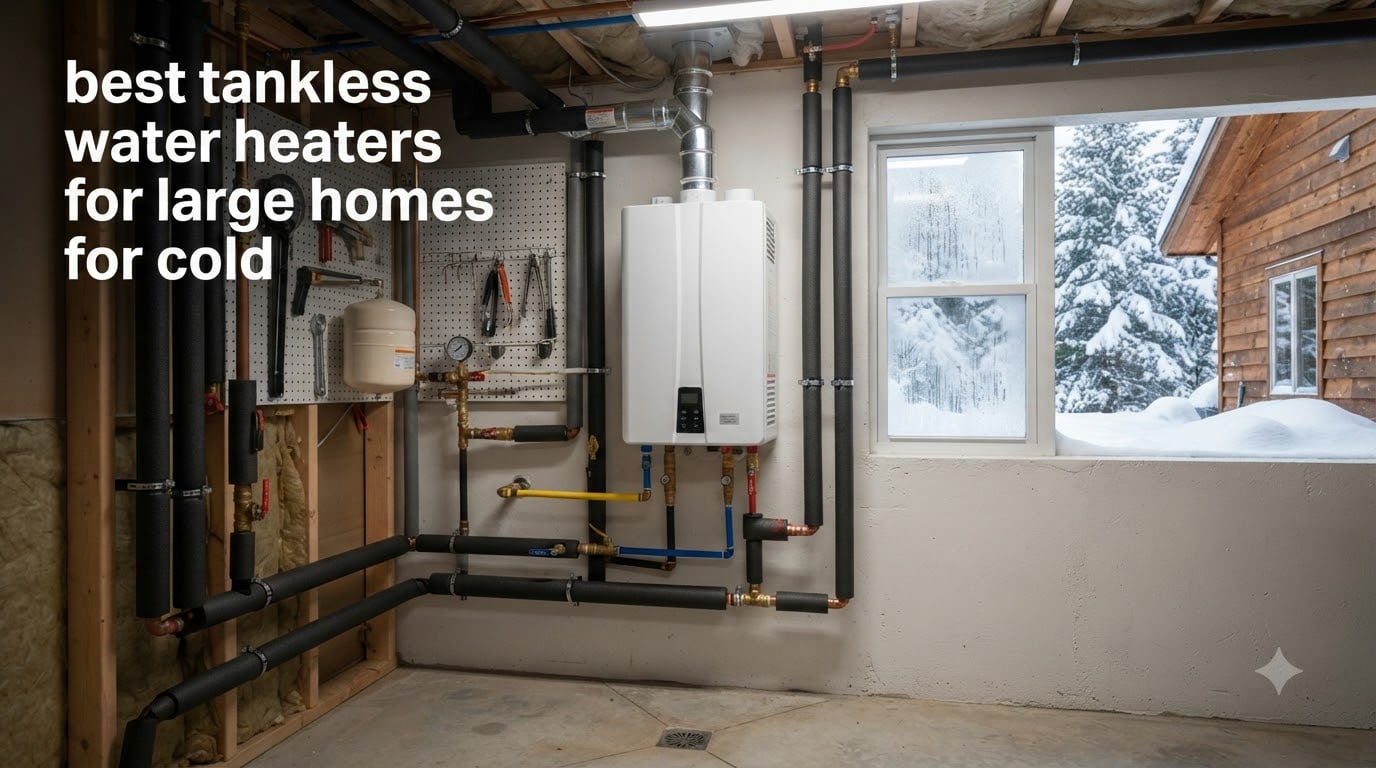
Choosing the best tankless water heaters for large homes for cold climates is harder than comparing a headline GPM figure. In winter, the same heater may deliver strong hot water during a mild autumn morning yet lose usable flow when groundwater reaches its coldest temperature of the year. My top three choices are the Ranein RH19K-NG for balanced whole-house performance, the MIZUDO WCIU-HW199A1G-NG-M0 for maximum demand, and the Stiebel Eltron Tempra 29 Plus for homeowners with serious electrical capacity but moderate peak flow.
I evaluated all 10 models for stated capacity, cold-weather controls, installation burden, review history, and fit for a large home. Gas units lead the list because they can create a much larger temperature rise without the electrical demand seen in whole-house electric systems. I also account for incoming-water temperature rather than pretending every home has the same winter conditions.
If you are still deciding between whole-house technologies, our whole-house tankless water heater guide is a useful companion. For homes that need a storage-based electric alternative, the large-home electric water heater guide covers another route.
Table of Contents
- Top 3 Picks for Large Homes in Cold Climates
- Best Tankless Water Heaters for Large Homes in 2026
- 1. Ranein RH19K-NG: Balanced High-Flow Gas Performance
- 2. MIZUDO 10.3 GPM: The Strongest Peak-Demand Pick
- 3. Stiebel Eltron Tempra 29 Plus: Best Electric for Moderate Demand
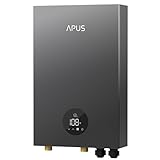
- 4. APUS 27kW: Compact Electric Power for Lighter Cold-Weather Use
- 5. WINTEMP 36kW: High Electric Output With a Heavy Panel Burden
- 6. WINTEMP 27kW: Efficient Electric Heating for Two to Four Points
- 7. APUS 5.43 GPM Gas: Compact Choice for a Smaller Large Home
- 8. Rheem RTGH 8.4 GPM: Condensing Efficiency With Long Protection
- 9. Rheem RTG 7.0 GPM: High-Rated Non-Condensing Gas
- 10. FOGATTI 7.5 GPM: Propane Power for Homes Without Natural Gas
- How to Size a Tankless Water Heater for a Large Cold-Climate Home
- Calculate temperature rise before choosing capacity
- Match the unit to the home’s peak demand
- Choose gas when the infrastructure supports it
- Choose electric when gas is unavailable or venting is undesirable
- Plan for cold-weather operation, not just the product label
- Verify fuel, electrical, and plumbing requirements before buying
- Frequently Asked Questions
- The Right Tankless Choice for a Cold-Climate Large Home
Top 3 Picks for Large Homes in Cold Climates


Stiebel Eltron Tempra 29 Plus
- 28.8kW output
- Advanced Flow Control
- No venting
- 3x40A breakers
Best Tankless Water Heaters for Large Homes in 2026
| Product | Specifications | Action |
|---|---|---|
 Ranein RH19K-NG Ranein RH19K-NG |
|
Check Latest Price |
| MIZUDO 10.3 GPM |
|
Check Latest Price |
| Stiebel Eltron Tempra 29 Plus |
|
Check Latest Price |
 APUS 27kW APUS 27kW |
|
Check Latest Price |
 WINTEMP 36kW WINTEMP 36kW |
|
Check Latest Price |
 WINTEMP 27kW WINTEMP 27kW |
|
Check Latest Price |
 APUS 5.43 GPM Gas APUS 5.43 GPM Gas |
|
Check Latest Price |
 Rheem RTGH 8.4 GPM Rheem RTGH 8.4 GPM |
|
Check Latest Price |
 Rheem RTG 7.0 GPM Rheem RTG 7.0 GPM |
|
Check Latest Price |
 FOGATTI 7.5 GPM Propane FOGATTI 7.5 GPM Propane |
|
Check Latest Price |
1. Ranein RH19K-NG: Balanced High-Flow Gas Performance
Ranein Natural Gas Tankless Water Heater, 8.5 GPM, 190,000 BTU, Indoor
8.5 GPM
190000 BTU
120V AC
2-year manufacturer warranty
Pros
- On-demand hot water
- Compact wall mount
- Standard 3/4 inch NPT fittings
- Automatic blower speed
- Supports 4-6 outlets
Cons
- Mounting hardware not included
- Category 3 stainless venting required
- Special venting raises installation scope
The Ranein is the strongest all-around choice in this group for a large home that needs high flow without jumping to a 10.3-GPM system. Its 190,000-BTU burner is paired with a stated 8.5-GPM maximum, which gives it enough capacity for several common fixtures when the incoming water is not at the coldest extreme.
Reviewers repeatedly point to the compact 15.08 by 24.25-inch body, simple controls, and dependable hot-water delivery. The LED display is useful because it exposes both outlet temperature and current flow, making performance easier to diagnose than a unit with only a basic status light.
The main catch is not heater output; it is installation completeness. The package does not include mounting hardware, and a direct-vent installation needs the correct Category 3 stainless vent system. Have a gas fitter verify venting, gas sizing, condensate strategy, clearances, and combustion air before ordering parts.
Its two-year manufacturer coverage is shorter than the heat-exchanger protection offered by some larger systems, so I would prioritize professional commissioning and annual descaling where water hardness warrants it.
This model fits a four- to six-outlet home best
Choose the Ranein if your household uses several showers or fixtures but does not need the absolute maximum flow on the list. It is especially sensible when high-BTU gas heating, a relatively compact footprint, and a simpler operating interface matter more than long heat-exchanger coverage.
For a family with three bathrooms and ordinary low-flow showerheads, the stated capacity should support realistic simultaneous use better than a small gas unit. Actual flow will fall if winter groundwater requires a very large temperature rise.
This model is a poor fit for an unfinished installation plan
Do not choose it if you expect the box to include every vent, bracket, or transition fitting. The 120V requirement also means controls and the blower need electricity, so it is not a passive gas appliance.
I would compare its installed performance with the MIZUDO and both Rheem models before deciding. The Ranein earns my editor’s choice because its 4.2 rating is backed by 316 reviews and its stated 8.5-GPM capacity fits more large homes without the largest electrical or combustion burden.
2. MIZUDO 10.3 GPM: The Strongest Peak-Demand Pick
MIZUDO Natural Gas Tankless Water Heater, 199,000 BTU, Indoor
10.3 GPM
199000 BTU
120V
5-year heat-exchanger warranty
Pros
- 10.3 GPM maximum
- WiFi and app control
- Freeze protection to minus 13°F
- Six-stage modulation
- Direct external-air vent
Cons
- Direct-vent kit sold separately
- Requires a 120V supply
The MIZUDO is the capacity leader here, pairing 199,000 BTU with a stated maximum of 10.3 GPM. That makes it the gas model I would shortlist first for a large home with five to seven potential outlet points, provided the local gas line and vent arrangement can support it.
Its six-stage gas modulation and reported plus-or-minus-one-degree temperature stability are more meaningful than a simple maximum-flow claim. They suggest the unit can reduce burner activity as demand eases, while WiFi monitoring gives a homeowner visibility into operating behavior.
The product data lists 16-plus safety mechanisms and active freeze protection down to minus 13 degrees Fahrenheit. That is encouraging, but active protection still needs power and correct installation; it is not a substitute for shelter, pipe insulation, or a planned power-loss procedure.
Reviewers praise flow, control accuracy, and setup, while also noting that the direct-vent kit is separate. I would confirm the vent diameter, termination, combustion-air route, and condensate drain with the installer before finalizing this model.
This model fits a very large household with overlapping demand
Use the MIZUDO when several showers, a laundry cycle, and kitchen hot water can overlap. Its 10.3-GPM rating provides more winter headroom than the 7.0- or 8.4-GPM systems in this roundup.
Remember that the maximum number is not the number available at every inlet temperature. A plumber should apply the manufacturer’s performance map to your coldest expected groundwater temperature and target outlet setting.
This model is excessive for a smaller peak-load home
A household with two bathrooms may leave much of this capacity unused. The added 120V dependency and separate vent kit also make installation planning more involved than the basic specifications suggest.
Among the gas models, the MIZUDO offers the most headroom and one of the strongest user ratings. It falls short of the editor’s choice because the Ranein’s much larger review base provides a more established long-term signal.
3. Stiebel Eltron Tempra 29 Plus: Best Electric for Moderate Demand
Stiebel Eltron Tempra 29 Plus Electric Tankless Water Heater, 28.8kW, 240V
28.8kW
3 GPM
240V
Advanced Flow Control
Pros
- Reliable on-demand heating
- No venting
- Advanced Flow Control
- Two temperature presets
- Compact 19-pound body
Cons
- Needs 3 dedicated 40A breakers
- 200A home service recommended
- Does not heat water during an outage
The Tempra 29 Plus is the best electric option when the home’s electrical system can support it but peak demand remains moderate. Its 28.8-kW heater has a stated flow rate of 3 GPM, so it is better suited to one strong hot-water event or several low-flow fixtures than three full showers in the coldest weather.
Stiebel Eltron’s Advanced Flow Control is the key decision point. Instead of letting the outlet become dramatically cooler when demand rises, it can reduce available flow to preserve the selected temperature, making cold-weather comfort more predictable.
Installation is the trade-off: this model requires three 40A breakers, 8-gauge copper conductors, and at least a 200A residential service according to the product record. There is no combustion vent, which simplifies the mechanical side, but the utility may need to assess service capacity and tariff.
The 451-review record is the largest in the analyzed set, and the supplied review summary repeatedly praises temperature accuracy and build quality. That depth of feedback is why I rank it as the safest electric choice here.
This model fits electrically capable homes with controlled demand
Choose the Tempra when you want precise electric heating, lack a gas connection, and can keep peak use near its stated 3-GPM capability. The two presets are convenient for different household routines, such as a lower everyday setting and a higher cleaning setting.
Its copper construction and 19-pound wall-mounted body are easier to place than a large gas system. For apartments, compact homes, or a point-of-use installation, the low weight and lack of venting are major advantages.
This model cannot support the largest whole-house peak loads
Skip it if three showers may run together or the panel cannot safely accept three additional high-draw circuits. A 200A service recommendation is not a guarantee, because other large electrical loads can make an upgrade necessary.
It also depends on household electricity. Homeowners in areas with frequent outages need a practical backup strategy, particularly if the unit serves an occupied home during winter.
4. APUS 27kW: Compact Electric Power for Lighter Cold-Weather Use
APUS 27kW Electric Tankless Water Heater, 240V, Up to 6.5 GPM, 3s Instant
27kW
Up to 6.5 GPM
240V
99% stated efficiency
Pros
- Compact wall mount
- Digital temperature adjustment
- Self-modulating output
- Memory function
- Three to four simultaneous uses
Cons
- Needs 3x40A breakers
- May miss 140°F at 4 GPM
- Professional installation recommended
The APUS 27kW advertises up to 6.5 GPM, but that figure is not a cold-climate performance promise. The supplied review insight specifically flags difficulty reaching 140 degrees Fahrenheit at 4 GPM when the incoming water is very cold, which makes accurate sizing more important than the headline maximum.
I see the APUS as a compact electric option for a large home with disciplined hot-water use, especially where gas is unavailable. Digital controls, one-degree adjustment, and self-modulation make everyday operation straightforward, while the 11.42 by 17.72-inch body does not dominate a mechanical room.
It still requires three 40A breakers and six 8-AWG cable runs according to the product record. Have an electrician evaluate panel space, service rating, conductor sizing, disconnect access, and simultaneous loads before treating the 99-percent efficiency claim as the main economic benefit.
The review record is positive but less extensive than the Tempra’s. I would use it in a home where actual winter flow calculations stay comfortably below the unit’s demonstrated performance map.
This model fits small mechanical rooms and moderate peak use
Choose the APUS if the compact chassis, familiar 240V format, and self-modulating controls solve a space constraint. Its memory function is a small but useful feature for households that alternate between preset routines.
A three- to four-point household can be realistic where fixtures are low-flow and cold inlet temperature is not at the regional minimum. Ask the installer to calculate the flow at your required temperature rise, not simply repeat the maximum 6.5-GPM claim.
This model needs a conservative cold-weather capacity plan
Avoid selecting it for simultaneous high-flow showers or a home with marginal electrical service. The review data says the unit may not reach 140 degrees Fahrenheit at 4 GPM under cold inlet conditions.
Professional installation is strongly advisable because the product record specifies substantial conductor and breaker requirements. The absence of venting does not make a 27kW appliance a simple plug-in upgrade.
5. WINTEMP 36kW: High Electric Output With a Heavy Panel Burden
WINTEMP 36kW Electric Tankless Water Heater 240V ETL Certified WiFi
36kW
Up to 8.7 GPM
240V
WiFi monitoring
Pros
- Up to 8.7 GPM
- WiFi app control
- Self-modulating operation
- Leak and overheat protection
- Wall-mounted design
Cons
- Requires 300A service
- Draws up to 150A
- Some flow-regulator reports
The WINTEMP 36kW is the most powerful electric model in the lineup, with a stated maximum of 8.7 GPM and up to 36 kW. That sounds ideal for a three- to five-bathroom house until the electrical requirements enter the calculation: the product record calls for four 40A double-pole breakers and recommends 300A household service.
Its self-modulating controls and WiFi monitoring can help a homeowner understand changing demand, while leakage, overheat, and dry-fire protection cover common failure modes. The wall-mounted chassis is compact relative to its stated output.
Reviewers generally praise consistent hot-water delivery and the app, but some report flow sensitivity in cold conditions. That makes fixture aerators, minimum activation flow, and the performance map worth discussing with a qualified installer rather than relying on a single GPM number.
At a 150A maximum draw, this unit can use more electricity than many whole homes consume through all other loads. The panel upgrade and service assessment are central to whether it makes sense for the property.
This model fits a home prepared for a major electrical upgrade
Choose the WINTEMP when a natural-gas route is unavailable, a 300A service assessment is practical, and peak electric demand justifies the infrastructure. Its app is useful for monitoring operation without opening the unit.
For a three- to five-bathroom layout, the stated 8.7-GPM maximum offers more apparent headroom than the Tempra. The real winter result will depend on inlet temperature and whether flow controls cause nuisance activation or shutdown.
This model is wrong for an ordinary panel with limited spare capacity
Do not install it based on the headline output alone. A service recommendation, utility requirements, local code, and the condition of the existing panel can change the project substantially.
Some reviewers mention needing a flow regulator, so I would test representative low-flow fixtures during commissioning. This is a performance tuning issue, not a reason to ignore the unit’s strong 4.3 rating and 183 reviews.
6. WINTEMP 27kW: Efficient Electric Heating for Two to Four Points
27kW 240V Tankless Water Heater Electric Whole House, Up to 6.3 GPM
27kW
Up to 6.3 GPM
240V
Two-year warranty
Pros
- Self-regulating operation
- Compact wall mount
- Leak and overheat protection
- Suitable for 2-4 points
- ETL certified
Cons
- 250A service recommended
- Some temperature-holding complaints
- Compatibility varies by plumbing setup
The WINTEMP 27kW targets homes with two to four hot-water points rather than a five-bathroom peak. It offers a compact 240V package, stated output up to 6.3 GPM, and several safety protections without requiring combustion venting.
Reviewers like the compact design and energy-saving control strategy. Some report difficulty holding temperature during showers, however, so the home’s incoming-water temperature and fixture flow should be tested against the manufacturer’s cold-weather curve before purchase.
The product record recommends 250A household service and three 40A double-pole breakers. That remains a substantial electrical project, and the real need can be higher when a home already has electric cooking, vehicle charging, or HVAC equipment.
Its 4.4 rating is tied to a smaller 107-review sample than the Tempra’s. That makes the detailed review evidence useful but still less mature than the best-established electric option.
This model fits a compact whole-house application
Choose it when the expected winter demand is within the 27kW performance range and the electrical panel can handle three dedicated circuits. The 2-to-4-point positioning is a useful reality check against the maximum 6.3-GPM claim.
The self-regulating feature should reduce unnecessary heating during low demand, while the compact wall body saves floor space. Those strengths make it a reasonable electric bridge between a small point-of-use heater and a 36kW system.
This model may disappoint with high-flow fixtures
Reviewers’ temperature-holding concerns matter in showers with unrestricted flow. Low-flow fixtures can improve stability, but reducing flow should be an intentional design decision rather than a surprise limitation.
It is not my electric winner because the Stiebel Eltron combines a 4.4 rating with 451 reviews and established flow control. WINTEMP is worth considering when compact dimensions and a lower stated output are the priorities.
7. APUS 5.43 GPM Gas: Compact Choice for a Smaller Large Home
APUS Natural Gas Tankless Water Heater, 120,000 BTU, 5.43 GPM Indoor
5.43 GPM
120000 BTU
140°F maximum
0.81 UEF
Pros
- Precise plus-or-minus-one-degree control
- 98% thermal efficiency
- Anti-freeze activation near 41°F
- Compact 19.2-pound body
- LED touchscreen
Cons
- Lower flow than other gas models
- Some lukewarm-output reports
The APUS 5.43 GPM is the compact gas choice for a large-home layout with moderate peak demand. At 120,000 BTU and 5.43 GPM, it is better matched to two showers plus a sink or three to four water points than to a household running several showers at once in extreme cold.
Its plus-or-minus-one-degree control, 98-percent thermal efficiency, and 0.81 UEF make the operating concept appealing. Anti-freeze activation near 41 degrees Fahrenheit is a useful layer, although it should be paired with the installation location and local freeze plan.
Reviewers praise the small footprint, clear display, and temperature control. The same review summary includes lukewarm-output reports, which reinforces the need to size from winter inlet temperature rather than the maximum label.
The unit is light for a gas appliance and wall-mountable, but its lower capacity keeps it out of the top tier for a genuinely high-demand household. It may still be a smart match for a well-insulated home with low-flow fixtures.
This model fits a home with three to four points and lower peak flow
Choose the APUS if a compact gas footprint and straightforward temperature control matter more than maximum simultaneous capacity. A 5.43-GPM unit can serve a well-designed large home when showers are short overlap events and fixture flow is controlled.
Its anti-freeze feature is a meaningful inclusion for a cold climate, and the compact chassis makes it easier to place indoors than a large condensing system.
This model lacks the headroom of larger gas units
Do not plan on a 5.43-GPM model supporting several unrestricted showers when the water is near its winter minimum. A lower outlet setting may preserve temperature but does not create extra hot-water capacity.
I would compare its calculated winter flow with the Ranein’s before making a final decision. The APUS is a good secondary pick, not the safest choice for a home where demand often peaks.
8. Rheem RTGH 8.4 GPM: Condensing Efficiency With Long Protection
Pros
- 8.4 GPM capacity
- 0.93 UEF
- Built-in freeze protection
- 15-year heat-exchanger warranty
- Condensing technology
Cons
- Professional installation required
The Rheem RTGH 8.4 GPM is the efficiency-led gas pick, with a 0.93 UEF and condensing design. Its 157,000-BTU input and 8.4-GPM stated capacity are well matched to a three- or four-bathroom home with overlapping fixtures.
Condensing technology extracts more heat from the combustion process, which can matter when the burner must raise very cold incoming water to a comfortable shower temperature. The product record also lists built-in freeze protection and a 15-year heat-exchanger warranty.
Condensing equipment has a more involved mechanical design than a basic non-condensing gas heater. I would have the installer confirm the drain path, vent material, gas supply, condensate neutralization where appropriate, and code-required clearances before work begins.
The 4.3 rating is supported by 57 reviews, the smallest gas review base in this lineup. Long coverage is valuable, but Rheem’s included summary notes mixed warranty-service experiences, so support quality deserves a local check.
This model fits owners who value efficiency and long component coverage
Choose the RTGH when the 8.4-GPM range fits the home and you want a condensing system rather than a non-condensing unit. Its 0.93 UEF is the strongest efficiency figure among the gas products reviewed here.
The heat-exchanger warranty is substantially longer than the two-year full-unit coverage listed for the Ranein and MIZUDO. That can be meaningful for a long-term ownership plan if local parts and service support are strong.
This model is not the best evidence-backed service experience
The 57-review sample is smaller than every other gas model’s sample, and the supplied review summary flags warranty-service concerns. I would ask a local Rheem specialist how parts are sourced and how service is handled in your region.
It is still a serious contender for a home that values efficiency over the Ranein’s higher review count. The MIZUDO offers more stated flow, while the Ranein combines 8.5 GPM with 316 reviews.
9. Rheem RTG 7.0 GPM: High-Rated Non-Condensing Gas
Rheem RTG Series 7.0 GPM Natural Gas Tankless Water Heater Indoor | 160,000 BTUs High Efficiency On Demand, Continuous Hot Water | Non-Condensing
7 GPM
160000 BTU
0.82 UEF
Non-condensing
Pros
- Highest listed gas rating
- 7.0 GPM for 2-3 showers
- LeakGuard protection
- Hot-start programming
- Digital plus-or-minus-one-degree control
Cons
- Non-condensing efficiency is lower
The Rheem RTG 7.0 GPM has the highest stated rating in the analyzed group, 4.6 from 62 reviews. That makes it a compelling choice for a large home that does not need the capacity of the MIZUDO or Ranein but still wants gas heating and precise outlet control.
Its 160,000-BTU input and 7.0-GPM stated flow support two to three showers according to the product record. LeakGuard adds leak detection and prevention, while Hot-start programming is designed to reduce cold-water surprises at the beginning of a draw.
The tradeoff is a 0.82 UEF because this is a non-condensing model. It also cannot capture as much energy from the combustion process as the Rheem RTGH, so buyers should compare the efficiency and venting requirements rather than treating the two Rheem systems as interchangeable.
Reviewers praise reliable performance, temperature consistency, and space-saving design. Some mention a wait for hot water at distant fixtures, so placement and recirculation planning remain relevant even with a capable heater.
This model fits a home with two to three overlapping showers
Choose the RTG when its 7.0-GPM stated capacity matches your peak-load calculation and you prefer a simpler non-condensing installation. The 4.6 rating is the strongest numerical signal in the product file.
Hot-start programming and digital control can make daily showers more comfortable, while LeakGuard is a useful safeguard in a mechanical room. It is a strong option when maximum flow is unnecessary.
This model gives up some efficiency and capacity
Do not select it solely for the 4.6 rating if your home has three or more high-flow showers. The 7.0-GPM limit is materially below the MIZUDO and Ranein figures.
Also factor in the non-condensing design. The RTGH is the better choice for an efficiency-first installation, while the Ranein offers a deeper review history and slightly more stated flow.
10. FOGATTI 7.5 GPM: Propane Power for Homes Without Natural Gas
FOGATTI Tankless Water Heater Gas Propane Indoor On Demand CSA Certified
7.5 GPM
170000 BTU
Liquid propane
150°F maximum
Pros
- 7.5 GPM for 3-5 points
- Plus-or-minus-one-degree water servo
- CSA certification
- Active heating anti-freeze
- Compact wall design
Cons
- Propane-specific installation
- Accessories sold separately
- Customer support receives mixed reviews
The FOGATTI 7.5 GPM is the right gas pick for a property served by propane rather than natural gas. Its 170,000-BTU input and stated 7.5-GPM flow can support three to five outlet points, giving it a useful middle ground between compact 5.43-GPM equipment and the largest 10.3-GPM system.
The water servo is designed to maintain plus-or-minus-one-degree temperature accuracy, while the four-stage combustion system and active heating anti-freeze device address two important cold-climate concerns. CSA certification is a helpful specification to review during the installation process.
It is propane-specific, not a natural-gas model that can be casually swapped. The vent pipe, fittings, and accessories are separate, and a few reviewers report mixed customer-service experiences, so I would verify the parts list and local support before committing.
The supplied review summary praises heating power, compact dimensions, and low-pressure compatibility, but also notes a few reliability concerns. That balanced feedback makes professional commissioning and a documented maintenance schedule sensible.
This model fits rural or propane-served homes with moderate high demand
Choose the FOGATTI when your fuel is liquid propane, natural gas is unavailable, and 7.5 GPM is sufficient after a winter sizing calculation. Its active anti-freeze feature is useful when the unit is installed in a protected but cold location.
The stated 15-to-150-PSI operating range may help homes with variable water pressure. Confirm the minimum activation flow and exact performance curve with the installer before pairing it with low-flow fixtures.
This model is unsuitable for an unverified fuel or accessory plan
Do not order it assuming the fuel type, vent pipe, or fittings can be adapted later. The product record says the vent pipe and fittings are sold separately, and a conversion is not a substitute for a correctly specified propane installation.
Customer support receives mixed reviews, so I would ask a local technician which parts are standard, how diagnostics work, and whether replacement components are available. The MIZUDO remains the better choice for maximum flow; the FOGATTI is the focused propane alternative.
How to Size a Tankless Water Heater for a Large Cold-Climate Home
The right size is the flow your home needs at the required temperature rise, not the largest GPM number on the box. A tankless heater’s capacity changes as incoming water gets colder, so a 10-GPM maximum can become a much lower usable flow during a northern winter.
Calculate temperature rise before choosing capacity
Subtract the coldest expected incoming-water temperature from your desired outlet temperature. Then compare that rise with the manufacturer’s performance map at the required GPM; do not assume a 2-GPM rise and a 5-GPM rise deliver the same result.
For a broad large-home starting point, many households need roughly 6 to 10 GPM depending on fixture count, flow-restrictor use, and overlap. A family of four with efficient fixtures may need a different system from a four-bathroom household that routinely runs multiple showers and a laundry cycle together.
Match the unit to the home’s peak demand
- List showers, faucets, dishwasher, and laundry loads that can overlap.
- Estimate each fixture’s actual flow rather than using a generic maximum.
- Use the local winter inlet temperature, not the summer temperature.
- Set a target outlet temperature and read the heater curve at that rise.
- Add modest design headroom for future fixture changes or household growth.
Gas models such as the Ranein, MIZUDO, Rheem, APUS, and FOGATTI are generally better suited to very large temperature rises than whole-house electric units. Electric models can work, but their output is tied to service amperage and often requires several dedicated circuits.
Choose gas when the infrastructure supports it
Gas heating usually offers more capacity per dollar of operating equipment and is less dependent on a residential panel’s spare amperage. The trade-offs are combustion-air, venting, gas-line, code, and sometimes condensate requirements.
The condensing Rheem RTGH has the highest listed UEF in this set at 0.93. The non-condensing Rheem RTG is simpler in concept but lists a 0.82 UEF, while the APUS and Ranein use natural gas and different modulation or venting designs.
Choose electric when gas is unavailable or venting is undesirable
Electric installation avoids a combustion vent and can be compact, but the panel is part of the appliance decision. The Tempra 29 Plus requires three 40A breakers, while the WINTEMP 36kW requires four 40A double-pole breakers and is listed with a 150A maximum draw.
For a large home, I would not call a 3-GPM electric heater a universal whole-house answer. It can be excellent for controlled demand, a small mechanical room, or a home without gas, but the 27kW and 36kW alternatives require a more serious electrical review.
Plan for cold-weather operation, not just the product label
Freeze protection is useful only when the unit has power, is correctly installed, and is not exposed to conditions beyond its listed protection. Ask where the unit will be mounted, how pipes and vents are insulated, and what happens during a winter power interruption.
- Keep an outdoor or semi-exposed unit in a weather-protected enclosure approved by the manufacturer.
- Insulate exposed water lines and follow the manual’s minimum spacing and ventilation requirements.
- Leave active freeze protection connected and test any alarm or diagnostic routine.
- Do not assume a heater’s built-in heater protects an entire plumbing system.
- Have a service plan for descaling, filter checks, vent inspection, and condensate maintenance.
Forum discussions summarized in the research repeatedly point to undersizing, complex installation, flow limitations, and freezing as the practical risks. They also favor Rinnai and Navien for reliability, but this roundup only includes the ten products supplied by the product file, so I do not substitute a different brand.
Verify fuel, electrical, and plumbing requirements before buying
A correct model choice still needs a correct home match. For gas, confirm fuel type, regulator and line capacity, vent material, termination, combustion air, drain handling, and service access.
For electric, have a licensed electrician inspect service size, panel capacity, conductor requirements, disconnects, grounding, and other large loads. For both technologies, installation quality affects the difference between a unit that meets its specification and one that disappoints during the first cold week.
Frequently Asked Questions
What are the best tankless water heaters for large homes?
The best choices for a large home are a properly sized gas unit for high peak demand, with the MIZUDO 10.3 GPM as the highest-flow option, the Ranein RH19K-NG as the strongest balanced pick, and the Stiebel Eltron Tempra 29 Plus as the best electric option for controlled demand. Choose from the actual winter temperature rise, outlet count, fuel type, and electrical capacity rather than maximum GPM alone.
Why are plumbers against tankless water heaters?
Plumbers are not universally against tankless systems, but common objections are undersized gas or electrical infrastructure, difficult retrofits, vent and condensate work, maintenance requirements, and the risk of lukewarm water when a unit is sized from a summer flow rate. A correctly designed and professionally installed system avoids most of those problems.
What size tankless water heater would I need for a family of four?
A family of four may need roughly 6 to 10 GPM depending on fixture flow and simultaneous use, but the correct answer must use the coldest incoming water temperature and the required outlet temperature. Start with actual fixture flows, identify overlapping uses, and read the manufacturer’s performance map at that temperature rise.
How do I keep a tankless water heater from freezing outside?
Install it in a manufacturer-approved protected location, insulate exposed water and vent lines, leave active freeze protection connected, and follow the manual’s clearances. Built-in freeze protection does not protect every pipe or guarantee operation during a power failure, so include a winter outage plan in the installation review.
The Right Tankless Choice for a Cold-Climate Large Home
The Ranein RH19K-NG is my editor’s choice because its stated 8.5-GPM capacity, 190,000-BTU output, 4.2 rating, and 316-review history create the best balance of flow, evidence, and installation practicality in this field.
The MIZUDO is the better choice when maximum overlapping demand is the priority, while the Stiebel Eltron is the strongest electric pick for a home with a 200A-class service plan and moderate flow. Whatever fuel you choose, size from winter temperature rise and verify the complete installation before you buy; those two steps matter more than any headline GPM number for a large home in a cold climate.